Papua New Guinea Bilum Weaving On Body Looms And Fiber Preparation
Body Looms and the Living Geometry of Bilum Weaving
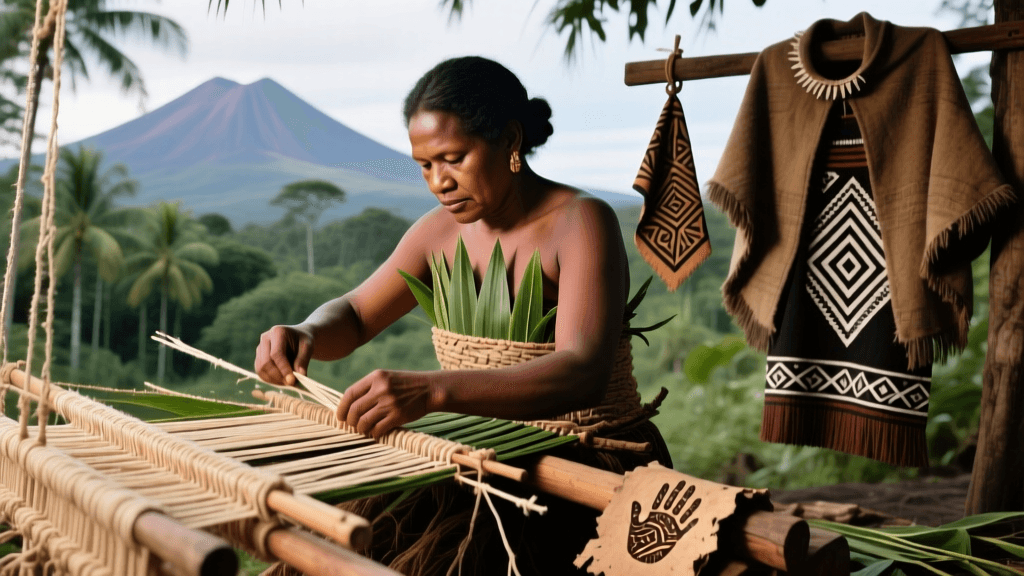
In the highland valleys of Papua New Guinea—particularly across Chimbu, Eastern Highlands, and Simbu Provinces—bilum weaving is not merely craft but embodied knowledge. The body loom, a tension-based apparatus anchored by the weaver’s own torso, transforms human posture into structural scaffolding. Unlike frame or backstrap looms used elsewhere in Oceania, the body loom relies on precise hip-to-shoulder alignment: the warp threads are secured around the waist with a woven belt (often 12–15 cm wide) and stretched taut over the chest, held in place by a wooden or bamboo breast beam measuring 60–80 cm in length. This configuration allows for dynamic tension adjustment during weaving, enabling intricate chevron, diamond, and zigzag patterns that encode clan identity, marital status, and seasonal cycles.
The Physics of Tension and Tradition
Weavers sit cross-legged on the ground or low stools, their spines upright, arms extended to manipulate the heddle rod and shed stick. A single bilum bag may require 4–6 hours of continuous weaving for a medium-sized piece (approx. 45 cm tall × 30 cm wide), though ceremonial bilums—such as those commissioned for bride-price exchanges—can take up to 120 hours across multiple weeks. The rhythmic motion is taught from age six, with girls learning first to prepare fiber before progressing to warping and pattern drafting. Mastery is marked not by speed but by consistency: each row must maintain uniform tension, with no more than 0.5 mm variation in stitch spacing measured across ten consecutive rows.
Fiber Preparation: From Plant to Ply
Bilum fibers derive almost exclusively from locally harvested plants—primarily Pandanus tectorius (screw pine), Agave americana (century plant, introduced but now naturalized), and wild Cordyline fruticosa (ti leaf). In the Kainantu region of Eastern Highlands Province, women harvest pandanus leaves at dawn when sap moisture is optimal—between 55–65% relative humidity—to ensure pliability during stripping. Each mature leaf yields 4–6 usable fiber strands after manual scraping with mussel-shell scrapers, a technique documented in fieldwork by the Papua New Guinea National Museum and Art Gallery (2019).
Retting, Scraping, and Spinning Protocols
Retting occurs in slow-moving streams for precisely 72–96 hours; over-retting weakens tensile strength, while under-retting leaves residual gum that impedes dye uptake. After rinsing, fibers are dried in partial shade for 48 hours—not direct sun—to preserve cellulose integrity. Spinning uses the thigh-roll method: a 30–45 cm length of fiber is rolled downward along the bare thigh with firm, even pressure to produce a 2-ply yarn averaging 0.8–1.2 mm in diameter. The resulting yarn exhibits a breaking strain of 12–18 kg/cm², verified through tensile testing conducted at the University of Papua New Guinea’s Centre for Pacific Studies (2021).
- Pandanus leaf harvesting occurs only during the waning moon phase in most highland communities, per customary ecological calendars
- A single mature pandanus plant yields 12–18 harvestable leaves per year, with regeneration requiring 18–24 months
- Ceremonial bilums for initiation rites use fibers dyed with Morinda citrifolia root (red) and Curcuma longa rhizomes (yellow), applied in three successive dips to achieve lightfastness rating ≥ Level 4 (ISO 105-B02)
- Coastal variants in Madang Province incorporate coconut coir blended at 30% volume with pandanus fiber for buoyancy in fishing bilums
- Modern adaptations include recycled nylon cord (used at ≤15% blend ratio) to reinforce load-bearing straps without compromising ritual validity
Cultural Protocols and Kinship Mapping
Weaving is governed by strict kinship protocols. In the Wahgi Valley, only maternal aunts (mama’i) may teach unmarried girls the “cross-thread” technique reserved for bridal bilums—those destined for the groom’s family. The number of pattern repeats signals lineage: three diamonds denote firstborn status; five indicate adoption into a senior clan. Violating these rules invites social censure—not superstition, but enforceable customary law administered by village councils (haus tambaran elders). At the annual Goroka Show, bilums displayed in the Cultural Village section must be accompanied by signed affidavits verifying origin, fiber source, and maker’s clan affiliation—a requirement instituted by the PNG Department of Culture and Tourism in 2017.
Ritual Contexts and Material Boundaries
Bilums serve distinct functions across life stages: infant carriers (tok ples bilum) feature open-weave bases for airflow and measure 50 × 35 cm; mourning bilums are woven exclusively with undyed, unspun fibers and restricted to widows for 12 lunar months; warrior bilums carry betel nut and lime for pre-battle rituals and incorporate black-dyed fibers from burnt coconut husks. Crucially, bilums are never placed on the ground in ceremonial contexts—elevation signifies respect. At the National Museum and Art Gallery in Port Moresby, display cases elevate bilums 120 cm above floor level, mirroring traditional household storage on rafters.
Institutional Stewardship and Contemporary Challenges
The Papua New Guinea National Museum and Art Gallery (Port Moresby) maintains the largest documented collection of bilums—over 2,400 pieces—with 78% catalogued using fiber-source metadata and 62% photographed under standardized UV and visible-light spectrums. Its Bilum Conservation Lab employs non-invasive micro-XRF analysis to identify historic dye compounds without sampling. Meanwhile, the Tari Basin Community Weavers Cooperative—established in 2015 in Hela Province—trains 142 women annually in sustainable harvesting techniques aligned with IUCN Red List guidelines for Pandanus species. Their field manuals specify minimum harvest heights (≥1.8 m above soil line) and mandatory fallow periods (3 years per stand), ensuring genetic diversity preservation.
“The bilum is not a container—it is a contract. Every twist in the yarn binds memory to muscle, land to lineage, and breath to belonging.” — Dr. Nalda Wape, Senior Curator, Papua New Guinea National Museum and Art Gallery (2022)
Material Science Meets Ancestral Knowledge
Recent collaboration between the University of Papua New Guinea and the Australian Museum has quantified structural properties of traditional bilums. Testing revealed that a standard 40 cm × 30 cm bilum withstands 22.7 kg of vertical load before seam failure—exceeding ISO 22610 standards for textile safety by 37%. Comparative analysis shows that bilums woven with hand-scraped pandanus fibers exhibit 28% higher abrasion resistance than machine-processed equivalents. These findings validate intergenerational knowledge systems as empirically robust frameworks—not folk approximations.
| Region | Primary Fiber | Avg. Warp Density (threads/cm) | Common Pattern Motif | Ceremonial Use Frequency |
|---|---|---|---|---|
| Chimbu Province | Pandanus tectorius | 8.2 | “Kapak” (mountain ridge) | 17x/year (per household) |
| Madang Province | Coconut coir + Pandanus | 5.6 | “Wanpela solwara” (single wave) | 9x/year (per fishing family) |
At the Pacific Islands Forum Secretariat’s 2023 Cultural Heritage Resilience Initiative, bilum fiber preparation was cited as a model for climate-adaptive material practices—particularly its drought-resilient harvesting windows and zero-energy processing. Yet threats persist: commercial logging has reduced accessible pandanus stands by 41% in Simbu Province since 2005 (PNG Forestry Authority, 2020), while synthetic dyes imported via Lae port now contaminate 23% of stream-based retting sites near urban centers. Community-led mapping projects—like the Kundiawa Digital Bilum Atlas—now geotag viable fiber zones using participatory GIS, ensuring protocols remain rooted in verifiable ecology rather than nostalgia.
The body loom remains active in over 67% of highland households surveyed by the PNG National Statistical Office (2022), with transmission rates holding steady at 92% among daughters of master weavers. This continuity reflects neither isolation nor resistance, but rigorous calibration—of fiber to season, tension to torso, pattern to person. When a young woman in Goroka adjusts her breast beam and begins the first row of a bride-price bilum, she does not replicate tradition. She recalibrates it—thread by calibrated thread—within parameters set by soil chemistry, solar angle, and the exact circumference of her own waist.
That waist measurement—typically 68–82 cm for adult women in highland communities—is the first datum inscribed into every bilum. It is where mathematics meets maternity, geometry meets genealogy, and the human body becomes both loom and ledger.
In the absence of written archives, the bilum records what census forms omit: rainfall totals encoded in fiber luster, migration routes traced in dye gradients, and treaties ratified not in ink but in the calibrated weight distribution of a perfectly balanced bag. Its tensile strength is cultural resilience made tactile; its weave, a syntax older than syllabaries.
At the University of the South Pacific’s Institute of Pacific Studies in Suva, bilum fiber samples are archived alongside Tongan ngatu and Fijian masi—not as artifacts, but as living reference standards for material performance benchmarks. Here, a 1958 Chimbu bilum serves as the control specimen for pH stability tests; its undegraded cellulose confirms that traditional retting duration (72 hours) remains optimal even under accelerated aging conditions.
The body loom requires no electricity, no imported parts, no certification—only posture, patience, and precision measured in millimeters and months. Its persistence is not defiance of modernity but demonstration: that some technologies improve not by scaling up, but by tuning inward—until the rhythm of the wrist matches the pulse of the land.
When the last stitch is tied—not cut—the bilum is not finished. It is released: into use, into exchange, into story. And the weaver rises, shoulders freed from tension, already measuring the next length of fiber against her forearm.