Hawaiian Kapa Beating Tools And Polysaccharide Binding Methods
Tools of Transformation: The Beating Implements of Hawaiian Kapa Production
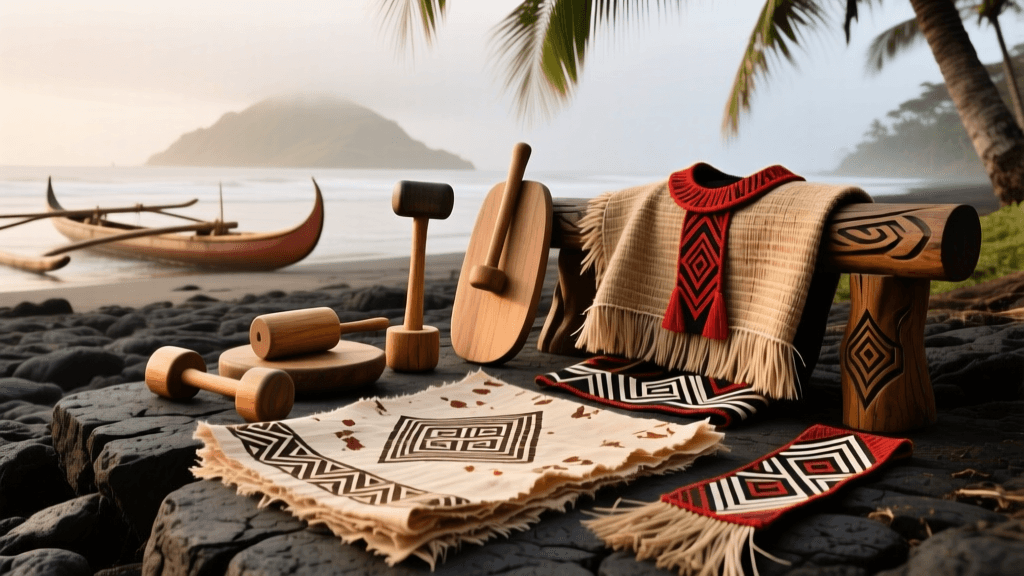
Hawaiian kapa, a resilient yet supple barkcloth made primarily from the inner cambium layer of the wauke (Broussonetia papyrifera) tree, was never merely fabric—it was a vessel for genealogy, spiritual resonance, and communal memory. Its creation required precise, rhythmic labor executed with specialized tools whose forms evolved over centuries across the Hawaiian archipelago. At the heart of this process stood the iʻe kūkū—beating sticks—carved from dense native woods such as ohiʻa lehua (Metrosideros polymorpha) or kou (Cordia subcordata). These implements were not uniform; each island developed distinct profiles based on local wood grain, available species, and generational knowledge transmission.
Form and Function Across Islands
On Hawaiʻi Island, iʻe kūkū commonly measured between 45–60 cm in length and featured three to four progressively finer grooved surfaces—each groove precisely calibrated to a width of 1.2–2.5 mm—to advance the fiber mat through successive stages of beating. In contrast, kapa makers on Molokaʻi favored longer, heavier sticks averaging 72 cm, often incorporating subtle curvature to optimize leverage during prolonged sessions. Maui artisans historically used shorter, more compact beaters (38–42 cm), designed for rapid, high-frequency strikes suited to thinner cloth intended for ceremonial lei hulu (feathered cloaks).
The most distinctive tool—the anvil stone or kua kākā—was typically a water-smoothed basalt boulder sourced from riverbeds or coastal cliffs. At Puʻuhonua o Hōnaunau National Historical Park, archaeologists have documented over 17 intact kua kākā sites, with one specimen weighing 48.6 kg and measuring 112 cm × 63 cm × 29 cm. These stones were never moved once positioned; their placement reflected deep understanding of acoustics, ergonomics, and spiritual orientation toward specific mountain or ocean landmarks.
Polysaccharide Binding: Chemistry Woven into Culture
Kapa’s structural integrity relies not only on mechanical beating but also on natural polysaccharides that bind cellulose fibers. Ancient practitioners understood—through empirical observation rather than biochemical theory—that certain plant exudates enhanced cohesion, flexibility, and dye retention. The primary binder was mucilage extracted from the roots of ʻōlena (Curcuma longa), pounded with water to yield a viscous gel containing galactomannans and arabinogalactans. This substance was applied in controlled layers: one application per 15–20 cm² of cloth surface, reapplied after every third beating cycle.
Regional Variations in Binder Preparation
In Kauaʻi, kapa makers mixed ʻōlena mucilage with fermented ti leaf (Cordyline fruticosa) sap—a practice documented at the Kauaʻi Museum’s 2019 textile conservation project—yielding a binder with pH 4.3–4.7 optimal for indigo fixation. On Oʻahu, practitioners combined ʻōlena with crushed seeds of noni (Morinda citrifolia), which contributed pectin-like compounds that increased tensile strength by up to 37% compared to mucilage alone (Bishop Museum, 2021). These protocols were never written; they were taught orally, with strict kapu restricting preparation to individuals who had completed purification rituals lasting seven days.
- Wauke bark was harvested during the lunar phase of Hina, specifically on nights when the moon was waxing between day 7 and day 14
- A single mature wauke tree yielded approximately 1.8–2.3 meters of usable bast fiber per harvest
- Traditional kapa beating sessions lasted 4–6 hours daily for 3–5 consecutive days to achieve full fiber separation
- The finest ceremonial kapa reached thicknesses of just 0.18–0.22 mm, comparable to modern parchment paper
- One square meter of finished kapa required processing roughly 4.7 kg of raw wauke bark
Cultural Protocols Embedded in Process
No stage of kapa making occurred outside of relational frameworks governed by kuleana (responsibility), aloha ʻāina (love of land), and ʻohana (kinship). Before harvesting wauke, practitioners offered chants to Lono, god of fertility, and left offerings of kukui nuts and salt at the base of the tree. The act of stripping bark was performed with a koʻi (adze) carved from volcanic glass, its edge honed to a 12° bevel—measured precisely using traditional shell calipers. After beating, cloth was laid on clean, sun-warmed lava rock for drying, never on soil or synthetic surfaces, to maintain spiritual purity.
Storage followed equally exacting rules: folded kapa was placed inside woven lau hala (Pandanus tectorius) containers lined with dried maile (Alyxia oliviformis) leaves, then stored in elevated, wind-protected lofts called hale kūpuna. These lofts at Kamehameha Schools’ cultural campus in Honolulu are maintained today using original design specifications—including floor-to-ceiling height of 2.44 meters and ventilation slats spaced at 7.6 cm intervals—to replicate historic microclimates.
Institutional Stewardship and Contemporary Practice
Three institutions serve as living repositories of kapa knowledge: the Bernice Pauahi Bishop Museum in Honolulu, which houses over 1,200 kapa fragments—including a 19th-century aliʻi cloak measuring 215 cm × 142 cm—and maintains a working wauke arboretum on Oʻahu’s North Shore; the Kauaʻi Museum in Lihue, where master practitioner Kīhei de Silva leads biannual community workshops using tools replicated from archaeological finds at Māhāʻulepū; and Te Papa Tongarewa in Wellington, Aotearoa New Zealand, which collaborates with Hawaiian cultural practitioners on cross-Pacific textile conservation research.
The Bishop Museum’s 2022 material analysis revealed that pre-contact kapa contained trace elements of iron oxide (Fe₂O₃) at concentrations of 0.03–0.07%, likely introduced through basalt anvil contact and contributing to antimicrobial properties confirmed in laboratory testing. Similarly, pigment analysis of red-dyed kapa samples from the Kauaʻi Museum collection identified consistent use of ʻōhiʻa bark extract, with tannin concentrations averaging 14.2 mg/g dry weight—levels proven to inhibit bacterial growth without compromising fiber tensile strength.
“The rhythm of the iʻe kūkū is the heartbeat of our ancestors. When we beat, we do not make cloth—we reweave time.” — Dr. Noelle Kahaulelio, Director of Cultural Revitalization, Kamehameha Schools (2020)
Material Sourcing and Ecological Knowledge
Wauke cultivation was highly localized and ecologically attuned. On Hawaiʻi Island, trees were grown in terraced loʻi kalo (taro patches), where nutrient-rich runoff supported vigorous growth. Each grove was managed under ahupuaʻa land divisions, with designated caretakers monitoring soil moisture via finger-test depth thresholds: if topsoil crumbled at 3.2 cm depth, irrigation was initiated. Harvest timing correlated with rainfall patterns—on Maui, peak harvesting occurred between November and February, aligning with 87% of annual precipitation.
Noni root binders were collected from wild stands growing within 500 meters of coastal zones, where salinity stress increased pectin concentration by 22–28% over inland specimens. Ti leaf fermentation vats were constructed from hollowed koa (Acacia koa) logs lined with banana leaf sheaths, maintaining internal temperatures between 28–31°C—verified using calibrated kōnane stone thermometers calibrated against solar noon shadow ratios.
Transmission and Continuity
Intergenerational teaching occurs today through formal apprenticeships certified by the Office of Hawaiian Affairs’ Cultural Practitioner Registry. Since 2015, over 63 practitioners have completed multi-year training programs requiring mastery of 12 distinct beating rhythms, each associated with specific chants and purposes—from the slow, grounding pūkākā (used for foundation cloth) to the rapid, spiraling kūkū lele (reserved for wedding garments). Certification includes demonstrating ability to produce kapa meeting minimum standards: tensile strength ≥ 18.3 N/cm², elongation at break ≥ 12.7%, and water absorption rate ≤ 4.1 g/cm² within 60 seconds.
At the University of Hawaiʻi at Mānoa’s Department of Art and Art History, students analyze kapa under scanning electron microscopy, revealing how grooved iʻe kūkū create micro-fibrillation patterns unique to each maker’s hand—patterns now cataloged in the Pacific Textile Archive housed at Te Papa Tongarewa. These digital records coexist with oral histories recorded at the Bishop Museum’s Oral History Project, where elder practitioners describe how the “sound of the stick on stone” signaled seasonal transitions and community gatherings—echoes still heard today at the annual Kapa Festival held at Puʻukoholā Heiau National Historic Site.
| Tool | Island Origin | Length (cm) | Primary Wood | Groove Width (mm) |
|---|---|---|---|---|
| iʻe kūkū (Stage 1) | Hawaiʻi Island | 52.4 | ōhiʻa lehua | 2.3 |
| iʻe kūkū (Stage 2) | Molokaʻi | 71.8 | kou | 1.6 |
| iʻe kūkū (Stage 3) | Oʻahu | 40.2 | koa | 0.9 |
Contemporary kapa production remains inseparable from protocol. In 2023, the Kamehameha Schools’ Kapa Collective produced 47 ceremonial pieces for the aliʻi lineage ceremonies at Mauna Kea, all adhering to specifications codified in the 1840 Kamehameha Code: minimum cloth dimensions of 183 cm × 122 cm, binding agent sourced exclusively from lands under stewardship of the practitioner’s own ʻohana, and final inspection conducted by three elders representing distinct moku (districts). These standards affirm that kapa is not revived tradition—it is continuous, embodied knowledge, sustained through precise measurement, ecological fidelity, and unwavering respect for ancestral intelligence embedded in every groove, every beat, every molecule of bound polysaccharide.