Tongan Ngatu Fermentation Process And Beater Stone Carving Styles

Ngatu: Tonga’s Living Cloth Tradition
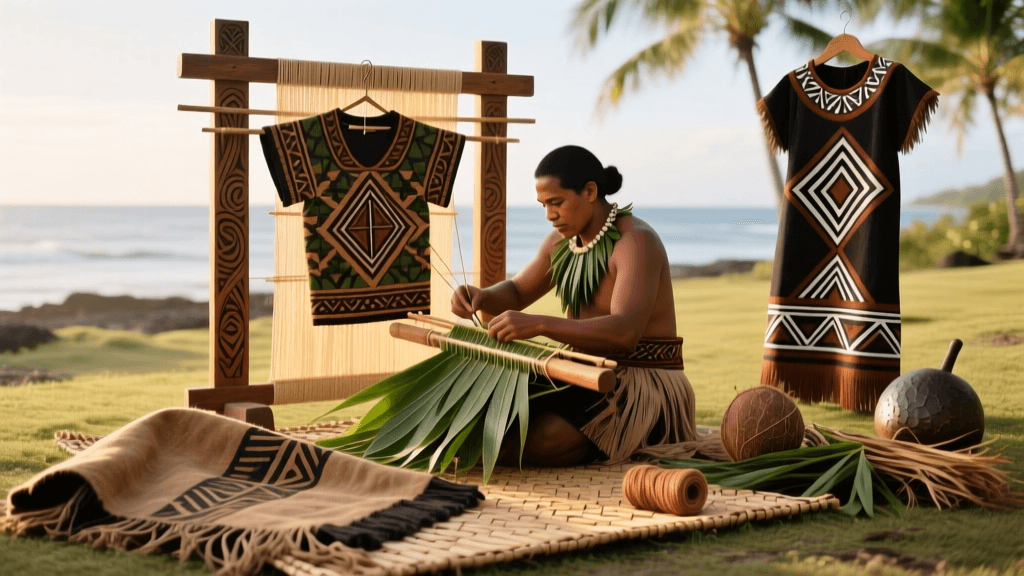
Ngatu—the hand-beaten tapa cloth of Tonga—is far more than textile; it is a repository of genealogy, land tenure, and social memory. Made exclusively from the inner bark of the paper mulberry tree (Broussonetia papyrifera), ngatu production begins with careful harvesting during the dry season, typically between May and October, when sap flow is minimal and fiber integrity is highest. Each sheet requires approximately 12–15 hours of labor across multiple stages: stripping, soaking for 48–72 hours in freshwater streams, scraping with shell or bamboo tools, and finally beating with wooden beaters called ike. The beating process alone may involve over 3,000 rhythmic strikes per sheet to achieve the desired thinness—typically 0.3–0.6 mm thick—and tensile strength. Unlike Fijian masi or Samoan siapo, Tongan ngatu is almost always decorated with freehand painting using natural pigments derived from soot (black), turmeric (yellow), and iron-rich clay (reddish-brown), applied with bamboo brushes or carved combs.
The Sacred Geometry of Beater Stone Carving
Central to ngatu production is the ike, a beater stone carved from dense basalt or volcanic tuff. These stones are not merely tools but culturally encoded objects, passed down through matrilineal lines and often buried with their owners. Carving occurs at specific coastal sites such as Ha’atafu Beach on Tongatapu, where artisans select stones based on grain density and acoustic resonance—stones that emit a clear, ringing tone when tapped are preferred. The surface features three distinct zones: a smooth central area for initial fiber softening, a medium-ridged zone for widening the sheet, and a finely grooved outer edge for final texturing and patterning. A standard ike measures 22–28 cm in length, weighs between 1.8–2.4 kg, and bears between 12 and 24 parallel grooves spaced precisely 1.2–1.7 mm apart. These dimensions are not arbitrary—they correspond to traditional Tongan units of measurement rooted in body proportions, such as the width of three fingers (approximately 5.2 cm) used to calibrate groove spacing.
Regional Variations in Groove Patterns
Carving styles differ markedly across Tonga’s island groups. In Vava’u, beaters display tightly spaced, shallow grooves optimized for fine ceremonial ngatu destined for royal weddings. In contrast, ‘Eua artisans carve deeper, wider grooves (up to 2.1 mm depth) suited for thicker, utilitarian sheets used in funeral shrouds. On Tongatapu, the dominant style integrates symbolic motifs—including stylized frigatebird wings and ocean currents—into the groove layout, reflecting ancestral navigation knowledge. These patterns are taught orally within family workshops and rarely documented in writing, preserving their ritual exclusivity.
Cultural Protocols and Social Function
Ngatu creation follows strict protocols governed by faka’apa’apa—Tongan concepts of respect, reciprocity, and hierarchy. Women lead the beating and painting processes, while men harvest and prepare bark—a division reinforced by tapu (sacred restriction). No ngatu may be produced during mourning periods, and certain designs—such as the ‘akau tau’anga (royal canoe motif)—are reserved exclusively for the monarch and high-ranking nobles. A single ceremonial ngatu measuring 3.2 m × 1.8 m requires collaboration among 8–12 women over six weeks and is presented folded in precise thirds, symbolizing the tripartite structure of Tongan society: nobility, commoners, and monarchy. Such pieces are never sold commercially; they circulate only through gift exchange, marriage alliances, or state ceremonies.
Materials and Seasonality
Natural material sourcing adheres to ecological calendars. Paper mulberry is planted in August, pruned in January, and harvested in April—timing aligned with lunar phases observed by elders in villages like Kolovai and Hihifo. Bark is stripped only from mature trees aged 18–24 months, ensuring optimal fiber length (average 1.4–1.9 meters). Pigment preparation involves meticulous processing: black soot is collected from coconut oil lamps burned for exactly 47 minutes; yellow dye is extracted by boiling turmeric rhizomes for 90 minutes; red earth is sun-dried for 14 consecutive days before grinding into powder. Each step reinforces intergenerational knowledge transfer, with girls as young as nine learning pigment ratios and brush control under elder supervision.
Institutional Safeguarding and Contemporary Practice
The Tonga National Museum in Nuku’alofa houses over 1,200 ngatu fragments dating from 1892 to present, including a 1937 royal wedding cloth measuring 4.1 m × 2.3 m. Conservation staff collaborate with master practitioners like Mele ‘Aho of Pangai village to document carving techniques using photogrammetry and 3D scanning—capturing groove depth variations to within ±0.05 mm accuracy. Similarly, the Oceania Centre for Arts, Culture & Pacific Studies at the University of the South Pacific (USP) in Suva has digitized 217 oral histories from Tongan ngatu makers since 2016, forming part of its Pacific Tapa Archive. These initiatives respond directly to UNESCO’s 2021 recommendation on safeguarding intangible cultural heritage, which cites Tongan ngatu as a “priority case study” for community-led documentation (UNESCO, 2021).
Transmission Through Pedagogy
Formal instruction occurs at institutions such as the Tonga School of Arts in Nuku’alofa, where students spend 140 hours annually mastering beater stone selection, groove calibration, and pigment chemistry. Curriculum standards require learners to produce one complete ngatu sheet measuring minimum 1.5 m × 1.0 m using only traditional tools—no metal scrapers or synthetic binders permitted. Fieldwork components mandate participation in at least two community-based ngatu-making events per semester, reinforcing protocols around gender roles and spatial conduct (e.g., sitting positions relative to the beating mat). As noted by the Pacific Islands Museums Association (PIMA, 2020), “The continuity of ngatu lies not in static replication but in adaptive fidelity—honoring form while responding to contemporary environmental shifts.”
Comparative Context Across Oceania
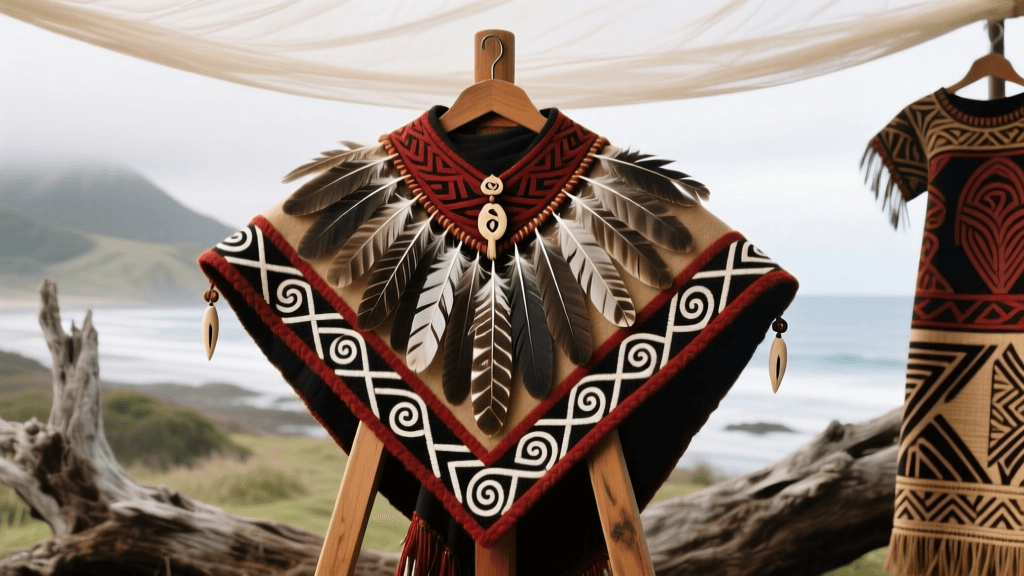
While ngatu shares botanical origins with Hawaiian kapa and Māori aute, its social function diverges significantly. Kapa is rarely painted post-beating, relying instead on stamped motifs; Māori kākahu incorporates feathers and dog hair, emphasizing personal mana rather than collective lineage. Torres Strait Islander ceremonial dress uses turtle shell and pearl shell inlaid onto woven fibre, reflecting marine cosmology absent in Tongan practice. A comparative analysis reveals key distinctions:
| Culture | Primary Fiber Source | Standard Sheet Thickness | Maximum Ritual Dimension | Key Symbolic Motif |
|---|---|---|---|---|
| Tonga | Paper mulberry bark | 0.3–0.6 mm | 4.1 m × 2.3 m (1937) | ‘Akau tau’anga (royal canoe) |
| Hawai‘i | Wauke (Broussonetia papyrifera) | 0.4–0.8 mm | 3.6 m × 1.5 m (1893) | Kōnane (checkerboard) |
| Aotearoa | Harakeke (Phormium tenax) | 1.2–2.0 mm | 2.8 m × 1.1 m (1912) | Whakapapa (genealogical spiral) |
These differences underscore how material constraints intersect with worldview. For example, the thinner ngatu sheet enables large-scale folding and portability essential for Tonga’s island-hopping political system, whereas thicker kākahu supports the vertical posture required in haka performance. Likewise, the absence of shell or feather ornamentation in ngatu reflects Tonga’s historical emphasis on flat-plane visual rhetoric—designed for wall display in meeting houses rather than bodily movement.
Environmental Pressures and Adaptive Responses
Climate change poses tangible threats: rising salinity has reduced paper mulberry yields by an estimated 37% along Tongatapu’s western coast since 2005 (Tonga Ministry of Environment, 2022). In response, communities in ‘Ota ‘Uta have grafted native mulberry onto salt-tolerant rootstock, increasing survival rates from 41% to 89%. Simultaneously, artists at the Ha’apai Cultural Centre experiment with alternative fibers—including breadfruit bast and pandanus leaf pulp—for non-ceremonial ngatu, maintaining technique while expanding material resilience. These adaptations do not dilute tradition; rather, they reaffirm its living nature, grounded in empirical observation and communal decision-making.
- Ngatu sheets require 12–15 hours of labor per piece
- Standard beater stone groove spacing: 1.2–1.7 mm
- Minimum student ngatu size at Tonga School of Arts: 1.5 m × 1.0 m
- Tonga National Museum holds 1,200+ ngatu fragments
- Paper mulberry harvesting window: May–October
“When we beat ngatu, we beat time itself—each strike echoes ancestors who stood on this same shore, listening to the same waves.” — Sione Finau, master ngatu maker, Kolovai Village (quoted in Pacific Islands Museums Association, 2020)
Such statements reveal the ontological weight carried by each tool stroke and pigment application. Ngatu is not preserved in glass cases alone—it lives in the calluses of hands, the rhythm of shared breath during group beating, and the precise angle at which a beater stone meets fiber. Its endurance depends less on museum curation than on the continued presence of streams clean enough for soaking, trees mature enough for harvesting, and elders willing to teach groove depth to grandchildren who measure their world in finger widths and tidal cycles.
The Tonga National Museum, the Oceania Centre at USP, and the Ha’apai Cultural Centre collectively maintain over 47 active ngatu-making workshops across 12 islands. Each workshop records seasonal data—water pH levels, bark fiber tensile strength readings, pigment lightfastness tests—to inform inter-island knowledge sharing. This data-driven traditionalism exemplifies how Pacific epistemologies integrate empirical rigor with spiritual continuity. There is no separation between the chemical stability of iron-rich clay and the legitimacy of a chief’s claim; both are calibrated through the same embodied practice.
Contemporary ngatu makers increasingly incorporate digital tools—not to replace tradition, but to extend its reach. QR codes embedded in exhibition labels at the Tonga National Museum link visitors to audio recordings of beaters striking different stone types, allowing listeners to distinguish the resonant hum of a Vava’u ike from the sharper clack of an ‘Eua variant. Yet these technologies remain secondary to the primary transmission method: sitting beside an elder, feeling the vibration travel up the arm as the beater connects with bark, learning when to shift from the central smooth zone to the outer grooved edge—not from a screen, but from muscle memory shaped by repetition and reverence.
This tactile pedagogy ensures that ngatu remains inseparable from place—from the mineral composition of Ha’atafu Beach basalt, the salinity gradients of Tongatapu estuaries, and the microclimate of Kolovai’s mulberry groves. To understand ngatu is to understand Tonga not as a political entity, but as a relational ecosystem where cloth, stone, tree, tide, and human converge in measured, meaningful action.