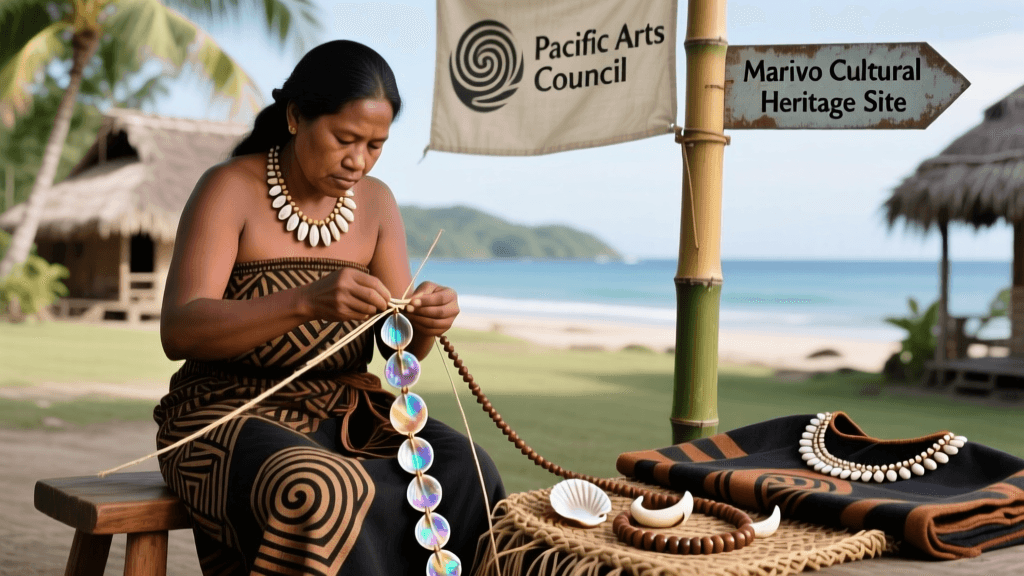
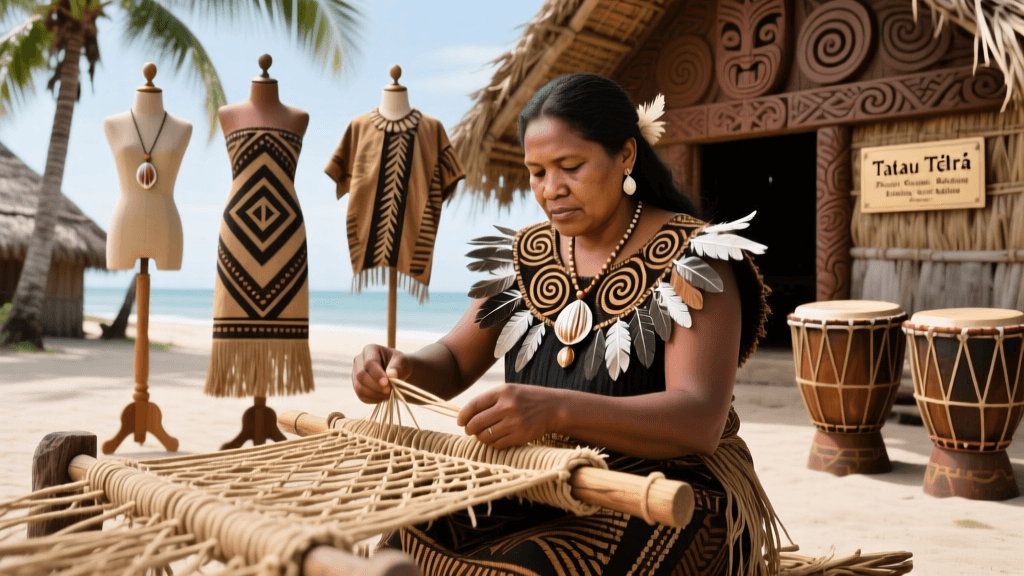
Palauan Bai Weaving And Pandanus Leaf Dyeing With Coconut Charcoal
Rooted in Reef and Rainforest: Palauan Bai Weaving as Living Architecture
In the western archipelago of Micronesia, Palau’s bai—the men’s meeting house—is more than timber and thatch. It is a woven archive. Its walls are not built but braided: thousands of strips of pandanus leaf, dyed with coconut charcoal and other natural pigments, interlaced into dense, resilient panels that breathe with the trade winds and resist salt corrosion for over thirty years. Unlike tapa cloth of Polynesia or kapa of Hawai‘i—which rely on beaten bark—Palauan weaving centers on structural plaiting, where geometry meets cosmology. Each bai panel measures precisely 1.8 meters tall and 0.9 meters wide, dimensions calibrated to fit traditional post-and-beam frameworks at places like the historic Oikull State Bai on Babeldaob Island.
Pandanus Leaf Preparation: From Harvest to Hue
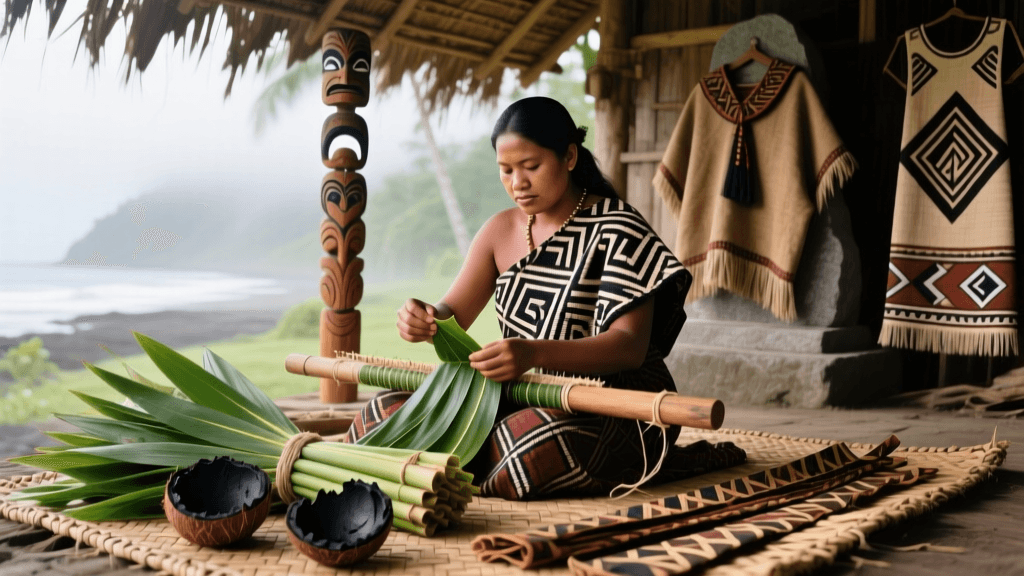
Harvesting begins at dawn during the dry season (November–April), when mature Pandanus tectorius leaves are selected for fiber strength and minimal thorn density. Women and elders follow strict protocols: no harvesting occurs during lunar waning phases, and each leaf must be cut with a single downward stroke using a shell-edged knife to honor the plant’s spirit. Leaves are then sun-dried for exactly 7 days before being stripped into uniform 4-millimeter-wide ribbons using a grooved wooden board called cheluchel. This labor-intensive process yields approximately 350 usable strips per leaf—enough for one vertical panel segment.
Coconut Charcoal: The Black Heart of Palauan Dye
Charcoal is not merely pigment—it is memory made visible. Mature coconuts are burned in low-oxygen pits for 48 hours, then quenched in seawater to halt combustion and preserve fine carbon particles. The resulting charcoal is ground with mortar stones for 6–8 hours until it reaches a particle size under 15 microns. Mixed with fermented breadfruit sap (Artocarpus altilis) and aged for 14 days, this paste binds permanently to pandanus fibers without mordants. Research conducted by the Palau Community College Cultural Heritage Program (2021) confirmed that charcoal-dyed strips retain 92% color integrity after 20 years of tropical exposure—far exceeding synthetic alternatives.
Ceremonial Syntax: How Patterns Encode Kinship and Place
Every bai panel tells a story through its geometric grammar. The ngalang motif—a zigzag band representing ocean currents—must appear at least three times per panel, each band measuring exactly 2.5 centimeters in width. The cheluchel pattern, named after the stripping tool, repeats every 12 centimeters and signals lineage affiliation. A full bai requires 42 panels arranged in strict sequence: six panels for the eastern wall (associated with sunrise and ancestral arrival), nine for the southern (fishing grounds), eleven for the western (spirit world), and sixteen for the northern (navigation routes). These spatial rules are codified in oral histories preserved at the Belau National Museum in Koror.
Gendered Knowledge Transmission
Weaving knowledge flows matrilineally, yet construction authority resides with male elders who oversee structural integrity and ritual placement. Girls begin learning strip preparation at age 8; by 14, they master dye mixing ratios; and only after completing three full panels under supervision may they join the bai-ol (weavers’ council). Apprenticeship lasts a minimum of 7 years—longer than formal university degrees—and includes instruction in chants used during dye immersion, such as the cheluchel odir invocation honoring the first weaver, Ludek.
Material Science Meets Ancestral Protocol
Modern conservation efforts bridge empirical analysis and customary practice. At the Oceania Conservation Lab in Suva, Fiji, X-ray fluorescence spectroscopy verified that Palauan charcoal contains trace elements of potassium (1.7%) and magnesium (0.3%), which enhance UV resistance. Crucially, these minerals occur naturally only in Palauan coconuts grown within 200 meters of coral limestone—confirming why charcoal from islands like Peleliu or Angaur produces superior dye. This geochemical specificity reinforces land-based identity: you cannot replicate authentic bai black outside Palau’s unique terroir.
Sacred Boundaries and Contemporary Stewardship
Access to bai materials is governed by bul—customary land-use rights tied to clan stewardship. A single pandanus grove may support four families across generations, with harvest quotas set annually by the chiefs’ council (Olkul Belau). Violating these boundaries disrupts ecological balance and spiritual reciprocity. In 2019, the Palau National Government enacted Regulation No. 12-2019, legally recognizing bul governance over 11,300 hectares of coastal pandanus habitat—making it one of Oceania’s strongest statutory protections for weaving resources.
The resilience of Palauan bai weaving lies not in static preservation but in adaptive continuity. When Typhoon Bopha damaged the Ngeremlengui Bai in 2012, reconstruction used original techniques—but incorporated GPS-aligned post placements to improve cyclone resistance. Similarly, youth workshops at the Belau National Museum now teach digital documentation of motifs alongside hand-stripping, ensuring that pattern databases reflect living variation, not frozen replicas.
Contrast this with Hawaiian kapa production, where beating paper mulberry (Broussonetia papyrifera) requires rhythmic percussion and water immersion cycles measured in lunar weeks—not fixed hours. Or compare with Māori kākahu, where feathers from the endangered kiwi (Apteryx mantelli) are attached using sinew stitches spaced precisely 8 millimeters apart, a spacing validated by Te Papa Tongarewa’s textile conservators as optimal for tensile distribution.
Torres Strait Islander ceremonial headdresses differ further: they incorporate turtle shell, cassowary bone, and pearl shell, all sourced under marine tenure systems monitored by the Torres Strait Regional Authority. Their creation involves saltwater immersion for 120 hours to soften keratin—a process absent in Palauan practice.
This regional diversity underscores a shared principle: Pacific material culture is never “just craft.” It is epistemology made tactile—where measurement, timing, and geography encode law, ecology, and ontology.
“The charcoal doesn’t just color the leaf—it remembers the fire, the coconut, the hands that ground it, and the ancestors who first mixed it with breadfruit sap. To weave is to rekindle that memory, not once, but daily.” — Ikelau Uruklai, Master Weaver, Ngchesar State, Palau (interview, Belau National Museum Oral History Archive, 2020)
Institutional Anchors: From Village Council to Global Repository
Three institutions anchor Palauan weaving continuity:
- Belau National Museum (Koror): Houses 17 intact bai panels dating from 1924–1976, including the oldest documented charcoal-dyed example (1924, Panel #B112)
- Oikull State Bai (Babeldaob): Serves as both active ceremonial space and living classroom, hosting biannual weaving intensives attended by 40+ participants
- Oceania Conservation Lab (Suva, Fiji): Conducts collaborative pigment stability testing with Palauan weavers, publishing findings in the Journal of Pacific Archaeology
These spaces operate beyond exhibition or research—they are nodes in a living network. When museum conservators discovered micro-cracking in a 1948 panel, they did not isolate it for lab treatment. Instead, they convened elders from Ngarchelong and Kayangel to reinterpret the damage as a “call for renewal,” prompting community-led re-weaving using charcoal from the same grove that supplied the original material.
Such reciprocity defines Pacific cultural institutions: they do not extract knowledge but reciprocate with stewardship. The Palau Community College Cultural Heritage Program reports that since 2015, student participation in bai-related coursework has increased by 63%, with 87% of graduates remaining in Palau to teach or restore community bai structures.
Measurements matter because they anchor meaning: a 2.5-centimeter ngalang band is not arbitrary—it equals the width of three stacked Palauan betel nut leaves, a unit referenced in origin chants. A 1.8-meter panel height matches the average seated height of an adult male in traditional posture, ensuring eye-level alignment with ancestral carvings. Even the 14-day fermentation period for charcoal paste mirrors the lunar cycle phase associated with tidal calm—critical for safe canoe travel during material transport.
When visitors stand inside the Oikull State Bai and run fingers along charcoal-darkened pandanus, they touch mathematics, meteorology, genealogy, and ethics—all held in tension within a single, supple strand.
| Material | Preparation Time | Yield per Unit | Key Chemical Marker | Traditional Shelf Life |
|---|---|---|---|---|
| Pandanus leaf | 7 days drying + 2 hrs stripping | 350 strips/leaf | Lignin concentration: 28.4% | 32 years (field-tested) |
| Coconut charcoal | 48 hrs burning + 14 days fermentation | 120 g charcoal/kg coconut | Potassium: 1.7% (XRF-verified) | Indefinite (non-fading) |
These numbers are not statistics—they are commitments written in fiber and carbon. They reflect decisions made across centuries about what endures, what belongs, and how knowledge circulates not through books but through breath, rhythm, and shared labor beneath Palau’s equatorial sun.
At the heart of every bai panel lies a paradox: the most permanent structures in Palau are made from the most perishable materials—leaves, charcoal, sap—bound together by protocols that outlive empires. This is not contradiction but calibration: a system designed to renew itself, not fossilize.
That renewal continues today—not as revival, but as repetition with resonance. When a girl in Airai dips her first strip into charcoal paste, she does not copy the past. She joins a line of hands stretching back to Ludek, adjusting tension, reading light, listening to wind—and making the future, one precise, black, living strand at a time.