Palauan Bai Chiefs House Attire Barkcloth Dyeing And Shell Inlay Techniques
The Bai: A Living Archive of Palauan Sovereignty and Craft
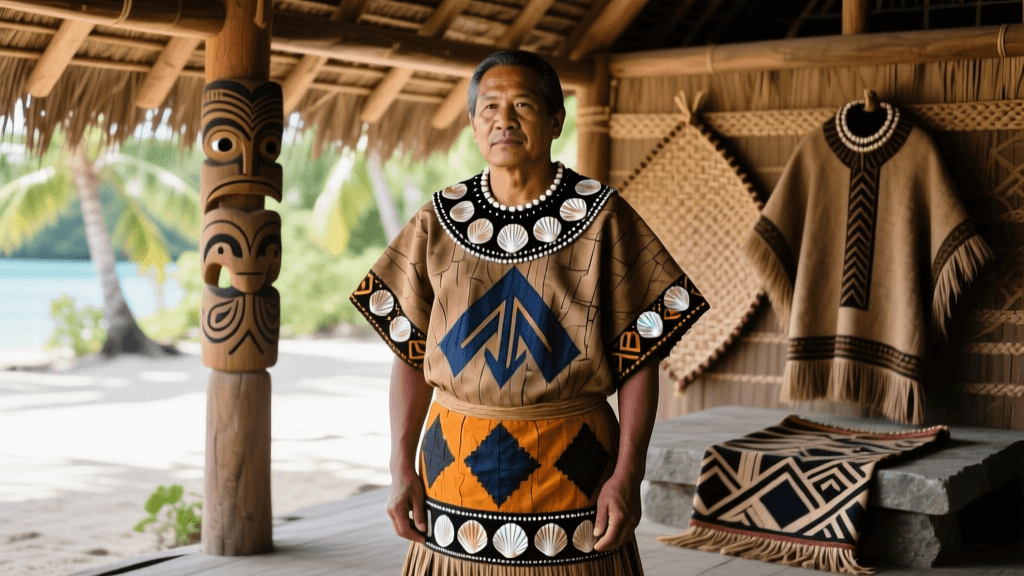
At the heart of Palauan social and spiritual life stands the bai—a men’s meeting house that functions not only as a political chamber but also as a three-dimensional manuscript of ancestral knowledge. Its towering thatched roof, carved wooden posts, and meticulously adorned interior surfaces encode genealogies, treaties, and cosmological principles. Among its most significant visual languages is the ceremonial attire worn by chiefs and elders during bul (council sessions) and chelid (initiation rites). Unlike static museum displays, these garments remain active participants in governance, their materials and motifs governed by strict protocols tied to lineage, rank, and seasonal cycles.
Barkcloth Production: From Ficus to Fabric
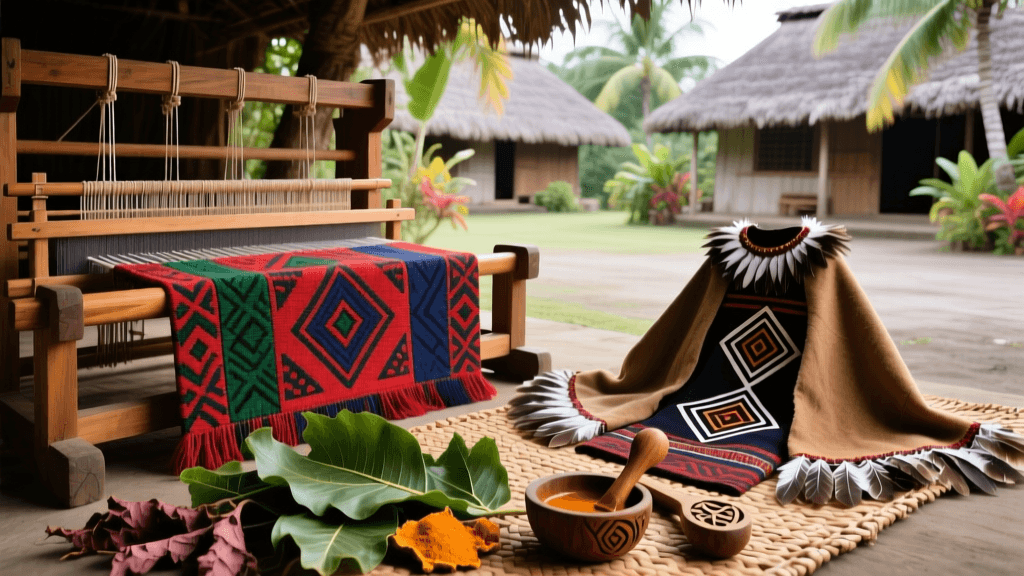
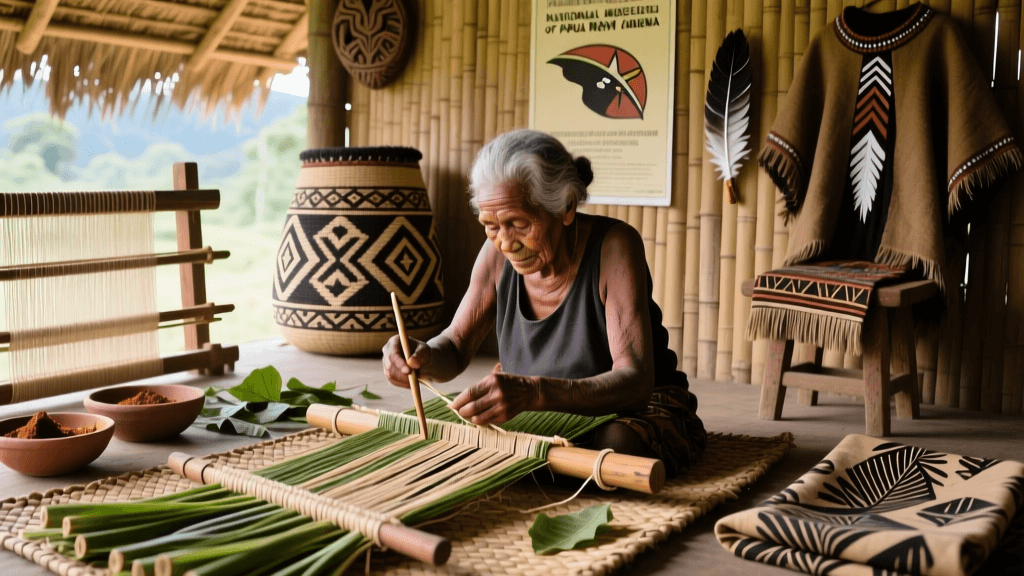
Palauan barkcloth—locally known as debes—is made exclusively from the inner bast of the Ficus prolixa tree, harvested during the dry season (November–April) when sap flow is minimal and fiber integrity is highest. Unlike Hawaiian kapa or Samoan siapo, Palauan debes is never beaten with grooved mallets; instead, it is scraped with sharkskin rasps and stretched over curved wooden frames for drying. This yields a supple, ivory-toned cloth averaging 1.8 meters in width and up to 4.2 meters in length per sheet. Each chief’s ceremonial sash requires six to eight sheets, layered and stitched with cordage spun from Pandanus tectorius leaf fibers.
Harvesting Protocols and Seasonal Timing
Before felling any Ficus prolixa, a ritual offering of betel nut and coconut water is made to the forest spirit Chelid. Only mature trees—measuring at least 25 centimeters in diameter and over 12 meters tall—are selected. Harvesters must avoid cutting during lunar phases associated with flooding (the waning gibbous moon), as moisture retention compromises fiber strength. These restrictions are codified in the Olbiil Era Kelulau’s Traditional Knowledge Protection Act of 2019.
Natural Dyeing: Earth, Root, and Ocean Pigments
Dyes are extracted without synthetic additives, relying on locally sourced botanicals and minerals. The deep red-brown used for chief’s sashes comes from the heartwood of Morinda citrifolia roots, boiled for precisely 72 hours in earthenware pots fired at 900°C. Black dye is derived from iron-rich mud collected from the mangrove estuaries near Ngermechel Island, fermented for 14 days alongside crushed Avicennia marina leaves. Yellow hues originate from turmeric rhizomes (Curcuma longa) grown in raised garden plots at Koror’s Ngchesar Agricultural Demonstration Site.
Dye Vat Specifications and Application
- Vats are constructed from hollowed Intsia bijuga logs, measuring 1.2 meters long × 0.6 meters wide × 0.4 meters deep
- Each vat holds 38 liters of dye solution, replenished every third immersion cycle
- Cloth undergoes seven full immersions, with 48-hour air-drying intervals between each
- Final color fixation uses a seawater rinse drawn from the Rock Islands’ southern lagoons, where salinity averages 35.2 parts per thousand
Shell Inlay: Precision Geometry and Ancestral Mapping
Chiefly attire features intricate shell inlays—primarily from the Tridacna gigas (giant clam) and Haliotis asinina (donkey ear abalone). Artisans cut shell into geometric tiles no thicker than 0.8 millimeters using obsidian blades knapped from volcanic glass quarried at Ngardmau Falls. Patterns follow the chelid grid system: a 12×12 matrix representing the twelve traditional states of Palau. Each tile is set into recessed grooves carved into the barkcloth backing with calibrated depth of exactly 0.3 millimeters—ensuring secure adhesion without cracking during movement.
Symbolic Dimensions of Inlay Layout
- The central 4×4 quadrant denotes the capital state of Melekeok, reserved for the Ibedul (paramount chief)
- Eight outer quadrants correspond to the eight high-ranking clans, each assigned specific shell species and orientation angles
- Tile spacing maintains uniform 2.5-millimeter gaps, symbolizing the navigational distances between major islands in traditional voyaging charts
Cultural Stewardship and Institutional Continuity
The transmission of these techniques occurs through intergenerational apprenticeships coordinated by the Palau Community College’s Office of Traditional Arts, which operates a dedicated debes workshop in Airai State. Since 2016, over 117 young Palauans have completed certification in barkcloth preparation under master artisan Ucher Belau. The Belau National Museum in Koror houses the oldest extant example of shell-inlaid debes: a 1928 ceremonial sash donated by Chief Reklai of Melekeok, measuring 3.1 meters long and containing 2,843 individual shell tiles.
Collaboration with regional institutions strengthens continuity. The Oceania Centre for Arts, Culture & Pacific Studies at the University of the South Pacific (Suva, Fiji) co-hosted the 2022 “Bark & Shell Dialogues” symposium, bringing together Palauan, Māori, and Torres Strait Islander practitioners to compare structural approaches to ceremonial textile conservation. As noted in their joint publication, “The resilience of natural fiber systems lies not in isolation, but in shared ecological literacy across archipelagic boundaries” (Oceania Centre, 2022).
The Field Museum in Chicago holds a documented collection of 42 Palauan barkcloth artifacts collected between 1909 and 1933, including two complete chief’s capes with intact shell inlay. Analysis confirms consistent use of Morinda-based red dye across all specimens, with average thread count of 14.3 warp threads per centimeter—a metric unchanged since pre-colonial production standards recorded in the 1894 German colonial survey of Palau.
Contemporary protocols strictly regulate who may wear shell-inlaid attire: only individuals formally installed in one of the five highest chiefly titles—Ibedul, Reklai, Uchelbelau, Kloulklubed, and Omengel—may don garments featuring Tridacna inlay. Abalone elements are restricted to those holding dual lineage rights from both eastern and western Palauan states. Violations are adjudicated by the Council of Chiefs in accordance with the Palau Constitution, Article VIII, Section 4.
Preservation efforts extend beyond physical objects. At the Palau International Coral Reef Center in Ngarchelong, researchers monitor Ficus prolixa populations using drone-based canopy surveys across 1,240 hectares of protected forest land. Their 2023 report documented a 17% increase in viable harvesting trees compared to baseline data from 2010—directly attributable to community-led reforestation initiatives coordinated by the Palau Conservation Society.
These practices resist commodification. No Palauan artisan sells shell-inlaid barkcloth for commercial display; such items enter circulation only via gifting during state ceremonies or as diplomatic tokens presented to foreign dignitaries at the Capitol Complex in Ngerulmud—the world’s smallest national capital city, covering just 7.2 square kilometers.
“The cloth does not speak for the chief—it speaks with him. When he moves, the shells catch light like reef fish darting between coral branches. That motion is law in motion.” — Chief Yutaka Tmetuchl, speaking at the 2021 Palau Heritage Summit, Belau National Museum
| Material | Source Location | Harvest Depth/Size | Processing Time | Institutional Oversight |
|---|---|---|---|---|
| Ficus prolixa bark | Airai State lowland forests | 25 cm diameter, ≥12 m height | 14-day scraping/stretching cycle | Palau Community College Traditional Arts Program |
| Tridacna gigas shell | Rock Islands Southern Lagoon UNESCO site | 0.8 mm thickness, 12×12 mm tile size | 3-week cutting/inlay sequence | Palau Conservation Society Marine Heritage Unit |
At the Koror State Cultural Festival each April, master dyers demonstrate pigment extraction using traditional clay pots, while youth teams compete in timed barkcloth stretching challenges—measuring speed against precision, not just output. Judges assess tension uniformity using calibrated spring gauges registering force in newtons, ensuring adherence to historical tensile standards of 4.2–4.8 N/cm². This empirical rigor underscores how Palauan craft knowledge integrates sensory experience, mathematical exactitude, and relational ethics—all held within the living architecture of the bai.
The bai remains unbuilt without its textiles. Its posts stand empty until cloth is hung, its rafters silent until shell tiles reflect firelight during night councils. Every fold, every hue, every embedded fragment of ocean-born mineral affirms a covenant—not merely with ancestors, but with the living soil, tide, and sky that continue to sustain Palau’s sovereign identity.