2026 Kimono Travel Guide: Packing Silk & Transport Tips
The 2026 Landscape of International Kimono Travel
As global tourism continues to evolve in 2026, the practice of traveling with personal traditional garments has transitioned from a niche hobby to a mainstream pursuit among cultural enthusiasts. Whether you are attending a formal tea ceremony in Kyoto, participating in a destination photoshoot in Kanazawa, or simply wishing to wear your own shoken (silk) kimono to a Japanese garden festival abroad, transporting these delicate garments requires meticulous planning. Unlike standard Western formalwear, a kimono consists of multiple layered components—the juban (undergarment), the main kimono, the obi (sash), and various himo (ties)—each demanding specific care to prevent permanent creasing, moisture damage, or fiber degradation.
According to guidelines from the American Institute for Conservation, organic textiles like silk are highly susceptible to environmental fluctuations, particularly the extreme humidity shifts experienced in airplane cargo holds and modern climate-controlled cabins. This comprehensive guide details the exact methodologies, modern gear, and on-the-go maintenance routines required to transport your kimono safely and elegantly in 2026.
Mastering the Tatami Fold for Transit
The foundation of safe kimono transport is the Tatami fold (also known as hon-datami). This traditional folding method aligns the garment's seams to prevent stress on the silk fibers and ensures the kimono rests flat without creating harsh, unnatural creases across the sode (sleeves) or okumi (front panels). When packing for a long-haul flight, executing this fold correctly is non-negotiable.
- Step 1: Preparation. Lay the kimono face down on a clean, dry surface. Ensure your hands are free of oils and lotions. Smooth out any existing wrinkles from the back body (the rear panel).
- Step 2: Folding the Sleeves. Fold the left sleeve back over the body of the kimono, aligning the edge with the center seam. Repeat with the right sleeve. The sleeves should now be layered neatly on the back panel.
- Step 3: The Front Panels. Fold the right front panel (okumi) inward along its natural seam line. Then, bring the left front panel over to meet the right, creating a straight, uniform edge down the center.
- Step 4: Lengthwise Fold. Fold the kimono in half lengthwise, bringing the left side over to meet the right side. The collar should now be folded neatly in the center.
- Step 5: The Final Thirds. Fold the bottom hem up to meet the collar, then fold the top third down over it. The resulting rectangle should measure approximately 65cm by 45cm, fitting perfectly into standard garment sleeves or carry-on luggage.
Once folded, wrap the kimono in a breathable, unbleached cotton furoshiki or acid-free tissue paper. Never use plastic dry-cleaning bags for long-term transit, as they trap off-gassing chemicals and moisture, which can lead to yellowing or mold growth on vintage silk.
Essential 2026 Transport Gear & Luggage
The luggage market in 2026 has seen significant advancements in garment-specific compartments, moving away from the cramped, wrinkle-inducing tri-fold suit carriers of the past. When selecting luggage for kimono transport, you must balance rigid protection against weight restrictions imposed by updated 2026 IATA carry-on regulations.
| Product Category | 2026 Top Recommendation | Material / Specifications | Est. Price (USD) | Best Use Case |
|---|---|---|---|---|
| Garment Folder | TUMI Alpha Bravo Search Garment Bag | Recycled Ballistic Nylon, 42-inch length, padded interior | $495 | Carry-on transport for 1-2 fully assembled kimono sets |
| Travel Steamer | Panasonic NI-FS500P Compact Steamer | 70ml tank, 19-second heat-up, dual voltage (100-240V) | $110 | Hotel room touch-ups and releasing transit creases |
| Humidity Control | Eva-Dry EDV-1100 Renewable Silica | Color-changing silica beads, wireless rechargeable | $25 | Hard-shell luggage moisture traps for tropical destinations |
| Wrapping Cloth | Muslin Furoshiki (100cm x 100cm) | Unbleached organic Japanese cotton | $35 | Inner layer protection and dust barrier |
| Hard-Shell Case | Rimowa Essential Check-In (Medium) | Polycarbonate, flex-divider system for flat stacking | $950 | Checked luggage for multiple kimono and heavy obi |
For travelers carrying highly valuable or antique silk kimonos, a dedicated soft-sided garment bag carried onto the plane is the safest option. Flight attendants in premium cabins on major carriers like ANA and JAL are accustomed to hanging garment bags in the first-class closets, though you must request this immediately upon boarding.
Climate Control: Protecting Silk from Transit Humidity
Silk is a hygroscopic fiber, meaning it readily absorbs and releases moisture from the surrounding environment. The Victoria and Albert Museum's Asian textile archives emphasize that rapid fluctuations in relative humidity (RH) can cause silk fibers to expand and contract, leading to micro-tears and the shattering of delicate metallic threads often found in formal furisode or tomesode garments.
When traveling to high-humidity destinations like Okinawa, Singapore, or Kyoto during the tsuyu (rainy season), passive moisture control is essential. Place renewable silica gel canisters inside your luggage alongside the wrapped kimono. Unlike chemical dehumidifiers that can leak corrosive liquids if punctured, renewable silica canisters absorb ambient moisture and can be recharged by plugging them into a standard wall outlet in your hotel room. Maintain an ideal RH of 45% to 55% within your luggage compartment to preserve the structural integrity of the shikken (silk crepe) and prevent the stiffening of the obi brocade.
On-the-Go Steaming and Hotel Care
Even with a perfect Tatami fold, minor creasing is inevitable after a 14-hour flight. Ironing a kimono with a traditional flat iron is strictly forbidden, as direct heat and pressure will crush the three-dimensional texture of chirimen (crepe silk) and leave permanent shine marks on the fabric.
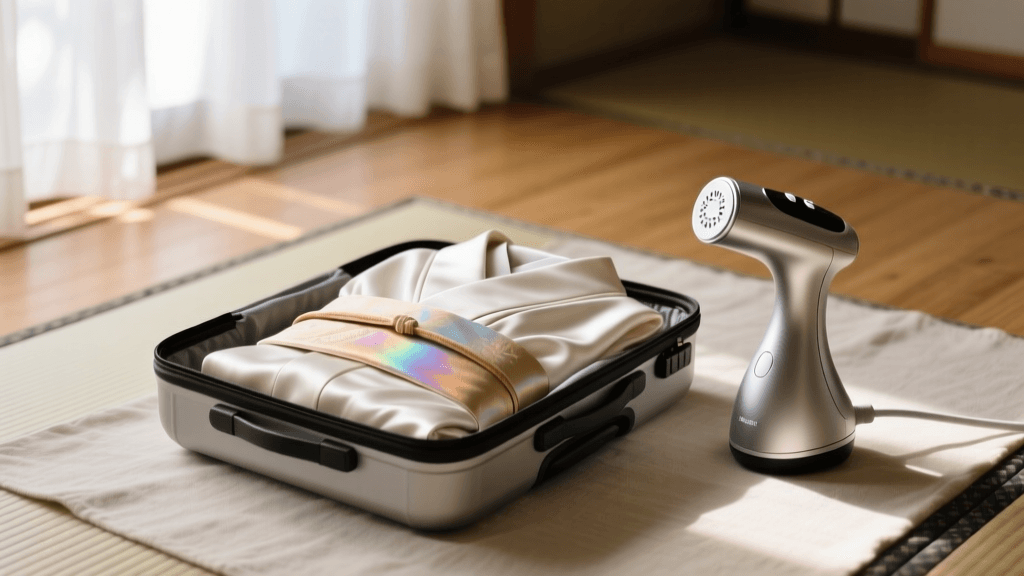
Instead, rely on a high-quality handheld travel steamer. The dual-voltage Panasonic models popular in 2026 are ideal because they eliminate the need for bulky voltage converters, which can cause power surges and damage the steamer's heating element. When steaming your kimono at your hotel:
- Use Distilled Water: Tap water in many international destinations contains high mineral content (hard water). When heated, these minerals can spit out of the steamer nozzle, leaving white calcium deposits on dark silk that are nearly impossible to remove without professional dry cleaning.
- The Hover Technique: Never let the metal plate of the steamer touch the silk. Hold the nozzle exactly two inches away from the fabric, allowing the vapor to penetrate the fibers and relax the wrinkles.
- Utilize a Kimono Hanger: Standard Western triangular hangers will stretch the shoulder seams (kata) of a kimono. Upon check-in, request a emono (a specialized, wide, flat kimono hanger) from the hotel concierge. Most high-end ryokans and international luxury hotels in Japan keep these in stock specifically for traveling guests.
Navigating Security and Customs with Delicates
Airport security protocols in 2026 utilize advanced CT scanners that generally no longer require the removal of liquids or electronics, but they do require bags to be free of dense, overlapping organic materials that can obscure the X-ray image. A tightly packed suitcase filled with multiple layered silk garments, heavy metallic obi-jime (cords), and dense brocade obi can appear as an impenetrable organic mass, triggering a manual bag search.
To expedite security checks and protect your garments from being rummaged through by security personnel, pack your kimono components in clearly identifiable, separate cotton pouches. If a manual search is required, politely inform the agent that the bag contains 'fragile antique silk textiles' and request that they handle the cotton-wrapped bundles gently. By combining the ancient discipline of the Tatami fold with modern 2026 travel technology and conservation science, you can ensure your kimono arrives at your destination in pristine, museum-quality condition, ready to be worn with pride and respect for the culture it represents.