Tlingit & Haida Button Blankets: 2026 Regalia Guide
Introduction to Pacific Northwest Coast Regalia
Indigenous North American dress traditions are profoundly diverse, varying drastically by region, climate, and cultural worldview. Along the Pacific Northwest Coast, where the temperate rainforest meets the ocean, the traditional garments of the Tlingit, Haida, and Tsimshian peoples stand as some of the most visually striking and culturally significant textile arts in the world. At the center of this sartorial heritage is the ceremonial button blanket, a garment that transcends mere clothing to function as a sacred embodiment of lineage, clan history, and spiritual authority.
As we navigate the cultural landscape in 2026, the revitalization of Indigenous arts has reached a powerful crescendo. Contemporary Native artists are not only preserving ancestral techniques but are also innovating within the boundaries of tradition. For collectors, cultural institutions, and those seeking to support Indigenous artisans, understanding the nuances of Pacific Northwest regalia—particularly the button blanket and its integration with traditional weaving—is essential. This comprehensive guide explores the anatomy, regional variations, and the 2026 market for authentic Tlingit and Haida ceremonial garments.
The Anatomy of a Ceremonial Button Blanket (A̱t.oow)
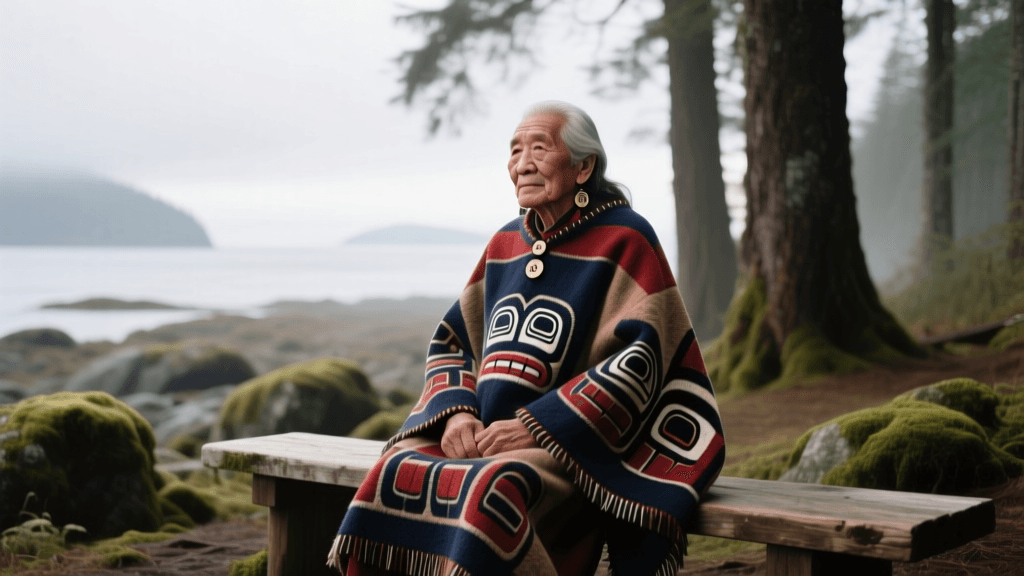
To the untrained eye, a button blanket might appear simply as a striking piece of textile art. However, within Tlingit and Haida cultures, these garments are classified as At.oow—sacred property that carries the spiritual weight and historical rights of a specific clan. They are not merely worn; they are danced, displayed, and passed down through generations as living legal documents.
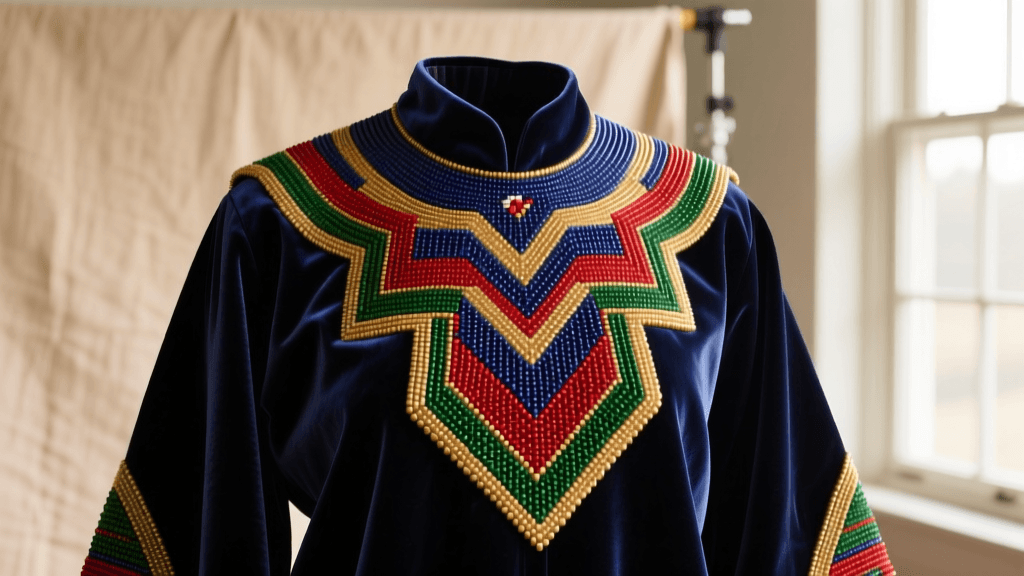
The standard construction of a button blanket involves a heavy, dark base fabric, traditionally navy or black Melton wool broadcloth. Upon this base, the clan crest is applied using intricate appliqué techniques. The crests—such as the Raven, Eagle, Wolf, Bear, Killer Whale, or Frog—are rendered in the distinct Pacific Northwest formline design, characterized by bold, flowing lines, ovoids, and U-shapes that interlock seamlessly. The outline and internal details of the crest are then meticulously hand-sewn with hundreds, sometimes thousands, of pearl buttons, creating a shimmering, percussive effect when the blanket is danced during a potlatch or ceremonial gathering.
The Integration of Chilkat and Ravenstail Weaving
While the appliqué broadcloth forms the main body, the most prestigious 2026 regalia often incorporate traditional woven elements. The collars and borders of high-status button blankets are frequently adorned with strips of Chilkat or Ravenstail weaving. These ancient weaving techniques, utilizing mountain goat wool and yellow cedar bark, are incredibly time-intensive. A single master weaver may spend over a year completing a Chilkat collar. In 2026, the integration of these woven textiles into broadcloth blankets represents the pinnacle of Indigenous North American dress traditions, merging two distinct but complementary artistic disciplines.
Regional and Tribal Variations
While the overarching aesthetic of the Pacific Northwest Coast is unified by the formline design system, distinct tribal and regional variations exist in the execution of ceremonial dress.
Tlingit Traditions and Clan Prerogatives
The Tlingit people, whose territories span the southeastern Alaska panhandle, maintain strict protocols regarding the display of crests. In Tlingit society, crests are owned by specific clans (moieties of Eagle/Wolf and Raven) and cannot be replicated or worn by those without the hereditary right. Tlingit button blankets are often characterized by their monumental scale and the bold, expansive use of negative space within the red appliqué. According to ongoing cultural preservation efforts documented by the Sealaska Heritage Institute, contemporary Tlingit artists in 2026 are increasingly focusing on the accurate historical replication of ancestral crest proportions, studying museum archives to ensure their ceremonial garments reflect pre-contact aesthetics.
Haida Innovations and Formline Mastery
Originating from Haida Gwaii (the Queen Charlotte Islands) and the southern tip of Prince of Wales Island, the Haida are renowned for their mastery of complex, interlocking formline designs. Haida regalia often features highly detailed, secondary figures nested within the primary crest. In 2026, Haida garment makers are experimenting with a broader palette of broadcloth colors, moving beyond the traditional red and black appliqué to incorporate deep greens and purples, reflecting the lush environment of the islands while maintaining strict adherence to traditional design rules.
Tsimshian Beadwork and Textile Integration
Further south, the Tsimshian people incorporate distinct regional flair into their regalia. Tsimshian button blankets often feature a higher density of beadwork integrated directly into the appliqué, creating a textured, three-dimensional surface. The Tsimshian also have a rich history of creating elaborate dance screens and tunics that complement the button blanket, creating a full-body ceremonial ensemble that is highly sought after by cultural institutions today.
Materials and Techniques in 2026
The evolution of available materials has significantly impacted the creation of Indigenous garments over the last century. Today, artisans balance historical authenticity with modern sustainability and ethical sourcing.
| Material Component | Historical Use (Late 19th Century) | 2026 Contemporary Standard | Sustainable / Ethical Alternatives |
|---|---|---|---|
| Base Fabric | Hudson Bay Company trade blankets, heavy stroud cloth | Premium imported Melton wool broadcloth (navy/black) | Upcycled vintage military wool, ethically sourced domestic wool blends |
| Appliqué Fabric | Trade flannel, felted wool | High-grade broadcloth, felted wool blends | Organic cotton flannel, naturally dyed hemp-canvas for lighter garments |
| Buttons | Shell buttons, early glass trade beads | Mass-produced mother-of-pearl and synthetic pearl buttons | Hand-carved abalone, sustainably harvested regional shell, recycled glass |
| Woven Borders | Mountain goat wool, yellow cedar bark | Merino wool yarns, processed cedar bark | Ethically shed goat wool, hand-processed local cedar, nettle fiber blends |
In 2026, there is a strong movement among master weavers and regalia makers to return to locally harvested materials. The processing of yellow cedar bark and the spinning of mountain goat wool are being taught in intensive community workshops, ensuring that the tactile qualities of ancestral garments are preserved. The Smithsonian National Museum of the American Indian has actively collaborated with Native communities to study the exact fiber compositions of 19th-century garments, providing modern weavers with the data needed to replicate historical yarn weights and tensions.
Sourcing Authentic Regalia: The 2026 Buyer's Guide
The commercialization of Indigenous aesthetics has long been a point of contention. For collectors, museums, and supporters looking to acquire Pacific Northwest regalia in 2026, navigating the market requires diligence, respect, and an understanding of federal protections like the Indian Arts and Crafts Act.
Identifying Authentic Artisans
Authentic Tlingit, Haida, and Tsimshian regalia is created exclusively by enrolled members of recognized tribes or certified Native artisans. When purchasing a button blanket or woven garment, buyers must verify the artist's tribal affiliation. In 2026, reputable online galleries and Native-owned cooperatives provide transparent documentation of an artist's lineage and clan affiliation. Avoid mass-market retailers or generic "festival" vendors offering "Native-inspired" capes or blankets; these are not only culturally appropriative but are often illegal under federal truth-in-advertising laws.
Pricing and Investment in 2026
The creation of a fully hand-sewn, museum-quality button blanket requires hundreds of hours of labor. As of 2026, the market rates for authentic Pacific Northwest regalia reflect this immense dedication:
- Standard Appliqué Button Blankets: $1,200 to $2,500. These feature machine-stitched or hand-stitched broadcloth appliqué with synthetic or standard shell buttons.
- Master-Level Ceremonial Blankets: $3,000 to $6,000+. These include entirely hand-sewn pearl button detailing, custom-dyed wools, and complex, multi-figure formline designs.
- Chilkat/Ravenstail Woven Collars and Robes: $8,000 to $25,000+. Due to the extreme rarity of master weavers and the thousands of hours required to process materials and weave the garments, these pieces are considered high-end fine art and cultural treasures.
Caring for and Preserving Ceremonial Garments
Whether you are a tribal member caring for family At.oow or an institutional curator managing a collection, the preservation of wool and shell garments requires specific environmental controls. The Burke Museum of Natural History and Culture in Seattle recommends strict climate control for textile archives, a standard that can be adapted for private collectors.
- Storage: Never hang a heavy button blanket by its shoulders for long-term storage, as the weight of the buttons and wool will distort the fibers. Store the garment flat in an acid-free archival box, interleaved with unbuffered acid-free tissue paper.
- Pest Management: Wool is highly susceptible to carpet beetles and clothes moths. In 2026, integrated pest management (IPM) utilizing pheromone traps and natural cedar blocks is preferred over chemical mothballs, which can degrade the dyes in the broadcloth and leave a toxic residue on the shell buttons.
- Light Exposure: Ultraviolet light rapidly fades the vibrant reds and blacks of the appliqué. Display regalia in low-light environments (under 50 lux) and rotate pieces out of public display every six months to prevent irreversible photodegradation.
Conclusion
The Indigenous dress traditions of the Pacific Northwest Coast are a testament to the resilience and enduring brilliance of the Tlingit, Haida, and Tsimshian peoples. The ceremonial button blanket is far more than a garment; it is a woven archive of ancestral rights, a conduit for spiritual expression, and a vibrant, living art form. As the market for authentic Indigenous textiles continues to evolve in 2026, prioritizing ethical sourcing, supporting Native-owned enterprises, and respecting the sacred nature of these garments ensures that this magnificent sartorial tradition will continue to thrive for generations to come.