Haudenosaunee Raised Beadwork & Velvet Regalia Guide 2026
Introduction to Haudenosaunee Regalia
The Haudenosaunee, widely known as the People of the Longhouse or the Iroquois Confederacy, possess one of the most visually striking and culturally profound textile and adornment traditions in North America. Comprising six distinct nations—the Mohawk, Oneida, Onondaga, Cayuga, Seneca, and Tuscarora—the Haudenosaunee have cultivated a unique aesthetic that merges pre-contact indigenous artistry with post-contact trade materials. As we navigate the cultural landscape in 2026, there is a profound resurgence in traditional garment creation, driven by younger generations reclaiming their heritage and master artisans passing down centuries-old techniques. According to the Haudenosaunee Confederacy, the preservation of these material cultures is intrinsically linked to the survival of their languages, clan systems, and spiritual practices.
This comprehensive guide explores the intricate world of Haudenosaunee velvet regalia and the world-renowned raised beadwork that adorns it. Whether you are an indigenous artisan seeking to refine your technique, a textile historian, or a cultural enthusiast, understanding the specific materials, regional variations, and archival care required for these garments is essential in 2026.
The Foundation: Velvet in Haudenosaunee Dress
Before European contact, Haudenosaunee clothing was primarily crafted from brain-tanned deer and elk hides, decorated with porcupine quillwork, moose hair embroidery, and shell beads. The introduction of European trade goods in the 17th and 18th centuries radically transformed indigenous dress. Broadcloth and, eventually, cotton velvet became highly prized materials. By the late 19th century, velvet had firmly established itself as the foundational fabric for Haudenosaunee formal regalia, particularly for the iconic men's velvet shirts and women's velvet skirts and overdresses.
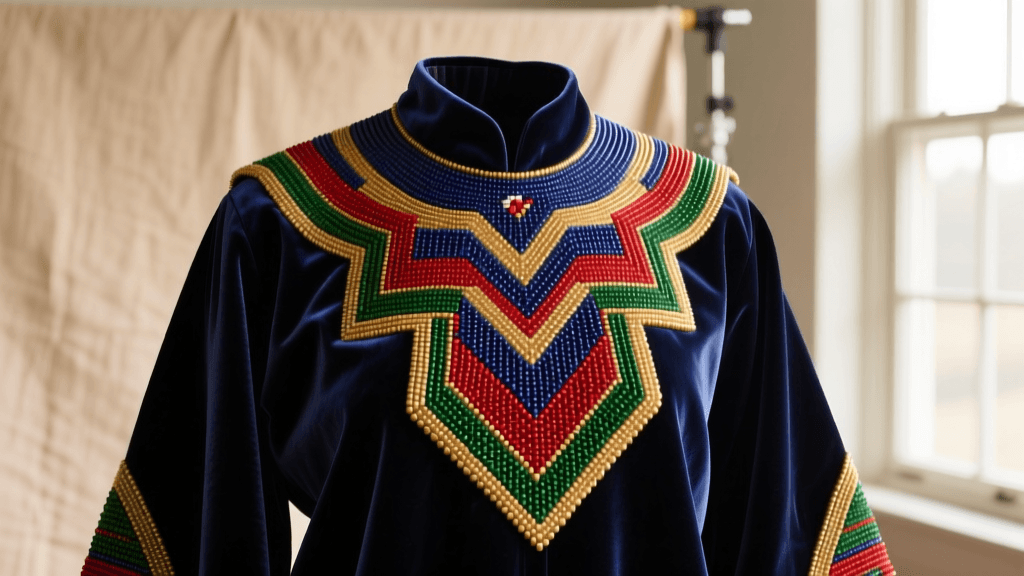
In 2026, the standard for high-quality traditional regalia remains 100% cotton velvet. Unlike the stretch velvets or synthetic panne velvets found in fast fashion, traditional cotton velvet possesses a dense, stiff pile that provides the necessary structural integrity to support heavy, three-dimensional beadwork without sagging or warping. Artisans today often source premium cotton velvet from specialized theatrical and historical textile suppliers, with prices in 2026 averaging between $45 and $65 per yard. The deep, rich colors—navy blue, black, forest green, and deep burgundy—serve as the perfect high-contrast canvas for the vibrant glass seed beads used in raised embroidery.
The Art of Raised Beadwork: The Two-Needle Technique
Haudenosaunee raised beadwork, often referred to in historical texts as 'Iroquois raised beadwork,' is a masterful technique that creates a stunning three-dimensional effect. Unlike flat beadwork seen in many Plains tribes' traditions, raised beadwork involves stitching beads over a padded surface, making the floral and geometric motifs literally pop off the velvet. The Smithsonian National Museum of the American Indian houses extensive collections of 19th-century Haudenosaunee pincushions and garments that highlight the historical mastery of this technique.
The secret to this 3D effect lies in the padding and the 'two-needle' or 'couching' method. First, the artisan cuts a design out of a stiff backing material, such as heavy felt, wool broadcloth, or modern Pellon interfacing. This padding is stitched onto the velvet. Then, the beader uses two needles simultaneously: the first needle strings the glass seed beads, while the second needle, threaded with a strong, waxed polyester or nylon thread, tacks the bead strand down over the raised padding. This allows the beads to arch and curve over the edges of the padding, creating a smooth, domed appearance that catches the light beautifully.
2026 Material Sourcing and Bead Sizing Guide
Selecting the correct bead size is critical for achieving the clean lines and tight curves characteristic of Haudenosaunee floral motifs. In 2026, Japanese seed beads, specifically Miyuki and Toho brands, remain the gold standard due to their uniform shape and consistent hole sizes. Below is a guide to the most commonly used beads and their current market applications.
| Bead Type | Size | Primary Application | 2026 Avg. Cost (per oz) |
|---|---|---|---|
| Miyuki Round Seed | 11/0 | Outlining, main floral petals, structural lines | $4.50 - $6.00 |
| Miyuki Round Seed | 13/0 or 15/0 | Filling tight spaces, intricate leaf details, shading | $7.00 - $9.50 |
| Toho Hex Cut | 11/0 | Adding sparkle to borders and central flower cores | $6.50 - $8.00 |
| Charlotte Cut (One-Cut) | 13/0 | High-shine accents, traditional whimsy detailing | $9.00 - $12.00 |
Regional Variations Across the Six Nations
While the foundational techniques of velvet tailoring and raised beadwork are shared across the confederacy, distinct regional and tribal variations exist. The Native Arts and Cultures Foundation frequently highlights how localized ecosystems and historical trade routes influenced the specific color palettes and motif preferences of each nation.
- Mohawk (Kanien'kehá:ka): Mohawk beadwork, particularly from communities like Akwesasne and Kahnawake, is renowned for its elaborate, sprawling floral designs. Mohawk artisans often incorporate a wider variety of pastel and translucent beads, and their velvet shirts frequently feature extensive beading on the yoke, cuffs, and a prominent central chest panel.
- Seneca (Onödowá'ga:): Seneca regalia often leans toward deeper, richer color palettes, reflecting the traditional dyes available in their western territories. The beadwork may feature slightly more geometric framing around the central floral motifs, and the velvet skirts often include a distinctive beaded border just above the hem.
- Tuscarora (Skarù:ręˀ): The Tuscarora, who joined the confederacy in the early 18th century after migrating north from the Carolinas, developed a highly recognizable beadwork style. They are historically famous for their intricate 'whimsies' and pincushions, and this translates to their garment work through incredibly dense, tightly packed bead fills and a preference for vibrant, high-contrast color pairings like bright pink and cobalt blue.
- Onondaga, Oneida, and Cayuga: These central and eastern nations often blend the floral exuberance of the Mohawk with the structural balance of the Seneca. Onondaga regalia, being the central fire-keepers of the confederacy, often features specific clan animal motifs (such as the turtle or the bear) integrated seamlessly into the surrounding strawberry and floral vines.
Motif Symbolism in Haudenosaunee Design
The designs stitched into velvet regalia are never merely decorative; they are deeply symbolic. The most ubiquitous motif is the strawberry plant. In Haudenosaunee cosmology, the strawberry is a sacred medicine, and its heart-shaped leaves and trailing vines represent the interconnectedness of the community, the continuity of life, and the sweetness of the earth. Artisans in 2026 continue to use the strawberry vine as a unifying border element on shirt yokes and skirt hems.
Other common motifs include the 'Tree of Peace' (the great white pine), clan animals (turtle, wolf, bear, heron, snipe, etc.), and the celestial dome or sky-world patterns. The placement of these motifs is deliberate. For instance, clan animals are often beaded on the left side of a garment, closer to the heart, signifying the wearer's lineage and their spiritual protectors.
Preservation and Archival Care for Velvet Regalia
Creating a fully beaded velvet shirt or skirt requires hundreds of hours of meticulous labor and a significant financial investment in materials. Proper preservation is critical to ensure these garments survive for future generations. The dense pile of cotton velvet is susceptible to crushing, while the glass beads and cotton threads can be damaged by environmental factors.
- Storage: Never fold a heavily beaded velvet garment. The weight of the beads will create permanent creases in the velvet pile and can snap the tension threads over time. Garments should be hung on wide, heavily padded archival hangers to distribute the weight across the shoulders.
- Environment: Store regalia in a cool, dark, and climate-controlled environment. In 2026, UV-protective garment bags made from unbleached, acid-free cotton muslin are the standard for protecting the velvet from dust and light degradation without trapping moisture, which could lead to mold or thread rot.
- Cleaning: Never dry-clean or machine-wash traditional raised beadwork. The chemicals used in dry cleaning can strip the finish from vintage or metallic-lined glass beads, and the agitation will destroy the velvet pile. Spot cleaning the velvet with a specialized, low-suction museum vacuum and a soft brush is the only recommended method for dust removal.
Conclusion
Haudenosaunee raised beadwork and velvet regalia represent a living, breathing art form that bridges the ancestral past with a vibrant 2026 present. By understanding the specific material requirements, mastering the two-needle couching technique, and respecting the regional and symbolic nuances of the Six Nations, artisans and collectors alike can ensure that the People of the Longhouse continue to shine in their traditional splendor for centuries to come.