Norwegian Bunad Silver Jewelry & Headwear Guide 2026
The Enduring Legacy of Norwegian Sølv in 2026
The resurgence of traditional European folk dress has reached new heights in 2026, with the Norwegian Bunad standing at the forefront of the global heritage movement. Far more than a simple national costume, the Bunad is a living, breathing tapestry of regional identity, genealogy, and artisanal mastery. However, the true soul of any Bunad lies not just in its meticulously embroidered wool fabrics, but in its accompanying accessories: the sølv (silver jewelry) and the highly specific regional headwear. According to the Norwegian Institute of Bunad and Folk Costumes, the silver and headwear serve as vital historical markers, denoting everything from a wearer's marital status to their exact valley of origin.
In 2026, the market for authentic Bunad accessories is thriving, driven by a new generation of heritage enthusiasts who prioritize artisanal authenticity over mass-produced souvenirs. Whether you are preparing for a summer solstice festival in Telemark, attending a traditional wedding in Hardanger, or simply curating a museum-grade collection, understanding the nuances of Norwegian folk accessories is essential. This comprehensive guide explores the anatomy of traditional silver, the strict rules of regional headwear, and how to authenticate and care for these heirloom pieces in the modern era.
The Anatomy of Bunad Silver: More Than Just Adornment
Historically, silver was the ultimate store of wealth for Norwegian farming families. It was worn on the body to keep it safe from thieves and, according to folklore, to ward off the huldra (mythical forest spirits). Today, a complete set of Bunad silver can represent a significant financial investment, often costing between 15,000 and 40,000 NOK in 2026, depending on the complexity of the filigree and the region it represents.
Essential Silver Components
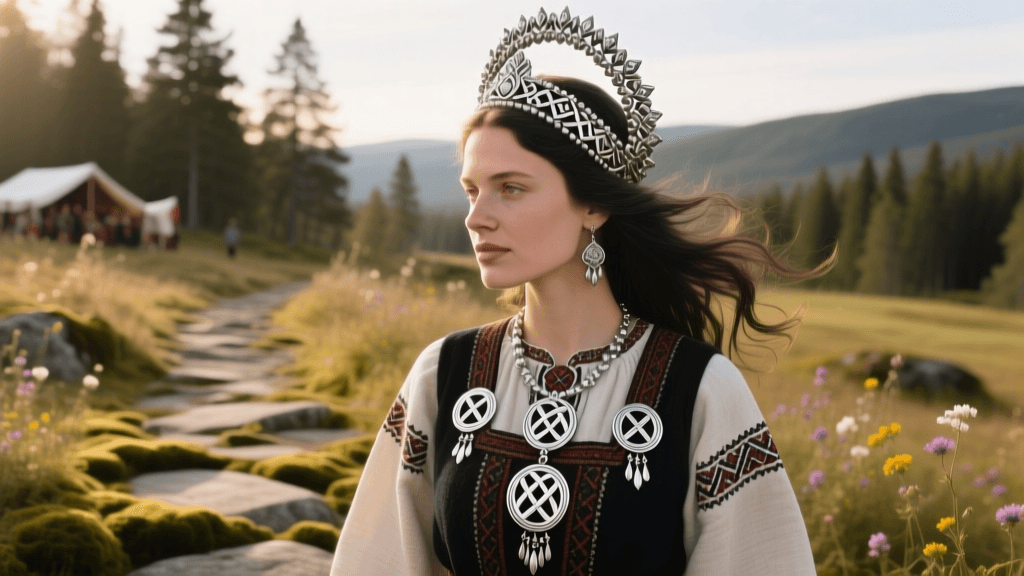
- The Sølje (Neck Brooch): The centerpiece of the Bunad. The traditional sølje features a circular base with dangling, spoon-shaped pendants called skjeer. These spoons historically symbolized prosperity and the hope that the wearer would never know hunger. A standard Hardanger sølje measures roughly 7 centimeters in diameter and weighs between 40 and 60 grams.
- Beltestøler (Belt Clasps): Used to fasten the heavy woven belts of regions like Setesdal and Gudbrandsdal. These are often large, ornate plates featuring intricate rosemaling (traditional floral painting) motifs translated into silver engravings.
- Maljer and Cufflinks: Small, delicate silver clasps used to secure the collar and cuffs of the linen under-shirt (skjorte). These are typically connected by a fine silver chain to prevent loss during vigorous folk dancing.
- Skospenner (Shoe Buckles): Placed on the instep of traditional leather Bunad shoes. In 2026, master silversmiths are reviving the lost wax casting method to recreate 18th-century shoe buckle designs that offer better structural integrity than modern stamped alternatives.
Regional Headwear: Skaut, Lue, and Brudekrone
While silver crosses regional boundaries with slight variations, headwear in Norwegian folk dress is strictly codified. The Norwegian Home Crafts Association (Husfliden) maintains strict guidelines on how headwear must be constructed and worn, as it acts as a visual language communicating a woman's social and marital standing within her community.
The Skaut (Married Women's Headdress)
The skaut is a masterpiece of textile engineering. Worn exclusively by married women, it consists of a heavily starched, bright white linen cloth that is folded and pinned into a specific, gravity-defying shape. The folding technique varies dramatically by region. For example, the Hardanger-skaut features a wide, halo-like brim that frames the face, while the Telemark-skaut is folded more tightly against the back of the head. In 2026, mastering the art of folding a skaut is considered a specialized skill, with master folders often hired specifically for wedding days to ensure the linen holds its shape through hours of celebration.
The Lue (Unmarried Women's Cap)
Unmarried women and young girls traditionally wear a lue, a close-fitting cap that covers the hair. In regions like Valle (Setesdal), the lue is often made of rich, dark fabrics adorned with vibrant silk ribbons and subtle silver thread embroidery. The cap signifies youth and availability, and its design is generally much simpler and lighter than the married woman's skaut.
The Brudekrone (Bridal Crown)
The most spectacular of all European folk headwear is the Norwegian brudekrone. Worn only on a woman's wedding day, these towering crowns are constructed from silver, brass, or copper, and heavily adorned with glass stones, pearls, and cascading silk ribbons. A traditional bridal crown from the Voss region can weigh up to 2.5 kilograms. Modern brides in 2026 often use specialized, hidden velvet supports to distribute the weight of the crown, preventing neck strain during the long ceremonial processions.
2026 Buyer's Guide: Authenticating Heritage Silver
As the demand for heritage dress has surged, so too has the market for imported, mass-produced replicas. When sourcing Bunad silver in 2026, whether from an antique dealer in Oslo or an online heritage marketplace, authentication is critical. Authentic pieces are crafted by certified silversmiths and carry specific hallmarks that guarantee their origin and material purity.
| Characteristic | Authentic 2026 Heritage Piece | Mass-Produced Tourist Replica |
|---|---|---|
| Hallmarks | Stamped with maker's mark, 925S, and town assay | Often unmarked or stamped with generic 'Silver' |
| Construction | Hand-soldered joints, individual cast pendants | Machine-stamped single piece, glued pendants |
| Weight (Standard Sølje) | 40g - 65g | 15g - 25g |
| Pin Mechanism | Heavy-duty steel pin with secure C-clasp | Flimsy alloy pin with basic tube clasp |
| Oxidation Detailing | Hand-applied liver of sulfur for deep contrast | Uniform chemical blackening or painted on |
When purchasing antique silver (pre-1950), be aware that older pieces may not conform to the modern 925 sterling standard. The Norwegian Museum of Cultural History notes that 19th-century rural silversmiths often melted down coins and older household items, resulting in silver alloys that can range from 800 to 950 parts per thousand. Always request a metallurgical X-ray fluorescence (XRF) test report when investing in high-value antique Bunad silver.
Modern Care and Maintenance for Folk Accessories
Proper maintenance of Bunad silver and delicate linen headwear ensures these pieces survive for future generations. The approach to care in 2026 balances traditional methods with modern, eco-friendly conservation science.
Caring for Sølv
Silver naturally tarnishes when exposed to sulfur in the air. For routine maintenance, avoid harsh chemical dips that strip away the intentional oxidation (the dark background that makes the raised silver patterns pop). Instead, use a specialized, eco-friendly silver polishing cloth infused with micro-abrasives. For deep cleaning, an ultrasonic cleaner can be used, but only if the piece does not feature glued-in glass stones or delicate enamel work, which can shatter or detach under high-frequency vibrations.
Storing the Skaut and Lue
The starched linen of a skaut is highly susceptible to moisture and creasing. After wearing, the linen should be gently hand-washed in lukewarm water with a pH-neutral textile soap, then heavily starched using a traditional potato-starch spray while damp. Once ironed and folded into its regional shape, the skaut must be stored in a breathable cotton bag with acid-free tissue paper to maintain its structural volume. Never store traditional linen headwear in plastic, as trapped humidity will quickly lead to irreversible mildew damage.
Conclusion: Wearing Heritage with Pride
European folk dress is not a static museum exhibit; it is a vibrant, evolving tradition. In 2026, wearing a Bunad complete with authentic, heavy silver jewelry and properly folded regional headwear is a profound statement of cultural continuity. By understanding the deep symbolism of the sølje, respecting the strict codification of the skaut, and committing to the proper authentication and care of these artifacts, wearers ensure that the rich textile and metallurgical heritage of Norway continues to shine brightly for centuries to come.