Norwegian Bunad Guide 2026: Regional Styles & Custom Tailoring Costs
The Living Heritage of the Norwegian Bunad in 2026
When discussing traditional European folk dress, few garments command the respect, meticulous craftsmanship, and national pride of the Norwegian bunad. As we navigate through 2026, the bunad remains far more than a historical costume; it is a living, breathing textile tradition worn at weddings, baptisms, and Norway’s Constitution Day (Syttende Mai). Unlike static museum pieces, the bunad evolves through rigorous community stewardship, balancing historical accuracy with contemporary tailoring techniques. For those looking to invest in a bunad this year, understanding the regional variations, the strict guidelines of heritage councils, and the current economic landscape of custom tailoring is essential.
It is crucial to distinguish between a folkedrakt (a historical, everyday folk costume from a specific era) and a bunad (a modern, reconstructed garment based on historical folk dress, standardized in the 20th century). The Norsk Folkemuseum (Norwegian Museum of Cultural History) houses thousands of original folkedrakt textiles that serve as the foundational blueprints for today’s bunads. In 2026, the demand for historically accurate reconstructions has surged, driven by a new generation of Norwegians and international diaspora seeking tangible connections to their ancestry.
Top Regional Bunad Variations: A Textile Journey
Norway’s dramatic topography—isolated fjords, deep valleys, and sprawling coastlines—resulted in highly distinct regional textile traditions. Today, there are over 450 distinct bunad designs. Here is a deep dive into the most iconic regional styles.
The Hardangerbunad: The Mother of All Bunads
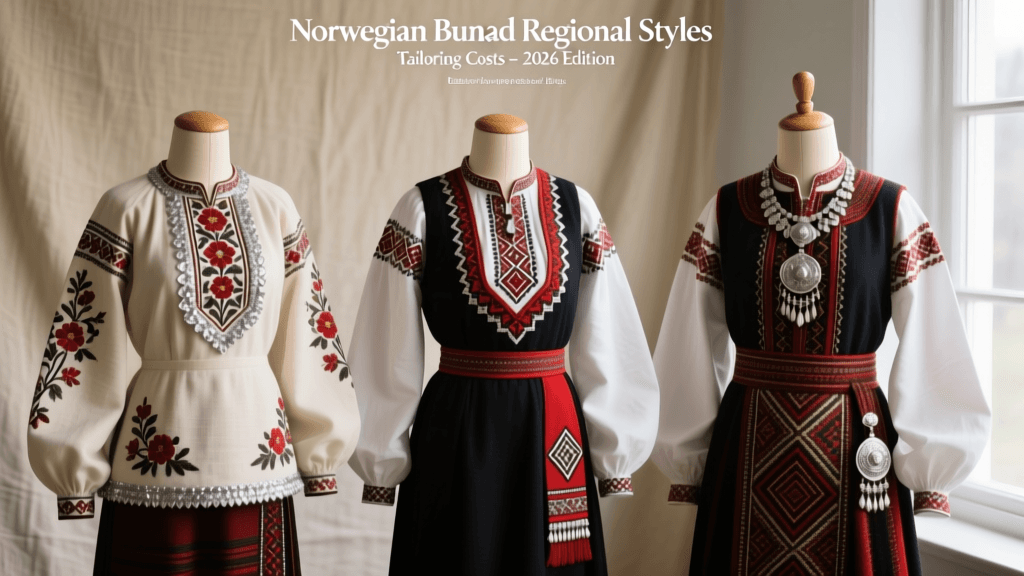
Originating from the Hardanger fjord region, the Hardangerbunad is widely considered the first official bunad, popularized during the national romantic movement. The women’s garment is characterized by its striking contrast: a black or deep blue worsted wool skirt and bodice, paired with a crisp white linen apron featuring intricate hardangersøm (whitework embroidery) and drawn-thread work. In 2026, master weavers in the region are increasingly utilizing heritage Spælsau wool, prized for its dual-layered fleece that provides a natural, water-resistant outer warp and a soft, insulating inner weft. The bodice is heavily adorned with red, green, and yellow wool embroidery, and the outfit is secured with elaborate oxidized silver clasps.
The Telemarksbunad: Rosemaling in Thread
Telemark is a region famous for rosemaling (traditional Norwegian decorative painting), and this fluid, floral aesthetic translates directly into its bunad. The Telemarksbunad for women features a dark blue or black wool skirt, but the true masterpiece is the bodice and apron. The embroidery mimics the sweeping C-curves and floral motifs of rosemaling, stitched in vibrant silks and wools. The men’s Telemark bunad is equally striking, featuring a richly embroidered vest (vest) worn over a linen shirt, paired with knee-breeches and distinctive silver buttons. Due to the sheer density of the embroidery, the Telemarksbunad commands some of the longest wait times from artisan collectives.
The Setesdalsbunad: Stark Contrasts and Heavy Silver
From the remote Setesdal valley comes a bunad that reflects the harsh, beautiful realities of inland Norwegian winters. The Setesdalsbunad is instantly recognizable by its heavy, dark woven wool and stark white accents. The women’s skirt often features a distinctive woven band at the hem, and the apron is typically black with white embroidery or vice versa. However, the defining feature of the Setesdal tradition is the sølje (silver jewelry). Setesdal silver is famously heavy, featuring large, dangling filigree drops and broad, ornate belt buckles. In 2026, with global precious metal markets fluctuating, authentic Setesdal silver sets represent a significant financial investment, often rivaling the cost of the wool garments themselves.
The Nordlandsbunad: Coastal Elegance
Representing the rugged northern coast, the Nordlandsbunad incorporates elements of the region’s maritime history and the opulent trade of the 18th and 19th centuries. The women’s bunad features a striking silk damask apron, a luxury material that historically arrived via trading ships to the Lofoten islands. The bodice is often made of a rich, dark blue wool with floral embroidery that reflects the brief, explosive bloom of the Arctic summer. It is a highly sought-after design in 2026, particularly among those with roots in Northern Norway, due to its elegant silhouette and vibrant color palette.
2026 Custom Tailoring Costs and Market Realities
Commissioning a bunad is not akin to buying off-the-rack clothing; it is a bespoke process governed by the Bunad- og folkedraktrådet (National Council for Bunad and Folk Costume). Every stitch, fabric choice, and silver piece must adhere to strict regional guidelines. As of 2026, inflation, the rising cost of ethically sourced European wool, and the surging price of silver have impacted custom tailoring costs. Furthermore, a new trend in 2026 is the use of 3D body-scanning technology by major ateliers, allowing international clients to commission garments without traveling to Norway for multiple in-person fittings.
| Regional Style | Primary Textiles | 2026 Custom Cost (USD) | Tailoring Lead Time |
|---|---|---|---|
| Hardangerbunad | Worsted wool, linen, silk thread | $4,200 - $5,000 | 8 - 12 Months |
| Telemarksbunad | Fine broadcloth, silk embroidery | $4,800 - $6,200 | 12 - 18 Months |
| Setesdalsbunad | Heavy woven vadmel wool | $3,900 - $4,800 | 6 - 10 Months |
| Nordlandsbunad | Wool, silk damask, linen | $4,500 - $5,500 | 10 - 14 Months |
| Men's Universal Vest Set | Wool vest, linen shirt, breeches | $2,800 - $3,600 | 6 - 9 Months |
Note: Prices listed reflect the base garment and standard silver accessories. Heirloom silver pieces or complex custom weaving can increase the final price by 30% to 50%.
The Art of Sølje: Silver Jewelry and Accessories
No bunad is complete without its corresponding sølje. Norwegian silver jewelry is not merely decorative; historically, it served as a portable bank account and a display of a family’s wealth and social standing. The silver used in bunads is typically 925 sterling silver, often oxidized to create a dark, antique finish that highlights the intricate filigree work and hanging løv (leaf-like pendants).
In 2026, the silver market has seen a notable price increase, making vintage and inherited sølje highly prized. A standard women’s silver set includes the bringesølje (chest piece), vespestøl (waist clasps), cufflinks, and a belt buckle. For the Hardangerbunad, the bringsølje is often a large, circular piece with a crown motif, while Telemark favors asymmetrical, floral-inspired silver designs. Buyers in 2026 are advised to purchase silver from certified Norwegian goldsmiths affiliated with the Norges Husflidslag (Norwegian Folk Art and Craft Association) to ensure the pieces meet historical and metallurgical standards.
Sourcing, Fitting, and Authenticating Your Bunad
If you are planning to acquire a bunad in 2026, the most reputable route is through local Husfliden stores or certified independent artisans. These organizations employ trained bunadtilvirkere (bunad tailors) who have undergone years of apprenticeship in historical sewing techniques, including hand-stitched buttonholes, hidden seams, and traditional linen undergarment construction.
For the international diaspora, the 2026 digital fitting process has revolutionized accessibility. Clients can now submit precise biometric data via standardized 3D scanning apps approved by the tailoring guilds. However, purists still recommend at least one in-person fitting in Norway to adjust the drape of the heavy wool skirt and the tension of the linen bodice, as digital scans sometimes fail to capture the dynamic movement of thick textiles.
Garment Care and Preservation in the Modern Era
A bunad is an heirloom meant to be passed down through generations. Proper care in 2026 involves a mix of traditional wisdom and modern conservation science. Wool garments should never be dry-cleaned with harsh modern chemicals, as this strips the lanolin from the Spælsau wool and degrades the historical dyes. Instead, specialists recommend airing the garments outside in the crisp, dry winter air—a traditional Norwegian method that naturally kills bacteria and neutralizes odors.
For storage, climate-controlled cedar wardrobes are the gold standard. In 2026, the use of natural pheromone-based moth traps has replaced chemical mothballs, which can tarnish the silver threads and oxidize the sølje. The silver itself should be stored in anti-tarnish cloth bags, separate from the wool, to prevent sulfur transfer from the textile dyes to the metal. When washing the linen skjorte (shirt), use enzymatic-free, pH-neutral detergents, and iron while damp to achieve the crisp, structured collars required for proper bunad presentation.
Conclusion: Wearing Your Heritage
The Norwegian bunad is a masterclass in regional identity, textile engineering, and cultural preservation. Whether you are drawn to the stark beauty of the Setesdal wool, the vibrant rosemaling of Telemark, or the maritime elegance of Nordland, investing in a bunad in 2026 is a commitment to keeping European folk dress alive. By respecting the guidelines of the heritage councils, supporting local artisans, and understanding the profound history woven into every thread and silver clasp, you ensure that this magnificent tradition continues to thrive for generations to come.