Norwegian Bunad Regional Guide 2026: Tailoring & Silver Costs
The Enduring Legacy of the Norwegian Bunad in 2026
As Norway approaches its 2026 Constitution Day (Syttende Mai) celebrations, the demand for authentic regional folk dress—collectively known as the bunad—has reached a decade high. Far from being a static museum relic, the bunad is a living textile tradition that continues to evolve while maintaining strict historical parameters. According to the Norsk institutt for bunad og folkedrakt (Norwegian Institute for Bunad and Folk Costume), there are over 450 distinct registered bunad variations across the country, each tied to a specific geographic region, valley, or fjord.
For collectors, cultural enthusiasts, and those investing in heritage garments, understanding the nuances of regional construction, 2026 tailoring costs, and the fluctuating silver market is essential. This guide breaks down the most prominent regional variations, provides actionable tailoring measurements, and details the current costs of commissioning an authentic Norwegian folk dress in 2026.
Regional Variations: A Comparative Guide
The Store norske leksikon (Norwegian National Encyclopedia) categorizes bunads based on their historical lineage. Some are direct, unbroken continuations of 18th-century rural festivity wear, while others are meticulous 20th-century reconstructions based on archaeological textile fragments.
Hardangerbunad (The 'White' Bunad)
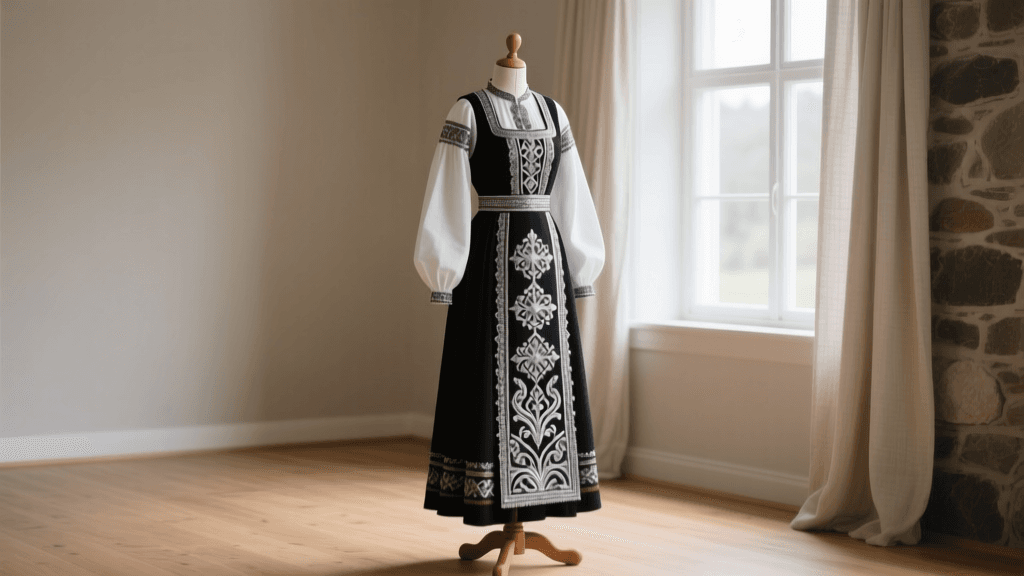
Originating from the Hardanger fjord region in Vestland county, this is arguably Norway's most recognizable folk dress. Often referred to as the 'white bunad' due to its striking linen apron and shirt, the Hardangerbunad relies heavily on kross-saum (cross-stitch) and smøyg (intricate smocking). In 2026, the trend among artisans is a return to unbleached, naturally grown European flax for the linen components, moving away from the stark, chemically bleached whites of the early 2000s. The wool skirt is traditionally deep black or navy blue, providing a high-contrast canvas for the geometric red, yellow, and green cross-stitch embroidery.
Telemark Bunad
The Telemark bunad is renowned for its opulent, free-flowing embroidery that closely mirrors the region's famous rosemaling (rose painting) woodwork tradition. The garment typically features a dark blue or black wool bodice and skirt, heavily embroidered with vibrant floral motifs in red, yellow, and blue silk threads. The Telemark variation requires a highly structured bodice, often reinforced with internal linen canvas to support the substantial weight of the accompanying silver filigree.
Hallingdal Bunad
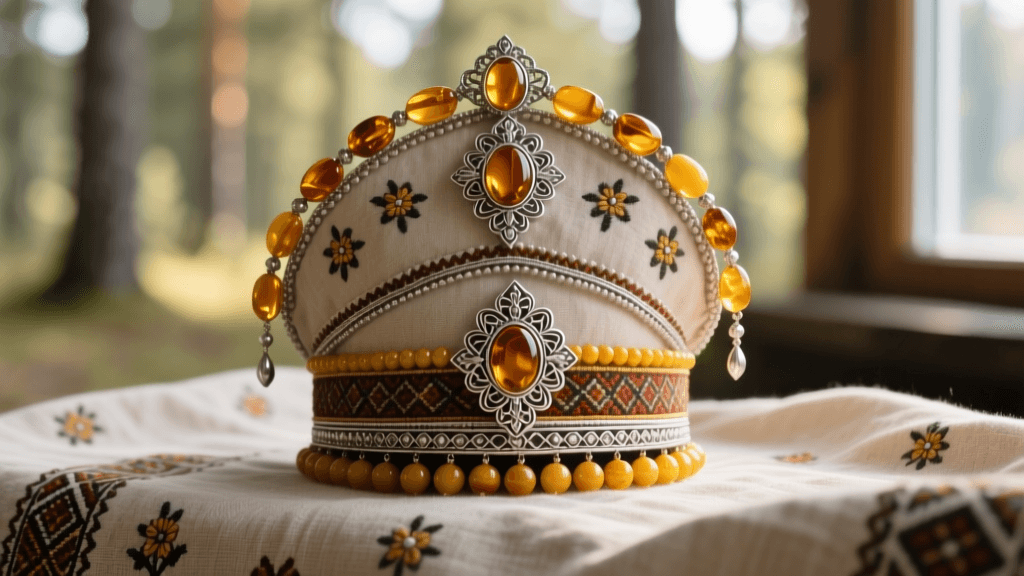
Hailing from the mountainous Hallingdal valley, this bunad is characterized by its rich, warm color palette—dominated by deep madder reds and earthy browns. The Hallingdal bunad is unique for its extensive use of perlebroderi (beadwork) and metallic thread embroidery, reflecting historical trade routes that brought glass beads and silver wire to the inland valleys. The most striking accessory is the skaut, a heavily embroidered, structured headpiece worn exclusively by married women, while unmarried women wear a delicate silver crown or a simple silk ribbon.
Embroidery Techniques and Textile Sourcing
The authenticity of a bunad is judged primarily by its textile composition and stitch accuracy. In 2026, sustainability and local sourcing have become paramount in the Norwegian heritage textile sector.
- Wool Sourcing: The gold standard for bunad wool in 2026 is spun at the historic Hillesvåg Ullvarefabrikk. Their custom-milled, tightly woven vadmel (a dense, fulled wool fabric) is water-resistant and holds the heavy embroidery without warping.
- Natural Dyes: Master embroiderers are increasingly utilizing historical dye recipes. Madder root (krapp) is used to achieve the specific rust-red required for the Hallingdal bodice, while woad (veid) and indigo are carefully balanced to match the archival blue threads of the Telemark florals.
- Stitch Regulation: The 'Bunad Police' (a colloquial term for heritage preservationists) strictly enforce stitch direction. For example, the smøyg smocking on a Hardanger shirt must be worked in a continuous, unbroken count; a single misaligned thread can disqualify a shirt from official regional exhibitions.
2026 Bunad Tailoring: Measurements, Materials, and Costs
Commissioning a bunad is a significant financial and temporal investment. Unlike standard haute couture, bunad tailoring is governed by strict cultural rules regarding fit and proportion. The hemline of the wool skirt, for instance, must traditionally graze the top of the wearer's traditional silver-buckled leather shoes when standing flat-footed, typically measuring 2 to 3 centimeters above the ground.
The bodice (liv) must be tailored to allow exactly 2 centimeters of ease over the handwoven linen shirt, ensuring the silver breast brooch (brystsølje) sits perfectly flat against the sternum without buckling the wool. Below is the 2026 market breakdown for commissioning a complete, authentic regional bunad through authorized Husfliden (Norwegian Craft Association) retailers.
| Component | Material Specification | 2026 Est. Cost (NOK) | 2026 Est. Cost (USD) | Lead Time |
|---|---|---|---|---|
| Skirt & Bodice | 100% Hillesvåg Vadmel Wool / Brocade | 18,000 - 26,000 | $1,700 - $2,450 | 6-9 Months |
| Linen Shirt | Handwoven Unbleached Flax Linen | 4,500 - 6,500 | $425 - $615 | 2-4 Months |
| Silver Belt | 925 Sterling Silver (Oxidized) | 16,000 - 32,000 | $1,500 - $3,000 | 1-5 Months |
| Chest Brooch | Traditional Filigree Silver | 3,500 - 9,000 | $330 - $850 | In Stock |
| Tailoring Labor | Master Artisan Fitting & Assembly | 8,500 - 13,000 | $800 - $1,225 | 3-5 Months |
| Total Estimate | Complete Ensemble | 50,500 - 86,500 | $4,755 - $8,140 | 9-14 Months |
Note: Prices fluctuate based on the complexity of the regional embroidery. A Telemark bunad with extensive hand-embroidered floral silk work will sit at the absolute top of this price range, while a simpler variation from the Østfold region may be closer to the lower bound.
Sourcing Authentic Bunad Silver (Sølv)
No bunad is complete without its regional silver jewelry, which historically served as a family's portable bank account and a display of social standing. In 2026, the silver market has seen a distinct shift in aesthetic preferences. While high-polish silver was highly sought after in the 1990s and 2000s, contemporary buyers and heritage experts now heavily favor oksidert sølv (oxidized silver). The darkened crevices of the filigree highlight the intricate Viking-era granulation techniques and provide a more historically accurate, antique appearance.
'The silver of the bunad is not merely decorative; it is an architectural necessity. The weight of the Telemark belt and the tension of the Hardanger neck buttons are calculated to anchor the heavy wool garments, ensuring the drape remains flawless throughout a day of traditional folk dancing.' — Archival notes from the Norsk institutt for bunad og folkedrakt.
When sourcing silver in 2026, buyers must look for the stemplet (hallmark) of recognized Norwegian silversmiths such as Sylvsmidja på Voss or Arven. A traditional Telemark silver belt (beltestøler) typically weighs between 180 and 250 grams of solid 925 sterling silver. Due to global precious metal fluctuations in early 2026, silver accessories have seen a 12% price increase compared to 2024, making early commissioning highly advisable.
Caring for Your Regional Folk Dress
Proper maintenance of a bunad ensures it survives as an heirloom for future generations. The dense wool vadmel should never be dry-cleaned with harsh modern chemicals, as this strips the natural lanolin that provides water resistance. Instead, 2026 best practices dictate spot-cleaning with a damp cloth and mild, pH-neutral wool soap, followed by airing the garment outside in a shaded, well-ventilated area—a traditional Norwegian method known as lufting.
The linen shirt requires separate care. It should be hand-washed in lukewarm water and ironed while still slightly damp using a high-heat steam press to ensure the crisp, structured collars required for the silver neck buttons (halsknapp). Silver jewelry must be removed before storage and kept in anti-tarnish flannel bags, separate from the wool, to prevent sulfur transfer from the environment.
Whether you are tracing your ancestry to the deep fjords of Hardanger or the forested valleys of Telemark, investing in a regionally accurate bunad in 2026 is a profound commitment to European textile heritage. By understanding the precise tailoring requirements, respecting the traditional embroidery stitches, and sourcing authentic materials, you ensure that these magnificent garments continue to tell the story of Norway's rural history for centuries to come.