Norwegian Bunad Guide 2026: Hardanger & Telemark Silver
The Living Heritage of the Norwegian Bunad in 2026
When discussing traditional European folk dress, few garments command the same level of national pride, meticulous craftsmanship, and everyday reverence as the Norwegian Bunad. Unlike many European folk costumes that have been relegated to museum archives or occasional tourist performances, the Bunad is a living, breathing tradition. In 2026, it remains the gold standard for formal wear in Norway, donned by over 70% of women and a growing percentage of men for Constitution Day (May 17), weddings, baptisms, and milestone anniversaries. However, navigating the world of Bunads requires a deep understanding of regional authenticity, historical accuracy, and the significant financial investment required for genuine articles.
The distinction between a folkedrakt (historical folk costume) and a bunad (a modern reconstruction based on historical garments) is fiercely guarded by the Bunad- og folkedraktrådet (The Bunad and Folk Costume Council). This official body ensures that regional patterns, fabrics, and silver jewelry remain historically accurate. As we move through 2026, the global surge in sustainable, heritage-based fashion has only increased the demand for authentic, locally crafted Bunads, pushing lead times for custom embroidery and hand-forged silver to unprecedented lengths.
Regional Deep Dive: Hardanger vs. Telemark
Norway’s rugged topography historically isolated its valleys, resulting in hyper-local textile traditions. While there are over 450 distinct Bunad variations across the country, the Hardanger and Telemark regions represent two of the most iconic and historically significant pillars of Norwegian textile heritage.
The Hardangerbunad: The Mother of All Bunads
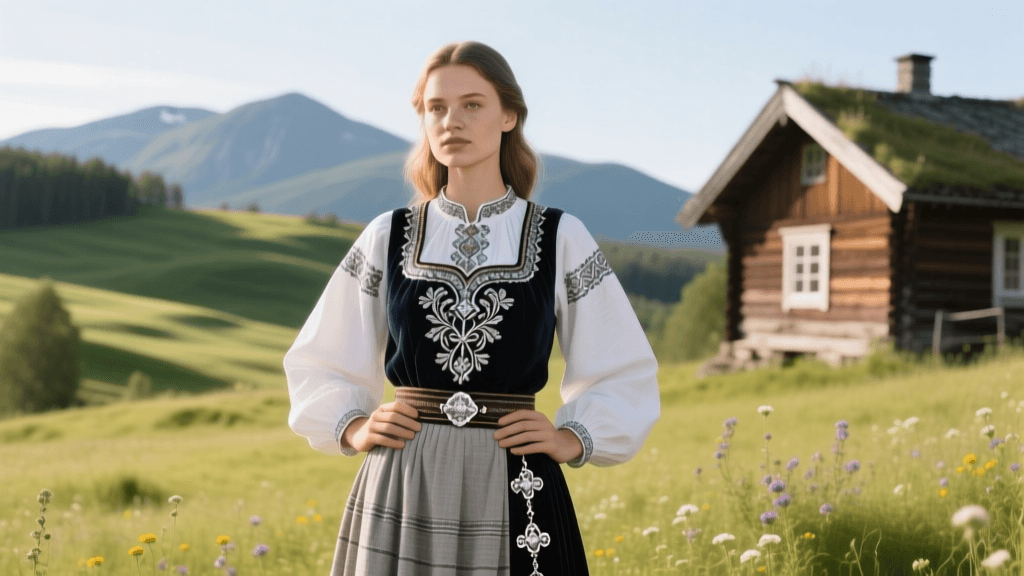
Often referred to simply as "Nasjonalen" (The National), the Hardangerbunad holds a special place in Norway’s cultural consciousness. During the 19th-century National Romantic period, as Norway sought to establish a distinct cultural identity separate from Sweden and Denmark, the traditional clothing of the Hardanger fjord region was elevated to a symbol of national pride. The women’s Hardangerbunad is instantly recognizable by its striking color palette: a black wool skirt and bodice, contrasted with a crisp white linen shirt featuring intricate hvitsøm (white-work embroidery) and drawn-thread work. The apron is typically black or dark blue, adorned with vibrant cross-stitch embroidery in red, green, and yellow threads. In 2026, master embroiderers in the Hardanger region still utilize locally spun wool and traditional linen, ensuring the garment drapes and wears exactly as it did a century ago.
The Telemarkbunad: Rosemaling and Rural Wealth
If Hardanger represents the national romantic ideal, the Telemarkbunad represents the historical wealth and artistic zenith of rural Norwegian agriculture. Telemark is the birthplace of rosemaling (traditional Norwegian decorative painting), and this flowing, asymmetrical floral artistry is directly translated into the region's textile embroidery. The women’s Telemark Bunad features a deep, rich wool skirt—often in dark green, navy, or black—paired with a heavily embroidered bodice and a spectacular silk-embroidered apron. The men’s Telemark Bunad is equally striking, featuring a dark wool jacket with elaborate floral embroidery on the cuffs and collar, paired with knee-breeches and hand-knit wool stockings. The sheer density of the embroidery on a genuine Telemark piece requires hundreds of hours of hand-stitching, making it one of the most expensive and sought-after regional variations in the country.
Decoding the Silver (Sølje): A 2026 Buyer’s Guide
No Bunad is complete without its sølje (silver jewelry). Historically, silver was a family’s portable bank account, worn on the body to display wealth and protect against evil spirits. Today, the silver remains the most costly component of the ensemble. The traditional technique of oxidering (oxidation) is used to darken the recesses of the silver, highlighting the intricate filigree work and contrasting beautifully against the white linen shirt.
As of 2026, the global commodities market has driven the price of raw silver to historic highs. Consequently, the cost of a complete, hand-forged Bunad silver set has increased significantly compared to previous decades. When purchasing silver, it is imperative to look for the 925S stamp, guaranteeing sterling silver, and to buy only from certified Norwegian silversmiths to avoid mass-produced, imported imitations that lack the correct historical motifs.
2026 Cost Breakdown for Authentic Telemark Silver
| Silver Component | Description & Placement | Est. 2026 Price (NOK) | Est. 2026 Price (USD) |
|---|---|---|---|
| Halsknapp | Neck button, securing the shirt collar | 3,500 - 5,000 | $330 - $470 |
| Brystsølje | Large chest brooch, often with hanging spoons or leaves | 12,000 - 18,000 | $1,130 - $1,690 |
| Livstøkke | Ornate belt buckle for the bodice | 8,500 - 12,000 | $800 - $1,130 |
| Maljer (Set of 4) | Waist buttons used to lace the bodice | 4,000 - 6,000 | $375 - $565 |
| Søljeveske | Silver-clasped leather or woven belt purse | 6,000 - 9,000 | $565 - $845 |
Note: Prices fluctuate based on the complexity of the filigree, the specific silversmith, and the daily spot price of silver. A complete, high-end Telemark silver set in 2026 can easily exceed 55,000 NOK ($5,100 USD).
Actionable Fitting and Measurement Guide
A Bunad is not bought off the rack; it is tailored to your exact measurements. Because the wool is heavy and the bodice is structured, a proper fit is essential for both comfort and historical accuracy. When visiting a certified Husfliden retailer or an independent master tailor, you will need to provide precise metrics. Here is how to prepare for your 2026 fitting:
- The Bodice (Liv): Measure the bust, underbust, natural waist, and upper waist. The bodice should fit snugly like a corset, providing back support without restricting breathing. Traditional Bunads do not use modern darts; the fit is achieved through strategic seam placement and lacing.
- The Skirt (Stakk): The most critical measurement is the skirt length. Historically, a Bunad skirt must fall exactly to the ankle bone. Measure from your natural waist down to the floor while wearing the specific heels or traditional leather shoes (bunadssko) you plan to wear with the garment. Account for a 3-5 cm hem allowance for future adjustments.
- The Shirt (Skjorte): Neck circumference and wrist circumference are vital, as the linen cuffs and collar are secured tightly by the silver Halsknapp and cufflinks. Ensure you can comfortably fit one finger between the collar and your neck.
- Weight Fluctuation Allowances: Master tailors intentionally build hidden seam allowances into the bodice and skirt waistbands. In 2026, sustainable fashion practices emphasize garments that last a lifetime; a well-made Bunad can be let out or taken in by up to 5-7 cm to accommodate natural body changes over decades.
Sourcing Authentic Garments and Avoiding Tourist Traps
The commercialization of European folk dress has led to a market flooded with cheap, overseas-manufactured "Bunads" that violate historical copyrights and utilize synthetic fabrics. To ensure you are investing in genuine Norwegian heritage, always verify the source. The Norsk Folkemuseum (Norwegian Museum of Cultural History) maintains extensive archives that inform the patterns used by certified makers. When purchasing, look for the official certification from the Bunad- og folkedraktrådet, or buy directly from established regional Husflid (handicraft) shops. Be highly skeptical of online retailers offering "complete Bunad sets" with shipping times of less than three months; authentic hand-embroidery and tailoring require a minimum lead time of 6 to 12 months in 2026.
Care, Storage, and Maintenance
A Bunad is an heirloom designed to be passed down through generations, but it requires meticulous care. Never dry-clean a wool Bunad unless absolutely necessary, as harsh chemicals strip the natural lanolin from the wool, leaving it brittle and prone to tearing. Instead, air the garment out in a cool, damp environment (like a bathroom after a shower) to release wrinkles and odors. Store the wool pieces in breathable, unbleached cotton bags alongside cedar blocks to deter moths—never use plastic, which traps moisture and causes mildew.
For the silver, avoid commercial silver dips or ultrasonic cleaners. These methods will strip the intentional oxidation from the crevices, ruining the three-dimensional contrast of the filigree. Instead, use a soft, dry silver-polishing cloth to gently buff only the raised, high-friction areas of the sølje, leaving the darkened recesses intact. With proper care, the wool will endure for a century, and the silver will only grow more beautiful with age, carrying the stories and celebrations of your family for generations to come.