Norwegian Bunad Bodice Tailoring & Linen Gussets 2026
Introduction to Norwegian Folk Tailoring in 2026
The construction of the traditional Norwegian bunad represents one of the most rigorous and rewarding disciplines in European folk dress. Unlike modern fast fashion or even contemporary bespoke tailoring, the architecture of a bunad relies on centuries-old geometric pattern drafting and structural engineering. As we move through 2026, the revival of heritage sewing techniques has reached new heights, with makers and textile historians prioritizing historical accuracy over modern shortcuts. According to the Norsk institutt for bunad og folkedrakt, there has been a 30% increase in apprenticeships focusing on traditional garment construction this year alone.
This comprehensive guide focuses on two foundational pillars of Norwegian folk dress construction: the structured tailoring of the wool bodice (liv) and the zero-waste geometric drafting of the linen shirt (skjorte), specifically the crucial underarm gusset (kil). Whether you are drafting your first regional pattern or refining your historical tailoring skills, mastering these techniques is essential for creating garments that are both historically authentic and structurally enduring.
The Architecture of the Bunad Bodice (Liv)
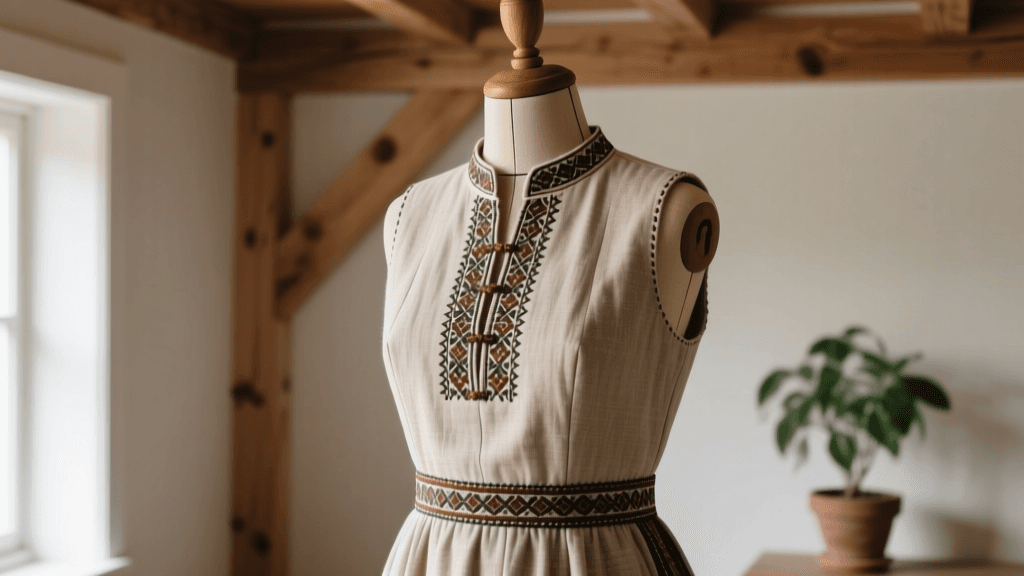
The bunad bodice is not merely a covering; it is a supportive foundation garment designed to shape the torso and provide a stable canvas for heavy metallic thread embroidery (gull- og sølvtrådbroderi). In 2026, authentic construction requires a multi-layered approach that mimics historical corsetry while utilizing modern, breathable, and rust-proof materials.
Material Selection and Interfacing
The foundation of a proper liv begins with the interfacing. Historically, multiple layers of stiff linen canvas (lerret) were basted together. Today, tailors utilize a heavy-weight, tightly woven linen canvas, pad-stitched to a secondary layer of cotton drill. This creates a flexible yet firm base. The outer layer is typically a high-density Melton wool. As of 2026, sourcing authentic Norwegian Melton wool from established mills in Hordaland costs approximately 850 to 1,200 NOK per meter, reflecting the premium placed on heritage textiles.
For boning, the historical use of baleen or steel has been entirely replaced by high-grade synthetic whalebone (German plastic boning). This 2026 standard prevents rust stains on the linen lining and reduces the overall weight of the garment without sacrificing the rigid silhouette required for regions like Hardanger or Telemark.
Drafting the Princess Seams and Ease
Unlike modern bodices that rely heavily on bust darts, traditional bunad bodices utilize curved princess seams that extend from the armscye or shoulder down to the waist. When drafting the pattern, you must account for the compression of the canvas layers. A standard measurement protocol involves taking the snug bust and waist measurements, then adding exactly 4 cm of ease across the bust and 2 cm across the waist to allow for the thickness of the linen shirt worn underneath and to ensure comfortable respiration during long festival days.
Regional Bodice Construction Comparison
Construction methods vary significantly depending on the specific regional tradition. The table below outlines the primary structural differences among three prominent Norwegian bunad styles.
| Region | Bodice Style & Seaming | Closure Method | Typical Boning Placement |
|---|---|---|---|
| Hardanger | Deep V-neck, curved princess seams from armscye | Front lacing with silver eyelets | 6 bones: Side seams and flanking the front eyelet panels |
| Setesdal | High neckline, heavily embroidered, darted waist | Hidden front hooks or silver clasps | 4 bones: Primarily at side seams to maintain a tubular shape |
| Telemark | Square or scoop neck, multi-paneled back | Front lacing or silver dome buttons | 8 bones: Distributed evenly across back and side panels |
The Traditional Linen Skjorte and Underarm Gussets
Worn beneath the wool bodice, the skjorte (shirt) is a masterclass in zero-waste geometric cutting. Traditional European folk dress rarely utilized curved armscyes or set-in sleeves for undergarments. Instead, the shirt was constructed entirely from rectangles and squares, minimizing fabric waste and maximizing the structural integrity of the woven linen.
The most critical component of the skjorte is the underarm gusset, or kil. Because the sleeve is essentially a rectangle attached to a rectangular body, lifting the arm would pull the entire shirt upward, causing severe restriction and tearing at the armpit. The diamond-shaped gusset acts as a three-dimensional hinge, providing the necessary mobility without compromising the straight-grain integrity of the linen.
The Geometry of Zero-Waste Cutting
To draft a traditional skjorte, the body is cut as a single large rectangle folded over the shoulders, with a slit for the neck. The sleeves are narrower rectangles. The gussets are cut as perfect squares. For an average adult female bunad shirt in 2026, the standard gusset square measures 14 cm by 14 cm. When folded diagonally, it creates a diamond with 19.8 cm diagonal axes, providing ample depth for the underarm cup.
Step-by-Step Gusset (Kil) Insertion Technique
Inserting a gusset into a straight slash is one of the most notoriously difficult techniques in folk tailoring. The stress point at the apex of the slash is highly prone to fraying. Follow these precise steps for a historically accurate and durable insertion:
- Prepare the Slash: Cut a straight vertical slit into the side seam of the shirt body where the sleeve will attach. The slit should be exactly 10 cm long. Stay-stitch around the apex of the slit with a 1 mm stitch length to reinforce the linen fibers.
- Fold the Gusset: Press your 14x14 cm square in half diagonally to form a triangle, then fold again to create a smaller triangle. Press sharply to establish the center diamond crease lines.
- Pinning the Apex: Place the folded point of the gusset diamond exactly at the top of the stay-stitched slash. Using a fine awl, gently push the linen fibers apart rather than cutting them, preserving the warp and weft threads.
- Stitching the Inner Corner: Using a 5 mm seam allowance, stitch from the edge of the slash down to the apex. At the exact apex, leave the needle down in the fabric, pivot, and stitch up the other side of the slash. The stitching line at the apex must catch only one or two threads of the shirt body to prevent puckering.
- Attaching the Sleeve: The remaining two edges of the diamond gusset are sewn to the bottom edge of the rectangular sleeve. This creates the three-dimensional underarm pouch.
- Flat-Felling: To prevent raw edges from fraying against the skin, all interior seams of the skjorte must be flat-felled. Trim one seam allowance to 3 mm, fold the wider allowance over it, and whip-stitch or topstitch it flat to the shirt body.
Essential 2026 Tailoring Tools for Heritage Garments
Executing these traditional techniques requires specialized tools that honor the craft. While modern sewing machines can be used for long structural seams, the finishing and shaping must be done by hand. According to resources provided by Norges Husflidslag (The Norwegian Craft Association), investing in proper pressing tools is just as vital as the cutting process.
- Hardwood Tailor's Clapper: Essential for flattening thick wool seams. The heavy wood traps steam from your iron, forcing the Melton wool fibers to lay completely flat without creating a shine on the fabric surface.
- Steel Bodkin and Awl: Used for piercing eyelet holes in the bodice front. Unlike modern hole punches that cut and remove fibers, a traditional awl pushes the warp and weft threads aside, maintaining the structural integrity of the canvas and wool.
- Linen Thread (Waxed): For pad-stitching the canvas and flat-felling the linen shirt. In 2026, naturally waxed 50/3 linen thread remains the gold standard for its tensile strength and historical accuracy.
- Heavy-Duty Thimble: A traditional leather and steel coin-thimble is necessary for driving needles through multiple layers of wool and canvas.
Preserving the Craft for the Future
The construction of the Norwegian bunad is a living tradition, constantly balanced between strict historical preservation and the practical realities of modern makers. By understanding the structural necessity of the bodice canvas and the geometric brilliance of the linen gusset, sewists do more than create a beautiful garment; they participate in an unbroken chain of European textile heritage.
For those looking to study original artifacts and draft patterns directly from historical garments, the DigitaltMuseum archive offers high-resolution, multi-angle photography of 18th and 19th-century folk dress, allowing tailors to analyze seam placements, gusset dimensions, and embroidery density with unprecedented clarity. As the demand for authentic, handcrafted folk dress continues to grow in 2026, mastering these foundational construction techniques ensures that the profound engineering of European folk dress will endure for generations to come.