Pacific Northwest Button Blankets & Chilkat Weaving Revival 2026
The Living Legacy of Northwest Coast Regalia
The Indigenous peoples of the Pacific Northwest Coast—encompassing the Tlingit, Haida, Tsimshian, Kwakwaka’wakw, and Nuu-chah-nulth nations—possess some of the most visually striking and culturally profound textile and garment traditions in the Americas. As we navigate through 2026, a powerful cultural renaissance is sweeping through these communities, marked by a fierce dedication to reclaiming, preserving, and innovating ancestral dress. Far from being static museum artifacts, Northwest Coast regalia are living, breathing entities that carry the spiritual weight, legal rights, and ancestral lineages of their wearers. This comprehensive guide explores the intricate worlds of Chilkat weaving and button blankets, examining how these monumental garment traditions are thriving in the modern era.
Chilkat Weaving: The Pinnacle of Textile Art
Chilkat weaving, known as naaxein in the Tlingit language, represents the absolute zenith of Indigenous textile art in North America. Originating with the Tsimshian and perfected by the Tlingit Chilkat people, these magnificent robes are characterized by their complex, curvilinear formline designs that depict ancestral crests and mythological beings. The creation of a single Chilkat robe is a monumental undertaking that, even with modern tools available in 2026, requires over a year of dedicated, full-time labor. The warp is meticulously crafted from the inner bark of the yellow cedar tree, spun with mountain goat wool, while the weft consists entirely of dyed mountain goat wool. The natural dyes—traditionally derived from hemlock bark for black, copper-bearing minerals for green, and wolf lichen for yellow—remain highly prized today, though some contemporary weavers supplement with colorfast commercial dyes to ensure the vibrancy of the garments for future generations.
The mid-20th century saw a severe decline in Chilkat weaving due to assimilation policies and the immense time investment required. However, 2026 marks a triumphant era of revitalization. Organizations dedicated to Indigenous arts have established rigorous apprenticeship programs, pairing master weavers with a new generation of apprentices. According to the Sealaska Heritage Institute, the integration of traditional ecological knowledge with contemporary studio practices has allowed younger weavers to master the complex mathematics and spatial reasoning required to translate two-dimensional formline paintings into woven textiles. Today, a master-crafted Chilkat robe is not only a sacred ceremonial garment but also a highly sought-after piece of fine art, with commissioned pieces frequently valued between $30,000 and $60,000 in the 2026 Indigenous art market.
Button Blankets: Innovation and Ceremony
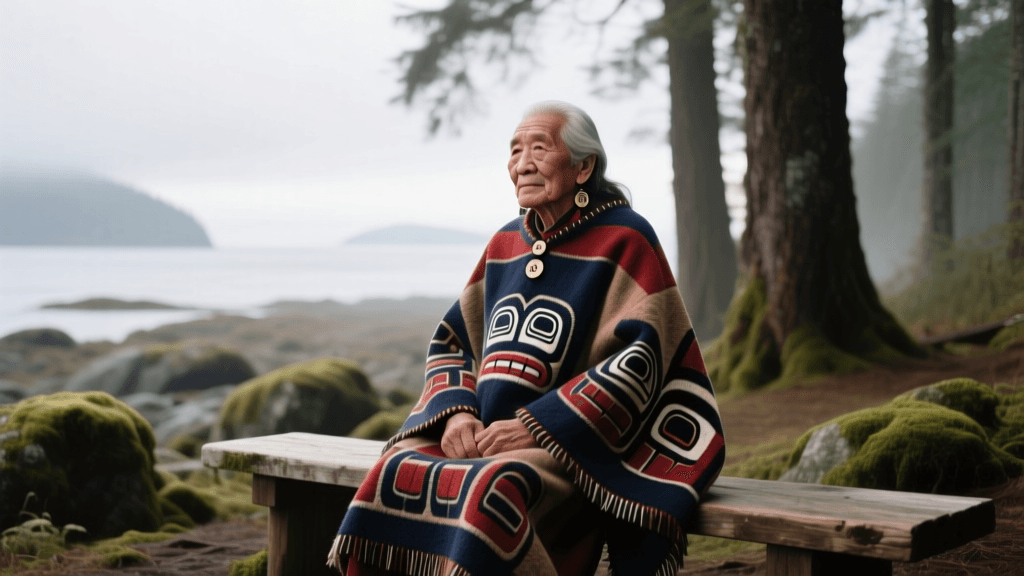
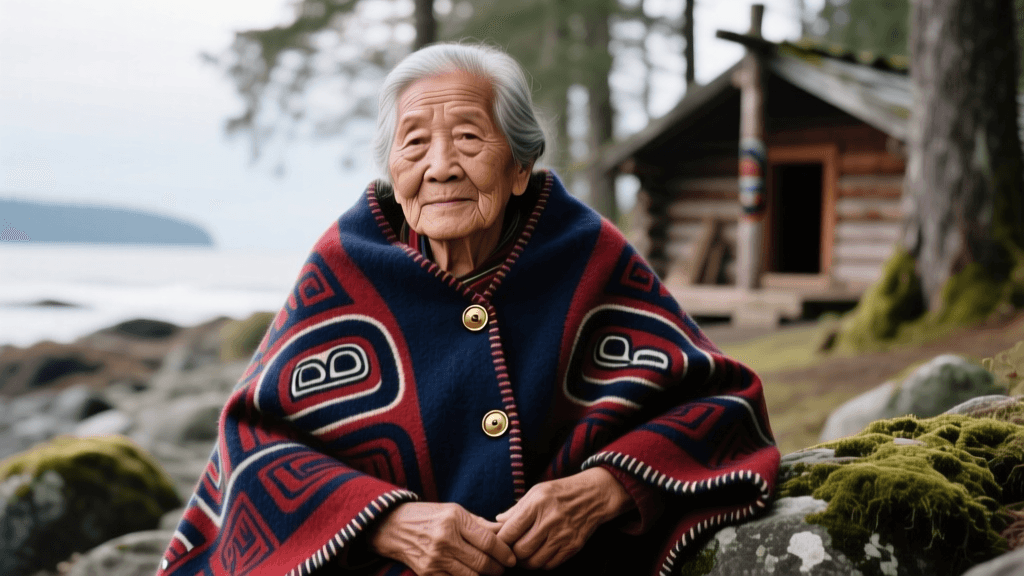
While Chilkat weaving relies on ancient, pre-contact techniques, the button blanket is a brilliant example of Indigenous adaptation and innovation. Emerging in the mid-19th century following the establishment of trade routes with European and American merchants, button blankets replaced the earlier woven cedar bark and mountain goat robes for everyday ceremonial use. The foundational garment is typically a heavy, dark wool blanket—historically sourced from the Hudson’s Bay Company or Pendleton Woolen Mills—adorned with intricate appliqué work in red flannel or broadcloth. The defining feature, however, is the incorporation of hundreds of gleaming abalone shell buttons, glass beads, and sometimes copper discs that catch the light of the fire during winter potlatches.
In 2026, button blanket makers are pushing the boundaries of the medium while strictly adhering to the rules of formline design and crest ownership. Contemporary artists are incorporating sustainable, locally milled wools, subtle LED lighting elements for dramatic dance performances, and laser-cut abalone inlays that allow for unprecedented precision in detailing the ovoids, U-forms, and split U-forms that make up the clan crests. The rhythmic clacking of the abalone buttons against one another during a dance is considered the voice of the ancestors, a sonic element that remains just as vital to the garment's purpose as its visual splendor.
Regional Variations in Formline and Regalia Design
While the foundational concepts of formline art and crest representation unite the Northwest Coast, distinct regional and tribal variations exist in how these elements are applied to regalia. Understanding these nuances is critical for anyone studying Indigenous North American dress traditions.
| Tribe / Nation | Primary Crest Motifs | Typical Color Palette | Distinctive Regalia Features |
|---|---|---|---|
| Tlingit | Raven, Eagle, Wolf, Bear, Killer Whale | Black, Red, Yellow-Green, White | Intricate formline appliqué, extensive use of abalone buttons, woven cedar bark hats. |
| Haida | Eagle, Raven, Bear, Frog, Dogfish | Bold Black and Red, minimal Yellow | Highly stylized, symmetrical formline, carved wooden frontlets attached to headpieces. |
| Tsimshian | Eagle, Beaver, Wolf, Killer Whale | Black, Red, Blue-Green, Yellow | Originators of Chilkat weaving, complex curvilinear designs, heavy use of mountain goat wool. |
Sourcing Authentic Materials in 2026
Sourcing authentic, sustainable materials remains one of the most pressing challenges for regalia makers in 2026. Mountain goat wool, essential for true Chilkat weaving, is heavily regulated by state and provincial wildlife agencies. Weavers must often rely on hunters who ethically harvest goats and carefully preserve the hides, or they must work with wildlife management programs that provide shed wool or hides from regulated population control measures. Yellow cedar bark must be harvested in the late spring when the sap is running, requiring weavers to travel to specific old-growth forests. The impact of climate change on the Pacific Northwest has altered the timing of these harvests, forcing artisans to adapt their ancestral calendars to shifting ecological realities.
The abalone shell, primarily harvested from the waters off the coast of California and Baja Mexico, faces its own supply chain hurdles. Due to overharvesting and marine heatwaves, wild abalone populations have struggled, making high-quality, large shells incredibly expensive. In response, many button blanket makers in 2026 are turning to sustainably farmed abalone or utilizing high-quality, ethically sourced mother-of-pearl and glass alternatives for less prominent sections of the blanket, reserving the most prized wild abalone for the eyes and joints of the central crest figure.
Protocol, Potlatches, and Wearing Regalia Today
It is imperative to understand that Northwest Coast regalia are not 'costumes' or mere clothing; they are legal documents, spiritual armor, and embodiments of ancestral rights. In Tlingit, Haida, and Tsimshian cultures, the right to wear a specific crest is inherited and strictly guarded. Donning a Chilkat robe or a button blanket during a potlatch or ku.éex (memorial ceremony) is a profound legal act that witnesses the transfer of names, the settlement of debts, and the honoring of the deceased. The garments are treated with immense respect; they are never placed on the floor, they are spoken to, and they are often ritually cleansed after being worn in the presence of heavy grief or spiritual conflict.
When a dancer wears a button blanket, the garment is considered to be alive. The dancer's movements animate the crest, allowing the Eagle to fly or the Bear to walk among the people. In 2026, the transmission of this protocol to younger generations is a primary focus of tribal cultural committees, ensuring that the spiritual weight of the garments is understood just as deeply as the technical skill required to create them.
Ethical Appreciation and Supporting Indigenous Artisans
The year 2026 has also seen significant strides in the repatriation of ancestral regalia from global institutions back to their communities of origin. The Smithsonian National Museum of the American Indian and regional institutions like the Burke Museum of Natural History and Culture in Seattle have increasingly partnered with tribal councils to facilitate the return of sacred garments. When ancestral robes return home, they are often greeted with elaborate ceremonies, fed, and sung to, before being carefully integrated back into the active ceremonial life of the clan or placed in state-of-the-art, climate-controlled tribal cultural centers.
The Indigenous North American dress traditions of the Pacific Northwest Coast stand as a testament to the resilience, adaptability, and profound artistic genius of the region's First Peoples. Whether it is the painstaking, meditative process of spinning mountain goat wool for a Chilkat robe, or the vibrant, rhythmic flash of a button blanket in the firelight, these garments bridge the ancient past and the dynamic present. As we look through 2026 and beyond, the continued revitalization of these textile arts ensures that the voices of the ancestors will continue to be seen, heard, and felt for generations to come. For those outside these cultures, the greatest way to honor these traditions is through education, ethical support of Indigenous artisans, and a deep respect for the sacred protocols that govern their creation and use.