Oaxacan Backstrap Loom Huipiles: 2026 Pricing & Authenticity Guide
The Enduring Legacy of Oaxacan Textile Arts in 2026
The traditional garments of Latin America represent a profound intersection of history, identity, and technical mastery. Among the most revered of these textiles is the Oaxacan huipil, a handwoven tunic-style garment that serves as a visual language for the indigenous Zapotec, Mixtec, and Nahua communities of southern Mexico. As we navigate the global textile market in 2026, the demand for authentic, ethically sourced indigenous garments has reached an all-time high. However, this surge in popularity has also brought an influx of mass-produced, machine-embroidered imitations that threaten the livelihoods of traditional artisans.
For collectors, cultural historians, and conscious consumers, understanding the nuances of Oaxacan backstrap loom weaving is no longer optional; it is essential. In 2026, artisanal cooperatives across Oaxaca have implemented new digital ledger certifications and expanded their direct-to-consumer networks, making it easier than ever to verify provenance and ensure fair compensation. This comprehensive guide will walk you through the intricate world of Oaxacan huipiles, detailing the magic of natural dyes, the mechanics of the backstrap loom, and the current market pricing for authentic pieces.
Cochineal: The Red Gold of the Americas
No discussion of Oaxacan textile arts is complete without examining cochineal (Dactylopius coccus), the parasitic scale insect native to the Americas that produces one of the most vibrant and colorfast natural red dyes in human history. Long before synthetic aniline dyes were introduced in the late 19th century, cochineal was a primary export of the Spanish colonies, prized by European royalty and the Catholic Church.
Today, in 2026, the revival of natural dyeing has become a cornerstone of the premium Oaxacan textile market. Artisans in regions like Teotitlán del Valle and Santo Tomás Jalieza cultivate nopal cacti to host the cochineal insects. The harvesting and drying process is labor-intensive, requiring thousands of insects to produce a single pound of dye. As of early 2026, the global price for premium, sun-dried Oaxacan cochineal has stabilized at approximately $180 to $220 USD per kilogram, reflecting both its agricultural scarcity and its high demand in the luxury sustainable fashion sector.
Master dyers manipulate the pH levels of the cochineal bath to achieve a spectacular spectrum of colors. By adding acidic lime juice, the dye shifts to a brilliant orange; by introducing alkaline wood ash or baking soda, it deepens into a rich, regal purple. When combined with natural indigo and iron mordants, weavers can achieve deep greens and blacks, allowing for the complex, polychromatic brocade patterns that define ceremonial huipiles.
Backstrap Loom vs. Pedal Loom: Understanding the Technique
To accurately assess the value of an Oaxacan textile, one must distinguish between the two primary weaving technologies used in the region: the pedal loom (telar de pedal) and the backstrap loom (telar de cintura).
The Pedal Loom
Introduced by the Spanish in the 16th century, the pedal loom is a large, stationary wooden frame operated by foot pedals. It allows for the rapid production of wide, continuous lengths of fabric, primarily used for rugs (tapetes), blankets, and rebozos. While pedal loom weaving requires immense skill and physical stamina, it is generally faster and yields wider textiles than the backstrap loom.
The Backstrap Loom
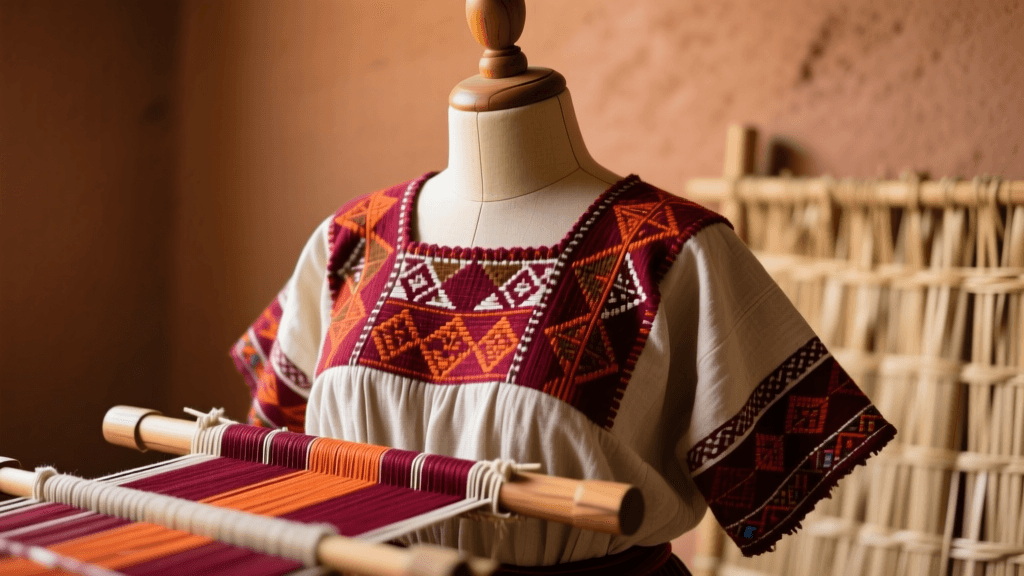
The backstrap loom is an ancient, pre-Columbian technology that remains the gold standard for traditional huipiles. The loom consists of a series of wooden sticks, with one end tied to a fixed post or tree and the other attached to a strap that wraps around the weaver's lower back. The weaver's own body provides the tension for the warp threads. This intimate connection between the artisan and the textile allows for unparalleled control over the warp, enabling the creation of intricate trama suplementaria (supplementary weft brocade).
Unlike embroidery, which is stitched onto a pre-woven fabric, brocade is woven directly into the cloth. The artisan uses a small stick to manually pick and raise specific warp threads, passing the colored weft thread through to create complex geometric and zoomorphic motifs. A single, heavily brocaded ceremonial huipil woven on a backstrap loom can take anywhere from three to eight months of daily labor to complete.
2026 Pricing Guide for Authentic Huipiles
The pricing of authentic Oaxacan huipiles in 2026 reflects the intense labor, the cost of natural materials, and the prestige of the weaving community. When purchasing directly from artisan cooperatives or verified ethical galleries, buyers should expect to pay prices that sustain the weaver's livelihood. Below is a comparative pricing chart based on current 2026 market data from verified Oaxacan textile collectives.
| Garment Type | Technique & Loom | Dye Profile | 2026 Market Price (USD) | Production Time |
|---|---|---|---|---|
| Daily Huipil (San Juan Colorado) | Backstrap, Cotton Brocade | Native Coyuche (Brown) & Indigo | $350 - $550 | 2 - 3 Months |
| Ceremonial Huipil (San Bartolo Yautepec) | Backstrap, Fine Silk/Cotton Blend | Cochineal, Indigo, Marigold | $800 - $1,400 | 4 - 6 Months |
| Wedding Huipil (San Pedro Amuzgos) | Backstrap, Gauze Weave with Brocade | White Cotton, Natural Dyes | $1,200 - $2,500+ | 6 - 9 Months |
| Commercial Rebozo (Pedal Loom) | Pedal Loom, Warp-faced | Mixed Natural & Synthetic | $120 - $250 | 1 - 2 Weeks |
How to Identify Authentic Handwoven Textiles
With the rise of 'artisanal-wash' fast fashion, distinguishing a genuine backstrap-woven huipil from a machine-made replica is a critical skill for buyers in 2026. Here are the primary indicators of authenticity:
- The Selvage Edge: True backstrap loom textiles feature finished selvage edges on all four sides. Because the warp is continuous and looped around the loom's end sticks, the fabric does not require cutting or hemming. If you see raw, cut edges or machine stitching along the sides, it is not a traditional backstrap textile.
- Warp Irregularities: Hand-spun and hand-dyed yarns possess natural variations in thickness and color saturation. Look closely at the warp threads; slight, rhythmic irregularities are the hallmark of human hands, whereas machine-woven fabrics are mathematically uniform.
- Brocade vs. Embroidery: Turn the garment inside out. In authentic brocade (trama suplementaria), the pattern threads float across the back of the fabric in distinct, horizontal skips. If the design is created by thousands of tiny, interlocking machine stitches that pierce the base fabric uniformly, it is machine embroidery.
- Olfactory Clues: Textiles dyed with natural materials often retain a faint, earthy scent. Cochineal may carry a slightly dusty, organic aroma, while indigo can smell faintly of fermentation or earth. Synthetic dyes often carry a chemical or petroleum-like odor, especially when warmed by the sun.
- Certification Tags: In 2026, the Oaxacan Ministry of Culture, in partnership with indigenous weaving cooperatives, has expanded the use of NFC-embedded 'Hecho a Mano' (Handmade) tags. Scanning these tags with a smartphone reveals the weaver's name, community, and the specific natural dyes used in the garment.
Ethical Sourcing and Supporting Artisan Cooperatives
The most effective way to combat cultural appropriation and ensure the survival of these ancient techniques is to purchase directly from artisan-owned cooperatives or verified ethical institutions. Organizations like the Museo Textil de Oaxaca play a vital role in preserving textile heritage, hosting archives of historical garments, and operating boutique spaces where 100% of the proceeds return to the weaving communities. Their ongoing exhibitions and educational programs remain the gold standard for understanding regional variations in Zapotec and Mixtec dress.
Furthermore, global advocacy groups such as Fashion Revolution continue to pressure international brands to disclose their supply chains, actively calling out companies that plagiarize indigenous Oaxacan designs without compensation or credit. As consumers, demanding transparency and choosing to invest in slow, indigenous-made fashion is a powerful act of cultural preservation.
For those looking to deepen their understanding of the cultural context surrounding these garments, the Smithsonian Center for Folklife and Cultural Heritage offers extensive digital archives and research papers detailing the socio-economic impact of textile cooperatives in Mesoamerica. By educating ourselves and paying fair market value, we ensure that the rhythmic clatter of the backstrap loom and the vibrant reds of Oaxacan cochineal continue to thrive for generations to come.