Crafting an Authentic Viking Smokkr and Kyrtill in 2026
The 2026 Renaissance of Norse Heritage Garments
As we navigate the historical crafting and living history landscape of 2026, the demand for uncompromising accuracy in Viking Age reenactment has reached an all-time high. Modern practitioners have moved far beyond the theatrical costumes of the early 2000s, embracing a rigorous, research-backed approach to textile reconstruction. Today, crafting a Norse kyrtill (under-tunic) and smokkr (apron dress) requires a deep understanding of historical agriculture, loom mechanics, and organic chemistry. This comprehensive guide will walk you through the precise methodologies, materials, and measurements needed to reconstruct high-status Viking Age women's garments using the most current 2026 heritage crafting standards.
Sourcing Heritage Wool: The Foundation of the Kyrtill and Smokkr
The foundation of any authentic Norse garment is the wool. Viking Age Scandinavians relied on dual-coated sheep breeds that produced both a soft, insulating undercoat (thel) and a long, water-resistant outercoat (tog). In 2026, the slow-fashion and heritage agriculture movements have made these ancient fleece types more accessible than ever, though prices have risen due to increased demand from historical textile artisans.
When sourcing wool for your kyrtill and smokkr, you must avoid modern, highly processed merino wools. Instead, seek out heritage breeds that closely mimic the archaeological textile record found in sites like Birka and Hedeby.
| Heritage Breed | Staple Length & Characteristics | Best Garment Use | 2026 Avg. Cost (Raw/Spun) |
|---|---|---|---|
| Icelandic Sheep | Dual-coated; Tog (up to 30cm), Thel (5-8cm) | Outer Smokkr, Cloaks, Weatherproofing | €35 / €110 per kg |
| Norwegian Spælsau | Dual-coated; Long, glossy outercoat, fine undercoat | High-status Kyrtill, Tablet Weaving Warp | €45 / €135 per kg |
| Gotland Pelt Sheep | Single-coated; Long, lustrous, grey/silver curls | Decorative Trims, Smokkr Panels, Hoods | €40 / €120 per kg |
| Shetland Sheep | Fine, soft, available in diverse natural moorit colors | Inner Kyrtill, Veils, Lightweight Undergarments | €30 / €95 per kg |
2026 Sourcing Tip: Connect directly with heritage breed conservancies in Scandinavia or the UK. Many artisan mills in 2026 now offer custom worsted and woolen spinning specifically calibrated to historical thread counts (e.g., Z-spun/S-spun combinations) for an additional premium.
Weaving the Diamond Twill (Kypert)
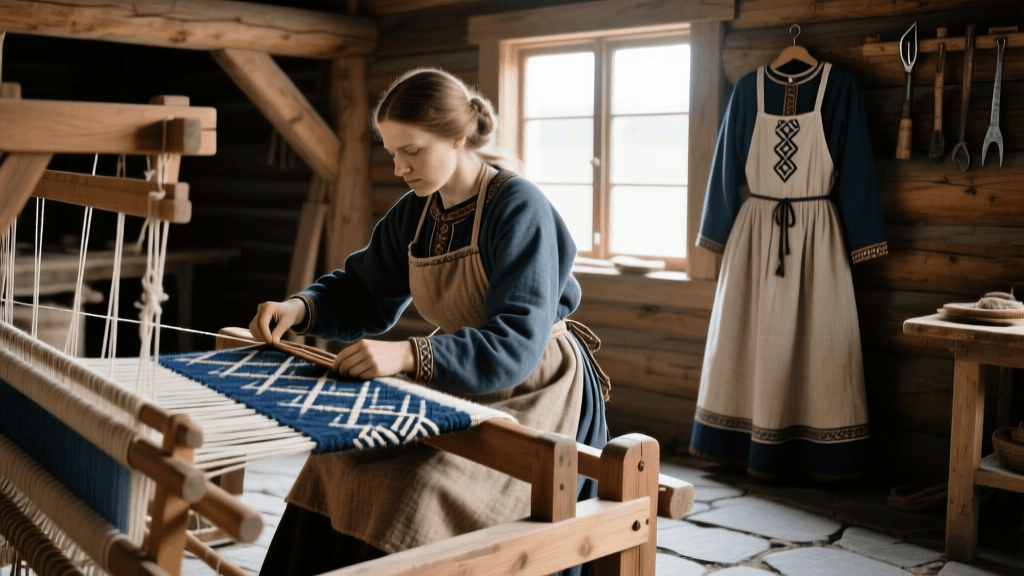
Archaeological finds from the Oseberg ship burial and the trading hub of Birka reveal a strong preference for diamond twill (known in Old Norse contexts as kypert). This weave structure creates a beautiful, textured geometric pattern that drapes elegantly and provides excellent insulation. According to extensive research preserved by the National Museum of Denmark, diamond twill was frequently used for high-status women's apron dresses, often woven with a Z-spun warp and S-spun weft to create a subtle optical shimmer.
Setting Up the Loom
While purists in 2026 continue to use reconstructed warp-weighted looms, many artisans utilize modern 4-shaft floor looms to achieve the historical 10-12 threads per centimeter density required for a weatherproof smokkr.
- Threading Draft: Use a pointed draft sequence: 1, 2, 3, 4, 3, 2. Repeat this across your entire warp width (typically 60-80 cm for a single smokkr panel).
- Tie-Up: Tie your treadles to shafts 1-2, 2-3, 3-4, and 4-1. This creates the continuous twill diagonal that reverses at the points.
- Treadling: Follow the exact same sequence as your threading: 1-2, 2-3, 3-4, 4-1, 3-4, 2-3. This produces the nested diamond motif.
- Beat and Density: Aim for 12 ends per cm (EPC) and 12 picks per cm (PPC). Use a heavy reed and beat firmly to ensure the fabric is dense enough to repel wind and light rain.
Natural Dyeing: Mastering Woad and Madder
Color was a powerful status symbol in the Viking Age. The most prized colors were deep blues derived from woad (Isatis tinctoria) and rich reds from madder (Rubia tinctorum). The Royal Botanic Gardens, Kew notes that woad cultivation has seen a massive resurgence in Europe by 2026, driven by sustainable agriculture initiatives and historical reenactors demanding authentic, non-toxic dye vats.
The 2026 Eco-Friendly Woad Vat
Historically, woad vats were fermented using urine or wood ash, a process that is impractical and unpleasant for modern home dyers. In 2026, the standard for historical accuracy combined with environmental safety is the fructose reduction vat.
- Extraction: If growing your own woad, harvest the leaves in late summer, soak in warm water (50°C), and whisk vigorously to oxygenate the liquid, precipitating the indigo pigment. For convenience, many 2026 artisans purchase pre-extracted woad pigment from heritage dye farms in France and Germany.
- The Vat: In a stainless steel pot, combine water, calcium hydroxide (to raise the pH to 9-10), and fructose powder as the reducing agent.
- Reduction: Heat the vat to exactly 50°C. Add your woad pigment. Stir gently, cover, and let it sit for 45 minutes. The liquid should turn a clear, yellowish-green, with a coppery sheen on the surface.
- Dyeing: Submerge your pre-scoured woolen kyrtill fabric. Leave it in the vat for 20 minutes. When you pull the fabric out, it will be yellow. As it hits the oxygen in the air, it will magically oxidize into a brilliant, authentic Norse blue.
"The shift toward botanical reduction vats in 2026 has allowed us to achieve the exact chemical signatures of Viking Age blues without the toxic heavy metals or harsh synthetics that plagued the reenactment community a decade ago." — Dr. Elinor Vance, Historical Textile Chemist.
Mordanting for Madder Red
To achieve the deep, blood-red tones seen in high-status Birka graves, use madder root. Madder requires a mordant to bind to the wool. Use a 15% weight-of-fabric (WOF) alum mordant, combined with 8% WOF cream of tartar to brighten the red. Simmer the wool at 85°C for an hour, then introduce the madder root. Keep the dye bath strictly below 70°C; if it boils, the red will turn muddy and brown due to the extraction of unwanted yellow tannins.
Tablet Weaving and Trim (Brikkevev)
No Viking Age smokkr is complete without intricate tablet-woven trim. In 2026, artisans have access to incredibly precise, laser-cut bone and horn tablets that replicate the exact thickness and friction of archaeological finds, allowing for tighter, more uniform weaving than the thick wooden cards of the past.
For a high-status apron dress, consider weaving a 3/1 twill tablet weave using 20/2 spun silk for the warp. The Oseberg ship burial yielded spectacular silk tablet weaves, proving that Norse elites traded extensively for luxury fibers. Set up 20 tablets, threaded in alternating S and Z directions to create a chevron or diamond pattern. Use a fine, tightly spun Spælsau wool for the weft, beating it in tightly with a bone or horn beater to completely hide the weft threads, resulting in a warp-faced band that is durable enough to withstand years of living history wear.
Assembly: The 2026 Consensus on Smokkr Construction
The construction of the smokkr has been the subject of intense academic debate for decades. However, by 2026, the consensus among leading textile archaeologists leans heavily toward the wrapped and pleated front panel design, heavily influenced by the re-evaluation of the Køge find and the tool placements in Birka graves.
Measurements and Cutting
- Back Panel: Cut a flat or slightly flared panel of diamond twill wool, measuring approximately 60 cm wide at the top and 90 cm long (falling to the mid-calf).
- Front Panel: Cut a wide rectangular panel (approx. 150 cm wide) of finely pleated or gathered wool. This panel wraps around the front and is secured by the brooches.
- Side Gores: Insert triangular gores into the side seams to allow for walking and sitting, ensuring the hem circumference reaches at least 200 cm.
- Shoulder Straps: Cut two straps of tablet-woven trim or folded wool, measuring 40-50 cm long, depending on your torso length.
Fastening with Tortoise Brooches
The garment is held together by a pair of oval, tortoise-shell style bronze brooches. When sourcing brooches in 2026, look for artisan bronze casters who use the lost-wax method based directly on 10th-century molds. Ensure the brooches feature a double-loop system on the back: one loop for the shoulder strap, and one for the front and back panels of the dress. Pin the straps securely, ensuring the tension is distributed evenly so the heavy wool does not tear over time.
Conclusion
Crafting a historically accurate Viking smokkr and kyrtill in 2026 is a profound journey into the past, bridging the gap between ancient Scandinavian ingenuity and modern sustainable crafting. By investing in heritage wools, mastering the diamond twill weave, and embracing the organic chemistry of woad and madder, you are not merely making a costume; you are resurrecting a tangible piece of European folk history. Whether you are preparing for the summer gathering at Lofotr or simply expanding your historical wardrobe, the dedication to these authentic techniques ensures that the legacy of Norse textile artistry continues to thrive in the modern era.