Nishijin vs Hakata Ori Kimono Obi Textile Guide 2026
The Soul of the Ensemble: Understanding Obi Textiles in 2026
In the intricate world of Japanese traditional garments, the kimono often captures the immediate gaze, but it is the obi (sash) that truly anchors the ensemble, dictating its formality, silhouette, and ultimate aesthetic. As we navigate the 2026 textile landscape, collectors, practitioners, and cultural preservationists are placing an unprecedented emphasis on textile provenance, weaving techniques, and sustainable artisanal practices. The choice between Japan’s two most prestigious obi textiles—Nishijin-Ori and Hakata-Ori—is not merely a matter of visual preference; it is a decision rooted in structural engineering, historical lineage, and practical wearability.
In 2026, the market for heritage textiles has evolved. With global silk supply chains stabilizing after the disruptions of the early 2020s, and with new Japanese government grants supporting young weavers, both Kyoto’s Nishijin and Fukuoka’s Hakata districts are experiencing a renaissance. However, understanding the distinct physical properties of these brocades is essential for anyone looking to invest in authentic, high-quality traditional garments this year.
Nishijin-Ori: Kyoto’s Brocade Masterpiece
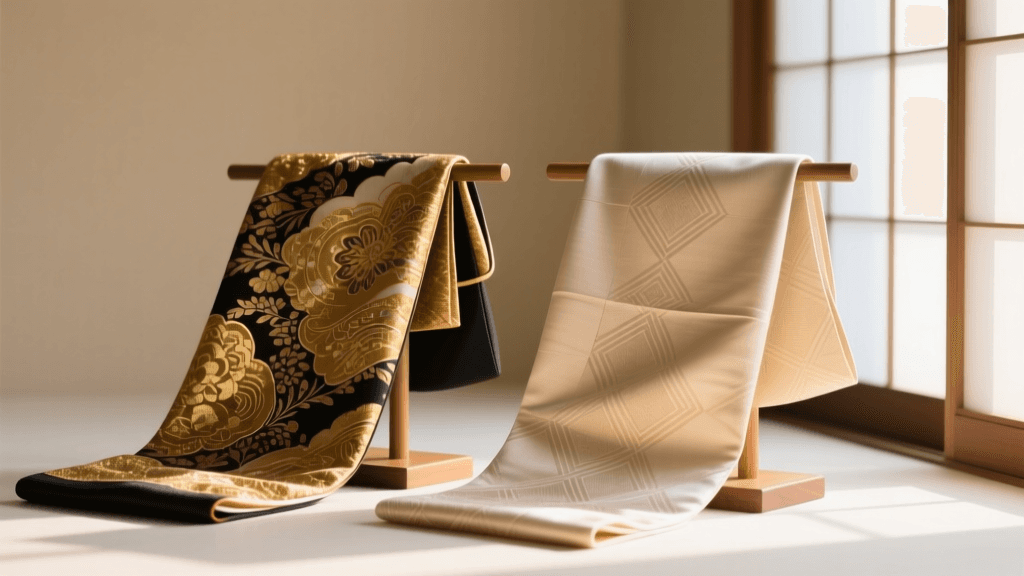
Nishijin-Ori is synonymous with opulence, complexity, and the imperial history of Kyoto. Unlike textiles that are woven first and dyed later, Nishijin-Ori is a yarn-dyed brocade. This means the silk threads are meticulously dyed before they ever touch the loom, allowing for the creation of extraordinarily complex, multi-colored pictorial patterns. According to the Nishijin Textile Industrial Association, the creation of a single premium Nishijin fukuro obi (the most formal type of women's sash) can involve over twenty distinct preparatory steps, from silk thread twisting to the punching of Jacquard loom cards.
In 2026, Nishijin weavers have increasingly integrated sustainably sourced, eco-certified mulberry silk with traditional metallic threads (such as kinran and ginran, or gold and silver leaf applied to paper and cut into thread). The resulting textile is heavy, sumptuous, and visually striking. Because the patterns are woven directly into the fabric, Nishijin-Ori possesses a distinct stiffness and a luxurious drape that holds elaborate knots beautifully. However, this structural rigidity means that Nishijin brocades require a skilled hand to tie, as the fabric resists tight folding and can be unforgiving of improper knotting techniques.
Hakata-Ori: Fukuoka’s Structured Elegance
While Kyoto’s Nishijin focuses on pictorial complexity, Fukuoka’s Hakata-Ori is celebrated for its structural integrity, geometric precision, and unique acoustic properties. Originating from the Hakata ward, this textile is characterized by its incredibly tight weave, achieved by using a high density of thin warp threads and a thicker, softer weft thread. The tension applied on the traditional shokki looms is so immense that the silk fibers compress tightly, creating a fabric that is remarkably durable and resistant to wrinkling.
The most famous hallmark of Hakata-Ori is its acoustic signature. When the fabric is tied or tightened, the compressed silk fibers rub against one another, producing a crisp, resonant sound known as shime. In 2026, this 'singing silk' remains a highly sought-after feature, particularly for formal men’s obi and martial arts practitioners who require a sash that will not loosen during rigorous movement. Furthermore, Hakata-Ori’s high friction coefficient makes it exceptionally forgiving for beginners learning to tie complex knots, as the fabric grips itself securely without the need for excessive tightening.
2026 Comprehensive Comparison Chart
To assist collectors and dressers in making informed purchasing decisions this year, we have compiled a detailed comparison of these two heritage textiles based on current 2026 market data and physical properties.
| Feature | Nishijin-Ori (Kyoto) | Hakata-Ori (Fukuoka) |
|---|---|---|
| Weave Structure | Complex Jacquard brocade, yarn-dyed, pictorial | Tight plain/twill weave, high warp density, geometric |
| Weight & Drape | Heavy, stiff, luxurious drape | Medium-heavy, highly structured, firm grip |
| Acoustic Profile | Muted, soft rustle | Distinct 'shime' (singing/crisp sound) |
| Best Suited Knots | Otaiko Musubi, Fukura Suzume | Bunko Musubi, Kaku Obi knots (men) |
| 2026 Avg. Retail Price (Fukuro) | ¥250,000 - ¥850,000+ | ¥120,000 - ¥350,000 |
| Formality Level | High to Highest (Ceremonial) | Medium to High (Versatile) |
Styling and Knots: Matching Textile to Technique
Choosing the right textile is only half the battle; understanding how the fabric behaves during the dressing process (kitsuke) is crucial for 2026 styling. If you are dressing in a formal kurotomesode or furisode and plan to tie an elaborate fukura suzume (sparrow knot) or a perfectly rounded otaiko musubi (drum knot), Nishijin-Ori is the traditional choice. The heavy gold and silver threads catch the light beautifully, and the stiffness of the brocade ensures the 'drum' of the knot maintains its architectural shape throughout a long event.
Conversely, if you are dressing for a tea ceremony, a summer festival, or if you are a student of kitsuke still mastering your tension control, Hakata-Ori is highly recommended. The natural friction of the Hakata weave acts as a built-in locking mechanism. When you pull the te (the decorative end of the knot) through the otaiko (the drum), the Hakata silk grips the underlying layers, preventing the dreaded 'sagging knot' that plagues many beginners. For men’s formal wear, the stiff, narrow Hakata kaku obi remains the undisputed standard in 2026, providing the necessary lower back support required when kneeling in seiza.
Sourcing Authentic Obi in the Modern Market
As the global appetite for vintage and authentic Asian traditional garments grows, the market has seen an influx of mass-produced, synthetic imitations. To ensure you are purchasing genuine heritage textiles in 2026, buyers must look for the official Traditional Craft Product designation. The Ministry of Economy, Trade and Industry (METI) strictly regulates this certification, requiring that the textile be hand-woven or produced on traditional looms, utilize historical techniques, and be manufactured in its designated region of origin.
When shopping online or visiting specialized boutiques in 2026, always request high-resolution macro photographs of the reverse side of the obi. A genuine Nishijin-Ori will show a complex, albeit slightly messy, interplay of floating weft threads on the back, indicative of its intricate Jacquard weaving. A genuine Hakata-Ori will feel remarkably dense and uniform, and the tension will be so tight that it is difficult to push a needle through the weave. Be wary of 'silk blend' obis marketed as heritage pieces; while modern blends offer easier care, they lack the acoustic and structural properties of pure, traditionally processed silk.
Preservation and Climate-Controlled Storage
Investing in a premium Nishijin or Hakata obi requires a commitment to proper preservation. The metallic threads in Nishijin brocades are particularly susceptible to oxidation and tarnishing if exposed to high humidity or airborne pollutants, while the dense silk fibers of Hakata weaves can develop permanent creases if stored improperly. In 2026, the standard for textile preservation has moved beyond simple cedar drawers.
Expert conservators recommend storing high-value obi in traditional kiri (paulownia wood) boxes, which naturally regulate moisture and repel insects. However, given the increasingly erratic seasonal humidity shifts observed in recent years, integrating smart home technology into your storage strategy is now best practice. Utilizing Wi-Fi-enabled hygrometers inside your storage space allows you to monitor the micro-climate in real-time via your smartphone. The ideal environment for 2026 silk preservation is a stable temperature of 18°C to 20°C (64°F to 68°F) with a relative humidity (RH) strictly maintained between 50% and 55%. If the RH drops below 45%, the silk fibers can become brittle and the metallic threads may snap; if it exceeds 60%, you risk the development of protein-eating mold and metallic tarnishing.
Final Thoughts on 2026 Textile Investments
Whether you are drawn to the pictorial majesty of Kyoto’s Nishijin-Ori or the structural, acoustic brilliance of Fukuoka’s Hakata-Ori, both textiles represent the pinnacle of Japanese weaving artistry. By understanding the distinct physical properties, current market valuations, and proper care requirements of these brocades, you can make informed, culturally respectful investments that will preserve the legacy of the kimono for generations to come.