Nishijin-ori vs Yuzen: Kimono Silk Craftsmanship Guide
The Pinnacle of Japanese Silk: An Introduction
When exploring the rich tapestry of Asian traditions, few garments command as much reverence as the Japanese kimono. At the heart of this iconic silhouette lies a world of extraordinary textile craftsmanship, dominated by two distinct and historically significant techniques: Nishijin-ori (brocade weaving) and Kyo-Yuzen (resist dyeing). For collectors, enthusiasts, and those looking to invest in authentic Japanese garments, understanding the nuanced differences between these two fabric types is essential. This guide delves deep into the looms and dye pots of Kyoto, offering actionable insights into sourcing, identifying, and caring for these masterpieces of silk craftsmanship.
Nishijin-ori: The Architecture of Woven Brocade
Nishijin-ori is not merely a fabric; it is an architectural marvel of textile engineering. Originating in the Nishijin district of Kyoto during the Heian period (794-1185), this weaving technique reached its zenith when local artisans integrated the French Jacquard loom during the Meiji Restoration. According to the Nishijin Textile Industrial Association, the production of a single Nishijin-ori obi (the sash worn with a kimono) can involve over twenty distinct specialized steps, from thread twisting and dyeing to the final weaving on complex jacquard looms.
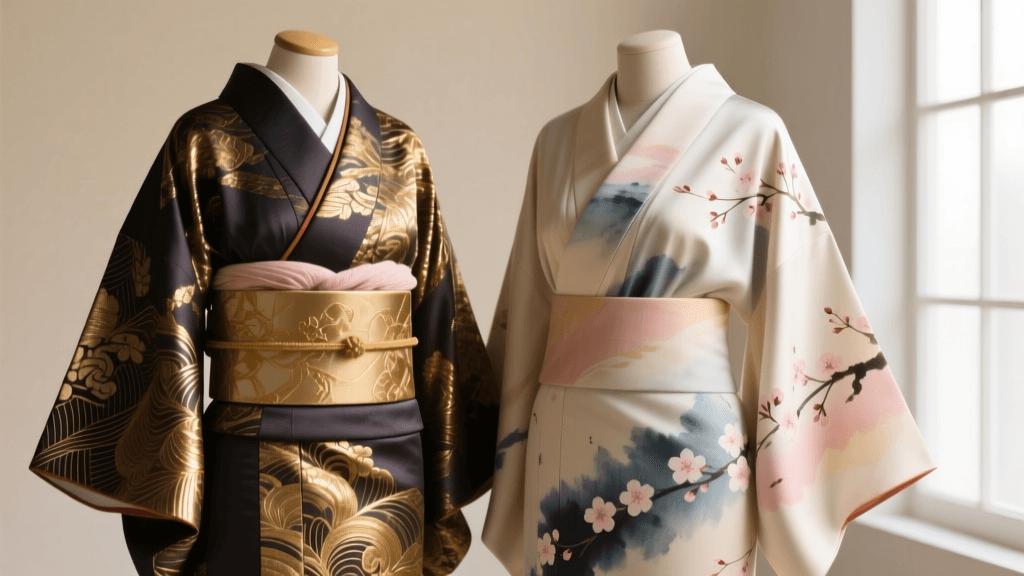
The hallmark of Nishijin-ori is its use of pre-dyed threads, often incorporating hikihaku (threads wrapped in delicate gold or silver leaf). The resulting fabric is thick, heavily textured, and incredibly durable. Because the pattern is woven directly into the structure of the cloth, the design is visible on both sides, though the reverse side typically shows a negative color palette.
Actionable Advice for Buyers
- Authentication: Run your fingers over the fabric. Authentic Nishijin-ori has a pronounced, raised texture. If the gold patterns are perfectly flat and printed, it is a modern synthetic imitation.
- Cost Expectations: A mass-produced, machine-woven Nishijin obi starts around ¥50,000 ($350 USD). However, a hand-woven, custom-commissioned Maru or Fukuro obi featuring pure gold thread will range from ¥500,000 to over ¥2,000,000 ($3,500 to $14,000 USD).
- Best Use Case: Due to its stiffness and weight, Nishijin-ori is primarily used for formal obi rather than the kimono itself, providing the necessary structural support for elaborate tying styles like the taiko musubi.
Kyo-Yuzen: The Painter’s Canvas in Silk
While Nishijin-ori relies on the structural interplay of threads, Kyo-Yuzen transforms silk into a fluid, wearable canvas. Developed in the late 17th century by Miyazaki Yuzensai, a fan painter from Kyoto, this technique revolutionized Japanese fashion by allowing for pictorial, free-flowing designs that were previously impossible with traditional weaving or tie-dyeing. The Kyoto Museum of Traditional Crafts highlights Kyo-Yuzen as one of Japan's most vital living crafts, characterized by its meticulous use of rice-paste resist.
The process begins with a master artisan sketching a design onto the silk using aobana (spiderwort flower) juice, which naturally washes away later. Next, a specialized resist paste called itome-nori is applied along the outlines using a small cone. This paste acts as a dam, preventing dyes from bleeding into adjacent areas. Once the resist dries, the artisan hand-paints the interior spaces with vibrant pigments, followed by steaming to fix the colors and rigorous washing in cold water to remove the paste.
Actionable Advice for Buyers
- Identifying Hand-Painted vs. Stencil: Look closely at the white outline separating colors. In authentic hand-painted Yuzen, the resist line (itome) is slightly raised and has organic, subtle variations in width. Stencil or digital prints will have perfectly uniform, flat lines.
- Cost Expectations: A high-quality, hand-painted Yuzen kimono (such as a Furisode for coming-of-age ceremonies) typically costs between ¥800,000 and ¥1,500,000 ($5,500 to $10,500 USD). Commissioning a bespoke piece from a living national treasure can exceed ¥3,000,000.
- Seasonality: Yuzen motifs are strictly governed by the seasons. Purchasing a kimono with cherry blossoms (sakura) is only appropriate for late March to early April. For year-round versatility, invest in auspicious motifs like cranes, pine, or geometric patterns.
Comparative Analysis: Woven vs. Dyed Silks
To make an informed acquisition, it is crucial to understand how these two techniques compare across practical metrics. The following table outlines the core differences to help you select the right fabric for your specific needs.
| Feature | Nishijin-ori (Brocade) | Kyo-Yuzen (Resist-Dyed) |
|---|---|---|
| Primary Technique | Jacquard Weaving (Pre-dyed threads) | Resist Dyeing & Hand-Painting |
| Visual Texture | Thick, raised, heavily textured | Smooth, fluid, soft drape |
| Typical Weight | Heavy (Ideal for Obi sashes) | Light to Medium (Ideal for Kimono bodies) |
| Price Range (USD) | $350 - $14,000+ (Per Obi) | $1,500 - $10,000+ (Per Kimono) |
| Maintenance Level | Moderate (Avoid moisture, spot clean) | High (Requires professional dry cleaning) |
Sourcing, Sizing, and Commissioning Guidelines
Purchasing traditional Japanese silk requires an understanding of standard measurements and the commissioning timeline. Unlike Western garments, kimono are not sold in standard sizes like small, medium, or large. Instead, they are crafted from a single bolt of fabric known as a tanmono.
A standard tanmono measures approximately 36 centimeters (14 inches) in width and 12 meters (13 yards) in length. This specific dimension dictates the maximum wingspan (sode-to-sode width) of the finished kimono. If you are commissioning a custom garment, the artisan will take your exact height, arm span, and hip measurements to determine how much fabric needs to be folded and stitched into the seams. For Western buyers, it is important to note that traditional tanmono widths can sometimes limit the final garment's circumference. If you require a larger size, artisans must weave a custom, wider bolt (habahiro tanmono), which adds significantly to the cost and lead time.
Timing and Lead Times
If you are buying off-the-rack in Kyoto boutiques, you can take your garment home immediately. However, commissioning a bespoke Nishijin-ori obi or a hand-painted Yuzen kimono is a slow fashion endeavor. Expect a lead time of 3 to 6 months for standard commissions, and up to 12 to 18 months if you are working with highly sought-after master artisans who maintain waiting lists. Plan your purchases well in advance of major life events like weddings or coming-of-age ceremonies.
Preservation and Maintenance of Luxury Silks
Both Nishijin-ori and Kyo-Yuzen require meticulous care to preserve their structural integrity and vibrant pigments. The Victoria and Albert Museum (V&A) notes that improper storage is the leading cause of degradation in historical and contemporary silk garments.
- Storage: Never store silk on wire hangers, as the weight of the garment will distort the shoulder seams. Fold the kimono along its original seam lines and wrap it in acid-free tatoushi (traditional Japanese paper). Store in a dark, dry wooden chest, ideally paulownia wood (kiri), which naturally regulates humidity and repels insects.
- Environmental Control: Avoid storing silk in plastic bags, as these trap moisture and emit chemical gases that can yellow the silk fibers over time. Silica gel packets can be placed in the corners of the storage chest, but ensure they do not directly touch the fabric to avoid localized drying and brittleness.
- Cleaning: Never attempt to wash a Yuzen or Nishijin garment at home. Water will cause the silk to shrink and the metallic threads to tarnish. Utilize a specialized Japanese dry cleaner who offers maru-arai (full garment cleaning) or shiminuki (expert spot treatment for specific stains like oil or sweat).
- Airing Out: Twice a year, during dry, cool autumn or winter days, remove your garments from storage and let them air out in a shaded, well-ventilated room for a few hours to prevent mold and musty odors.
Conclusion
Investing in Nishijin-ori and Kyo-Yuzen is an investment in centuries of Asian tradition, mathematical precision, and artistic brilliance. Whether you are drawn to the sculptural, golden elegance of a woven brocade obi or the poetic, painted landscapes of a Yuzen silk kimono, understanding the craftsmanship behind the cloth ensures that your collection will remain vibrant, authentic, and deeply meaningful for generations to come.