Nishijin-ori vs Yuzen: The Ultimate Kimono Fabric Guide
The Architectural Marvels of Japanese Silk
When discussing traditional Japanese garments, the kimono stands as an unparalleled masterpiece of textile engineering. However, to the untrained eye, the vast terminology surrounding kimono craftsmanship can be overwhelming. At the heart of Japanese sartorial heritage lies a fundamental dichotomy in fabric creation: the woven brilliance of Nishijin-ori and the painted elegance of Yuzen dyeing. Understanding the distinction between these two techniques is essential for collectors, cultural enthusiasts, and anyone looking to invest in authentic Japanese textiles. This guide explores the craftsmanship, pricing, and practical care of these legendary fabrics, providing actionable insights for navigating the world of high-end kimono.
Nishijin-ori: The Pinnacle of Woven Silk
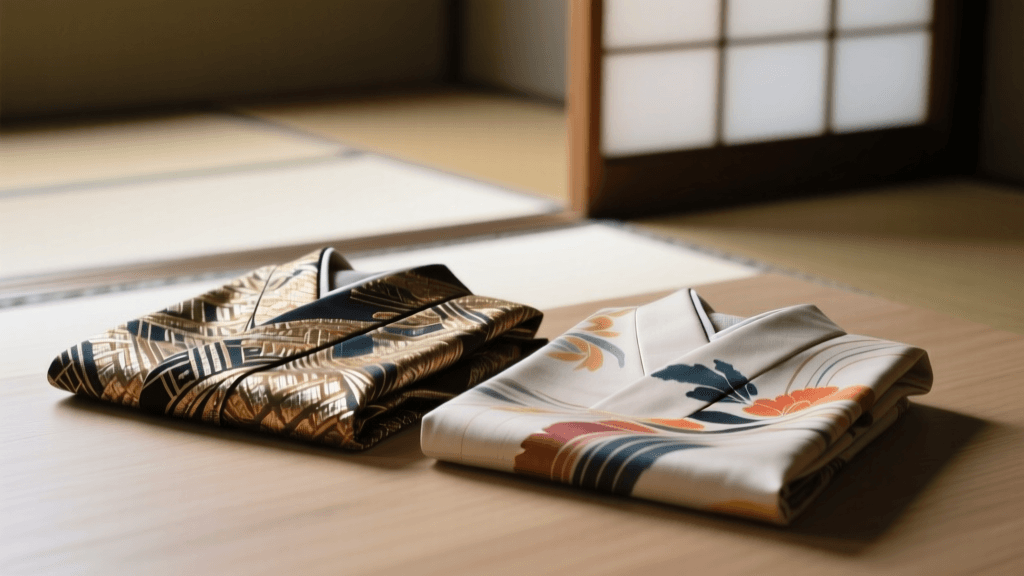
Nishijin-ori is not merely a fabric; it is a structural marvel originating from the Nishijin district of Kyoto. Unlike dyed fabrics where the pattern is applied to the surface of the cloth, Nishijin-ori patterns are intricately woven into the very foundation of the silk using pre-dyed threads. The craftsmanship involves a complex interplay of warp and weft, often incorporating metallic threads, gold leaf, and silver foil to create a three-dimensional, brocade-like texture.
The introduction of the Jacquard loom to Japan during the Meiji period revolutionized Nishijin weaving, allowing for larger, more complex motifs. Today, a master weaver may spend up to two months crafting a single high-end Fukuro obi (a formal bag sash). The resulting textile is notably heavy, stiff, and possesses a distinct acoustic rustle known as kinu-nari (the sound of silk).
Actionable Buying Advice for Nishijin-ori
- Product Focus: Nishijin-ori is most commonly and appropriately utilized for Obi (sashes) rather than the main kimono body, due to its stiffness and weight. Look for Fukuro obi or the ultra-formal Maru obi.
- Cost Expectations: A genuine, hand-loomed Nishijin Fukuro obi ranges from $2,500 to $8,000 USD. Vintage pieces from the mid-Showa era can be found for $300 to $800 USD, though the metallic threads may show oxidation.
- Authentication: Authentic pieces feature a certification stamp on the reverse side of the obi, issued by the Nishijin Weaving Industrial Association. According to the Japan National Tourism Organization, the Nishijin Textile Center in Kyoto remains the premier authority for verifying these traditional weaving certifications.
Yuzen Dyeing: The Canvas of Silk
If Nishijin-ori is architecture, Yuzen is fine art. Developed in the late 17th century by Miyazaki Yuzensai, this resist-dyeing technique transformed the kimono into a wearable canvas. The process begins with a master artist sketching a design directly onto the silk using a water-soluble blue flower juice (aobana). A glutinous rice paste (itome-nori) is then meticulously applied along the outlines to act as a resist barrier, preventing dyes from bleeding into adjacent areas.
There are two primary regional styles of Yuzen that collectors must know:
Kyo-Yuzen (Kyoto Style)
Kyo-Yuzen is characterized by its opulent, stylized, and highly decorative motifs. It frequently employs gold leaf (kimpaku), silver leaf, and intricate embroidery. The aesthetic is bold, aristocratic, and heavily associated with the courtly culture of Kyoto. It is the premier choice for formal Furisode (long-sleeved kimono for unmarried women) and Tomesode (formal kimono for married women).
Kaga-Yuzen (Kanazawa Style)
Originating from the Kanazawa region, Kaga-Yuzen is deeply rooted in naturalism. It strictly utilizes the Kaga Gosai (five traditional colors: indigo, crimson, yellow, green, and purple). A defining, actionable trait for identifying authentic Kaga-Yuzen is the presence of mushikui (depictions of bug-eaten leaves) and bokashi (meticulous color gradation from the edge of a motif toward its center). It avoids the heavy use of gold leaf, favoring a more subdued, samurai-class elegance.
Actionable Buying Advice for Yuzen
- Timing and Lead Time: Commissioning a custom, hand-painted Yuzen kimono is a test of patience. The multiple stages of steaming, washing, and drying require a lead time of 3 to 6 months.
- Cost Expectations: A hand-painted Kyo-Yuzen Furisode typically costs between $3,000 and $7,000 USD. Kaga-Yuzen garments, requiring immense technical skill for the bokashi shading, often start at $4,500 USD and can exceed $15,000 USD for master-level pieces.
Comparative Analysis: Woven vs. Dyed
To summarize the practical differences for buyers and collectors, refer to the structured comparison below:
| Feature | Nishijin-ori (Woven) | Kyo-Yuzen (Dyed) | Kaga-Yuzen (Dyed) |
|---|---|---|---|
| Primary Technique | Jacquard / Hand-loom Brocade | Rice-paste Resist & Gold Leaf | Rice-paste Resist & Gradation |
| Visual Texture | Heavy, raised, metallic sheen | Smooth, vibrant, highly decorative | Smooth, naturalistic, painterly |
| Typical Garment Use | Obi (Sashes), Haori jackets | Furisode, Tomesode, Houmongi | Houmongi, Iromuji, Komon |
| Price Range (USD) | $2,500 - $8,000 (Obi) | $3,000 - $7,000 (Kimono) | $4,500 - $15,000+ (Kimono) |
| Drape and Weight | Stiff, structural, heavy | Fluid, lightweight, elegant | Fluid, lightweight, elegant |
The Anatomy of a Kimono Bolt: Tanmono
Whether woven in Nishijin or dyed in Kanazawa, traditional kimono fabric is constructed from a standardized bolt known as a Tanmono. Understanding the Tanmono is crucial for anyone purchasing vintage fabrics or commissioning bespoke garments. A standard women's Tanmono measures approximately 36 centimeters (14 inches) in width and 12 meters (13.1 yards) in length.
This specific dimension is not arbitrary; it dictates the zero-waste cutting method of the kimono. The garment is constructed from straight, rectangular panels cut directly from the bolt without diagonal tailoring or curved seams. When purchasing antique silk, always verify the bolt width. Pre-World War II Tanmono can be as narrow as 32 centimeters, which may not provide adequate width for modern tailoring adjustments, limiting their use to creating Haori jackets or decorative textiles.
Preservation and Care: Maru-arai and Kiribako
Investing in high-end silk requires specialized maintenance. Traditional Japanese silk garments are never machine washed, and standard dry cleaning can strip the silk of its natural oils and ruin the stiffening agents in Nishijin-ori brocades.
Maru-arai (Traditional Full Wash)
The gold standard for kimono cleaning is Maru-arai, a meticulous process where the kimono is completely unstitched into its original rectangular panels, washed in specialized solvents, re-stretched on bamboo frames (shinshi), and then hand-sewn back together. This process restores the fabric's tension and removes invisible perspiration salts that cause long-term degradation. Expect to pay between $150 and $250 USD for this service, with a turnaround time of 3 to 4 weeks.
Kiribako (Paulownia Wood Storage)
Protein-based silk is highly susceptible to humidity fluctuations and insect damage. The traditional solution is the Kiribako, a chest crafted from solid Paulownia wood. Paulownia is naturally hygroscopic; it swells in high humidity to create an airtight seal against moisture and pests, and contracts in dry weather to allow the silk to breathe. A high-quality, domestically crafted Kiribako is an essential investment, costing between $500 and $1,500 USD. Always wrap the silk in Tatou-shi (acid-free, anti-moth paper) before placing it inside the chest.
Sourcing and Authentication in the Modern Market
Navigating the secondary market for vintage kimono requires a keen eye for textile integrity. As highlighted in the Victoria and Albert Museum's comprehensive Kimono exhibition, the evolution of these garments reflects broader socio-economic shifts in Japan, meaning that mass-produced, screen-printed imitations flooded the market in the late 20th century. To ensure you are purchasing genuine Yuzen or Nishijin, examine the reverse side of the fabric. Hand-painted Yuzen will show dye penetration to the reverse side of the silk, whereas cheap screen-printed imitations will leave the back stark white.
Furthermore, the Kyoto City Tourism Association emphasizes the importance of supporting certified artisan cooperatives. When buying new, always request the denshohyo (traditional craft certificate), a physical sticker or tag that guarantees the textile was handcrafted in Japan using approved, heritage methodologies. By understanding the profound technical differences between the loom and the dye brush, collectors and enthusiasts can build a garment atlas that truly honors the legacy of Japanese sartorial artistry.