Hanfu Travel Photography: Dynasty Styling & Locations
The Renaissance of Hanfu Travel Photography
Over the past decade, the Hanfu movement has transformed from a niche historical reenactment hobby into a mainstream cultural and fashion phenomenon. As noted by Sixth Tone, the revival of traditional Han Chinese clothing has sparked a massive boom in cultural tourism, with millions of young travelers donning historically inspired garments to explore ancient capitals, scenic water towns, and sacred mountains. For travel photographers and cultural enthusiasts, Hanfu offers an extraordinary opportunity to blend fashion, history, and landscape photography into a single, breathtaking visual narrative.
However, capturing the essence of Hanfu requires more than just pointing a camera at a beautiful garment. It demands an understanding of historical silhouettes, fabric behavior, and the synergy between the clothing and the environment. As highlighted in a feature by BBC Travel, the global fascination with these garments is deeply tied to their visual storytelling potential. This comprehensive guide will walk you through dynasty-specific styling, ideal travel destinations, and the technical photography skills required to elevate your Hanfu travel portfolio.
Matching Hanfu Dynasties to Travel Destinations
To create a cohesive and historically resonant visual story, it is crucial to match the specific dynasty's aesthetic with the appropriate architectural and natural landscapes. Below is a quick-reference chart for planning your Hanfu travel photography expeditions.
| Dynasty | Key Garment Style | Ideal Travel Destination | Best Season & Lighting |
|---|---|---|---|
| Tang (618–907 AD) | Qixiong Ruqun (Chest-high skirt), Pibo (Silk shawl) | Xi'an (Datang Everbright City, Giant Wild Goose Pagoda) | Spring/Autumn; Golden Hour & Night Lanterns |
| Song (960–1279 AD) | Beizi (Open-front coat), Baidi (Pleated skirt) | Hangzhou (West Lake, Lingyin Temple) | Early Summer/Morning; Overcast & Soft Diffused Light |
| Ming (1368–1644 AD) | Mamianqun (Horse-face skirt), Aoqun (Standing collar jacket) | Beijing (Forbidden City, Temple of Heaven) | Winter/Autumn; Mid-day Sun & High Contrast |
Tang Dynasty (618–907 AD): Opulence in Xi'an
The Tang Dynasty represents the golden age of cosmopolitan China, characterized by bold colors, expansive silhouettes, and profound cultural exchange along the Silk Road. The quintessential Tang garment is the Qixiong Ruqun, a chest-high tie skirt paired with a short-sleeved or long-sleeved top, often draped with a Pibo (a long, flowing silk shawl). The aesthetic is voluptuous, vibrant, and unapologetically grand.
Location & Styling: Xi'an, the ancient capital of Chang'an, is the ultimate backdrop for Tang Hanfu. The Datang Everbright City pedestrian district, with its massive Tang-era replica architecture and thousands of red lanterns, provides a cinematic environment. For styling, opt for rich jewel tones like crimson, emerald, and gold. Makeup should feature the traditional Huadian (forehead floral applique) and bold, sweeping eyebrows. According to Wikipedia's comprehensive guide to Hanfu, Tang styles frequently incorporated exotic motifs and wider sleeves, making them perfect for dynamic, sweeping photography.
Photography Tip: Shoot during the blue hour (just after sunset) when the sky turns deep indigo and the warm tungsten lanterns illuminate the subject's face. Use a fast prime lens (like an 85mm f/1.4) to isolate your subject and turn the distant lanterns into beautiful, creamy bokeh.
Song Dynasty (960–1279 AD): Minimalist Elegance in Hangzhou
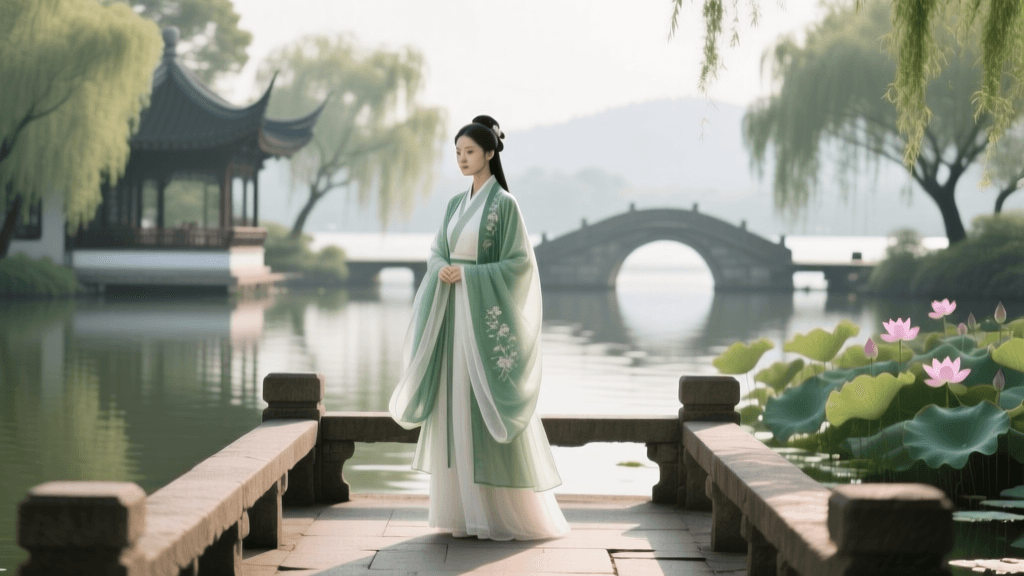
In stark contrast to the extravagance of the Tang, the Song Dynasty embraced intellectualism, restraint, and minimalist elegance. The silhouettes are slender and vertical, heavily featuring the Beizi (a long, open-front coat with side slits) worn over a delicate pleated skirt. The color palette shifts toward muted, natural tones: celadon, pearl white, pale lotus pink, and ink blue.
Location & Styling: Hangzhou's West Lake, with its weeping willows, misty waters, and ancient stone bridges, perfectly mirrors the poetic restraint of Song aesthetics. The Su Causeway in the early morning mist is an iconic shooting location. Keep accessories minimal—perhaps a single jade hairpin or a bamboo fan. The makeup should be fresh and dewy, occasionally incorporating subtle pearl accents on the cheeks, reflecting the refined taste of the Song literati.
Photography Tip: Overcast days are your best friend for Song Dynasty shoots. The soft, diffused light flatters the delicate, lightweight fabrics (like chiffon and thin silk) without blowing out the highlights. Use a 35mm or 50mm lens to capture the subject interacting with the natural environment, emphasizing the harmony between humanity and nature.
Ming Dynasty (1368–1644 AD): Regal Silhouettes in Beijing
Ming Dynasty Hanfu is characterized by its structured, regal, and heavily layered silhouettes. The most famous garment is the Mamianqun (horse-face skirt), featuring flat panels at the front and back with deep, intricate pleats on the sides, often woven with gold or silver threads (Zhijin). Tops frequently feature standing collars and elaborate metal buttons, projecting an air of dignity and formality.
Location & Styling: Beijing's imperial architecture, particularly the striking red walls and golden roof tiles of the Forbidden City or the sweeping marble terraces of the Temple of Heaven, provides a majestic canvas for Ming Hanfu. The heavy brocades and structured collars stand up well to the crisp, cold air of a Beijing autumn or winter. Pair the outfit with a plush, fur-lined cloak (Doupeng) for winter shoots, adding both historical accuracy and visual texture.
Photography Tip: The stiff, structured fabrics of the Ming Dynasty catch the light beautifully. Look for harsh, directional mid-day sunlight to create deep shadows and highlight the metallic threads woven into the skirts. A circular polarizer filter is essential here to cut the glare off the silk and enhance the saturation of the imperial red walls.
Essential Wardrobe Prep and Travel Logistics
Traveling with traditional garments requires meticulous planning. Hanfu consists of multiple layers, delicate ties, and easily wrinkled fabrics. Whether you are renting from a local studio or bringing your own collection, proper preparation is the difference between a frustrating shoot and a masterpiece.
- The Base Layer: Always pack skin-tone, seamless undergarments. For chest-high skirts, a strapless tube top or a traditional Moxiong (tube-shaped undergarment) is mandatory to prevent wardrobe malfunctions and provide a smooth foundation.
- Wrinkle Management: Silk and linen wrinkle the moment you look at them. Pack a portable, handheld garment steamer. Irons are often too harsh and can scorch delicate embroidered threads.
- The Emergency Kit: Bring double-sided fashion tape (crucial for securing overlapping collars), safety pins, and small binder clips to temporarily tailor waistbands that are too loose for modern, smaller frames.
- Footwear: Traditional embroidered cloth shoes (Xinggou) are beautiful but lack arch support for cobblestone streets. Pack a pair of comfortable, neutral-colored modern slip-ons for walking between locations, changing into the traditional shoes only when the camera is rolling.
Camera Gear and Technical Settings
Capturing the intricate details of Hanfu—such as the delicate embroidery on a Ming collar or the translucent drape of a Song sleeve—requires the right technical approach. While modern smartphone cameras are capable, a dedicated mirrorless or DSLR system offers the necessary control.
Lenses: A 70-200mm f/2.8 telephoto zoom is invaluable for travel photography in crowded tourist sites like the Forbidden City. It allows you to compress the background, isolate your subject, and crop out modern distractions like exit signs and tourists. Conversely, a 35mm f/1.4 is perfect for environmental storytelling in the quiet bamboo groves of Hangzhou.
Shutter Speed & Movement: Hanfu is designed to be in motion. The long sleeves and flowing skirts require a fast shutter speed to freeze the fabric gracefully. Set your shutter speed to at least 1/500th of a second when the model is twirling or tossing a sleeve. If you want to capture a dreamy, ethereal blur in the Pibo (silk shawl), drop the shutter to 1/60th and use a neutral density (ND) filter to maintain a wide aperture in bright daylight.
Posing and the Art of Movement
Static, rigid posing contradicts the very nature of traditional Chinese clothing. Hanfu tailoring relies on flat cutting and geometric draping, meaning the garment only truly comes alive when the wearer moves. Instruct your model to walk slowly toward the camera, look over their shoulder, or gently interact with props like paper umbrellas, folding fans, or willow branches.
"In traditional Chinese aesthetics, there is a concept known as Liubai—the art of leaving blank space. In Hanfu photography, this means allowing the negative space of the landscape to breathe alongside the flowing lines of the garment, rather than filling every pixel with the subject."
Encourage the model to use their hands to manipulate the fabric. Gently lifting the front panel of a Mamianqun while walking up stone steps, or allowing the wind to catch the wide sleeves of a Tang top, creates organic, painterly compositions reminiscent of classical ink wash paintings.
Conclusion
Hanfu travel photography is a deeply rewarding pursuit that bridges the gap between ancient artistry and modern visual storytelling. By understanding the historical nuances of the Tang, Song, and Ming dynasties, matching them with their rightful architectural landscapes, and employing thoughtful photographic techniques, you can create images that are not only visually stunning but culturally resonant. As the global appreciation for Asian traditions continues to grow, your lens has the power to document and celebrate the living, breathing legacy of Han Chinese sartorial heritage.