Nishijin Ori Weaving: Inside Kyoto's Kimono Artisan Workshops
The Legacy of Nishijin-ori: Kyoto's Crown Jewel of Textiles
When discussing the pinnacle of Japanese traditional garments, the conversation inevitably turns to the textiles that bring them to life. Among these, Nishijin-ori (Nishijin weaving) stands as the undisputed mastercraft of Kyoto. Renowned for its opulent brocades, intricate patterns, and unparalleled durability, Nishijin-ori is the premier fabric used for high-end kimono and obi (sashes). According to the Ministry of Economy, Trade and Industry (METI), Nishijin-ori is officially designated as a Traditional Craft Product of Japan, a title reserved for artisanal practices that have been continuously maintained for over a century and rely heavily on manual, traditional techniques.
The name 'Nishijin' translates to 'Western Camp,' a direct reference to the devastating Onin War (1467-1477) which split Kyoto into eastern and western military factions. The weavers who fled the city during the conflict returned to the western camp area after the war, establishing the weaving district that still bears the name today. As detailed by The Metropolitan Museum of Art's Heilbrunn Timeline of Art History, Japanese textiles evolved significantly during the Muromachi and Edo periods, with Nishijin weavers absorbing continental techniques and refining them into distinctly Japanese aesthetic expressions, characterized by heavy, multi-colored weft-patterned brocades.
The Division of Labor: A 20-Step Masterpiece
Unlike many regional crafts where a single artisan oversees a piece from raw material to finished product, Nishijin-ori operates on a highly specialized division of labor. A single obi can require the collaboration of over twenty distinct artisans, each a master of a specific micro-process. This system ensures absolute perfection at every stage but also means that the loss of a single specialized artisan can disrupt the entire supply chain.
Core Stages of Production
- Zuan (Design): The process begins with a textile designer who drafts the pattern on specialized graph paper, calculating the exact warp and weft thread intersections.
- Nenshi (Thread Twisting): Raw silk threads are twisted to specific tensions. The degree of twist dictates the fabric's final texture and drape.
- Senshoku (Dyeing): Threads are dyed before weaving (yarn-dyeing), allowing for complex, multi-colored patterns. Artisans use both traditional plant dyes and modern chemical dyes for colorfastness.
- Seikei (Warping): Thousands of warp threads are aligned with microscopic precision. A single error here will ruin the final pattern.
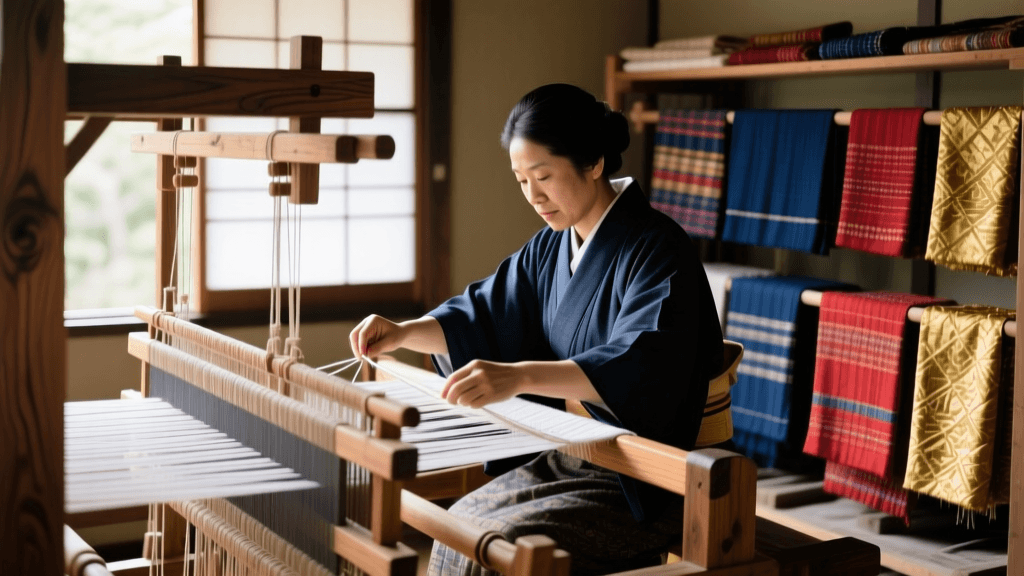
- Shokki (Weaving): The actual weaving is done on traditional handlooms or modern Jacquard looms. The most complex brocades still require hand-weaving, where the artisan uses a shuttle to pass the weft thread while simultaneously manipulating individual warp threads with a bamboo pick.
Understanding Nishijin Textile Classifications
For collectors and kimono enthusiasts, understanding the specific classifications of Nishijin textiles is crucial when evaluating quality and price. The table below outlines the primary types of Nishijin-ori you will encounter in Kyoto workshops and department stores.
| Textile Type | Japanese Name | Characteristics | Primary Use |
|---|---|---|---|
| Gold Brocade | Kinran | Woven with flattened gold-leaf paper or metallic threads. Extremely stiff and luxurious. | Formal Maru and Fukuro Obi |
| Silver Brocade | Ginran | Similar to Kinran but uses silver-leaf threads. Offers a cooler, more subdued elegance. | Formal Obi, Noh Theater Costumes |
| Patterned Weave | Mon-ori | Features subtle, tone-on-tone patterns woven directly into the silk without metallic threads. | Everyday Kimono, Haori, Accessories |
| Pongee | Tsumugi | Woven from pre-dyed, slubbed silk threads. Has a rustic, textured feel despite high quality. | Casual Kimono, Nagoya Obi |
Experiencing Artisan Workshops in Kyoto
Visiting a Nishijin workshop is a highlight for anyone interested in Asian traditions and textile arts. The Kyoto City Official Travel Guide highly recommends dedicating at least half a day to exploring the Nishijin district, located just north of the Kyoto Imperial Palace. Here is a practical guide to the best workshop experiences available.
1. The Nishijin Textile Center (Public Exhibition)
This is the most accessible starting point for international visitors. The center offers free admission to its museum floors, which display historical garments, including exquisite Heian-period court costumes (Junihitoe). Practical Details:
- Location: Horikawa-dori, Imadegawa, Kamigyo Ward.
- Cost: Free entry; Kimono rental and weaving experiences range from 1,500 to 5,000 JPY.
- Timing: Open daily 9:00 AM to 5:00 PM. Allocate 2 hours.
- Highlight: The daily live demonstrations of hand-weaving and the traditional 'Yusuri' (thread twisting) technique.
2. Hosoo Flagship Store & Gallery (Luxury Retail & Cafe)
Founded in 1688, Hosoo is arguably the most famous Nishijin-ori brand today. Their modern flagship store in Nakagyo Ward is an architectural marvel that blends traditional machiya aesthetics with contemporary design. Practical Details:
- Location: Nakagyo Ward, near Karasuma-Oike Station.
- Cost: Free to browse the gallery; Cafe items start around 1,000 JPY.
- Highlight: The basement gallery often hosts rotating exhibitions of rare, museum-quality obi. The on-site cafe serves matcha in cups wrapped in custom Nishijin textiles.
3. Private Atelier Tours (Advanced Enthusiasts)
For serious collectors, booking a private tour through a specialized cultural concierge (such as Kyoto-based artisan tour operators) allows access to small, family-run weaving sheds. These ateliers often specialize in a single technique, such as Kara-ori (Chinese-style weave used for Noh costumes). Etiquette & Advice: Always book at least 4 weeks in advance. Photography is usually strictly prohibited inside private weaving sheds to protect proprietary pattern designs. Bring cash if you intend to purchase small accessories directly from the weaver.
A Collector's Guide to Purchasing Nishijin-ori
Buying authentic Nishijin-ori requires an understanding of sizing, certification, and pricing. Whether you are purchasing a full-length obi or a small decorative piece, use this actionable advice to ensure you are getting a genuine artisan product.
Verifying Authenticity
Look for the official Traditional Craft Product Certification sticker issued by METI. This gold and red seal guarantees that the item was woven in the designated Nishijin district using traditional silk threads and manual processes. Without this seal, the item may be a mass-produced, machine-made imitation from overseas.
Measurements and Pricing Tiers
- Fukuro Obi (Formal Sash): Measures approximately 30 cm wide by 420 cm long. A genuine hand-woven Nishijin Fukuro Obi featuring Kinran (gold brocade) will typically start at 300,000 JPY (approx. $2,000 USD) and can exceed 2,000,000 JPY ($13,500 USD) for master-weaver pieces.
- Nagoya Obi (Semi-Formal/Casual Sash): Measures 30 cm by 360 cm, pre-folded and stitched for easier tying. Prices range from 80,000 JPY to 250,000 JPY depending on the complexity of the Mon-ori pattern.
- Accessories: For budget-conscious collectors, Nishijin artisans produce exquisite small items. Neckties, wallet pouches, and spectacle cases range from 3,000 JPY to 15,000 JPY. These make excellent, authentic souvenirs that support the local weaving economy.
Preserving the Craft: Challenges and Modern Innovations
Despite its prestige, the Nishijin weaving industry faces a severe existential threat. The average age of a master weaver in Kyoto is now over 65, and the grueling physical nature of hand-weaving, combined with the long apprenticeship required, has led to a sharp decline in young successors. Furthermore, the decreasing daily use of kimono in Japan has shrunk the domestic market.
However, the artisans are not surrendering. To survive, Nishijin workshops are pivoting toward international luxury markets and interior design. Brands like Hosoo have successfully collaborated with global fashion houses such as Dior and Chanel, integrating Nishijin brocades into haute couture collections and luxury hotel interiors. By adapting their ancient techniques to modern, global aesthetics while maintaining the rigorous standards of their ancestors, Kyoto's kimono artisans are ensuring that the rhythmic clatter of the Nishijin loom will echo through the streets of Kyoto for generations to come.
Whether you are a textile scholar, a kimono collector, or a cultural traveler, stepping into a Nishijin workshop offers a profound connection to the living history of Japanese fashion. It is a reminder that behind every breathtaking silk garment lies a vast, invisible network of dedicated human hands.