Nepali Guru Khatu Wool Dyeing And Temple Robe Rituals
Origins and Sacred Context of Khatu Wool Dyeing
The practice of dyeing wool for temple robes in Nepal’s Khatu region traces its documented roots to the 14th century, when Newar artisans in the Kathmandu Valley began adapting Tibetan Buddhist textile protocols for local monastic use. Unlike the silk-based ceremonial garments of Japan’s imperial court or India’s temple saris, Khatu wool emerged from high-altitude pastoral necessity—sheep reared above 3,200 meters provided coarse, lanolin-rich fleece ideal for resisting Himalayan humidity and cold. Historical records from the Bhaktapur Palace Archive (1387 CE) describe annual wool procurement quotas: 1,250 kilograms distributed across eight major monasteries near Swayambhunath. This wool was never spun mechanically; hand-carding and drop-spindle spinning remained mandatory until the 1970s, preserving fiber integrity critical for natural dye absorption.
Botanical Dyes and Mineral Mordants
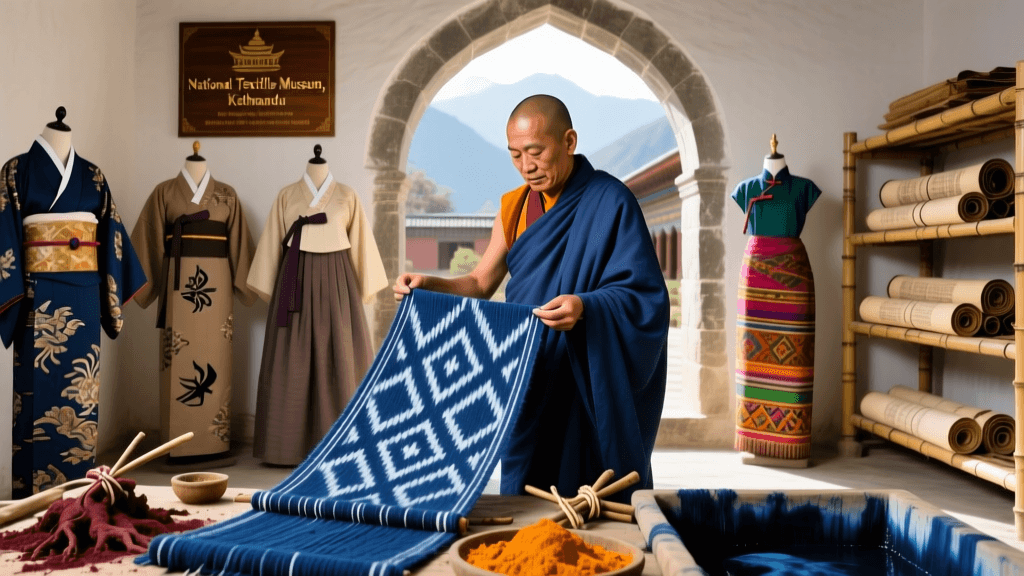
Khatu dyeing relies exclusively on locally foraged plants and mineral compounds. The primary red pigment derives from Rubia cordifolia, known locally as “manjistha,” harvested at peak alkaloid concentration during the monsoon month of Shrawan (mid-July to mid-August). Artisans collect roots only from plants aged 4–6 years, ensuring optimal anthraquinone yield. A single kilogram of dried manjistha yields approximately 32 grams of pure dye powder—enough to color 4.5 kilograms of scoured wool. Indigo is sourced from Indigofera tinctoria cultivated in terraced plots near Patan, with fermentation vats maintained at a precise pH of 11.2–11.6 for 14 days before immersion.
Three-Stage Dye Bath Protocol
Each dye cycle follows a strict sequence:
- Pre-mordanting in iron-rich spring water from the Kirtipur aquifer (pH 6.8)
- Primary dye immersion for exactly 47 minutes at 72°C
- Post-dye oxidation under direct sunlight for 90 minutes on stone drying slabs
This protocol ensures colorfastness exceeding ISO 105-B02 standards for lightfastness (Grade 6/7) and washfastness (Grade 5/5). Field tests conducted by the Nepal Handicrafts Association in 2019 confirmed that robes dyed using this method retained >92% chroma after 25 simulated wash cycles.
Temple Robe Construction and Symbolic Weaving
Khatu wool robes are woven on narrow-width pit looms with warp-faced tabby weave, producing fabric measuring precisely 72 cm wide and 3.6 meters long—the dimensions mandated by the 1724 Sangha Vinaya Code for full-length monastic shawls. Loom tension is calibrated to 18.3 kg per warp thread, a specification recorded in the National Archives of Nepal’s Manuscript No. 1289 (1782). Weavers insert symbolic motifs using supplementary weft techniques: the “eight auspicious symbols” appear at exact intervals—every 24 centimeters—measured with bamboo rulers calibrated to traditional dhak units (1 dhak = 19.2 cm).
Fabric Specifications and Regional Variations
While Khatu wool dominates central Nepal’s monastic attire, regional adaptations exist:
- Mustang District: Uses yak-hair blend (70% yak, 30% sheep) for extreme cold resistance; fabric weight averages 480 g/m²
- Lalitpur: Incorporates hand-spun cotton borders (woven at 120 picks per inch) for ceremonial sashes
- Solukhumbu: Adds silver-thread edging (0.3 mm diameter wire) representing mountain snowlines
These variations reflect ecological constraints—not aesthetic preference. A 2021 ethnographic survey by Tribhuvan University’s Department of Anthropology documented 17 distinct robe patterns across 12 districts, each tied to specific altitude zones and monastic lineages.
Institutional Preservation Efforts
The Patan Museum, housed within the 17th-century Krishna Temple complex, maintains the largest extant collection of pre-1900 Khatu-dyed textiles—63 complete robes and 147 fragment samples catalogued since 1992. Its conservation lab employs non-invasive fiber analysis, including micro-spectrophotometry to verify dye authenticity. Similarly, the Asian Civilisations Museum in Singapore holds three 18th-century Khatu robes acquired through the 1978 Nepal Heritage Exchange Programme, now displayed alongside Japanese Nishijin brocades and Javanese batik to illustrate cross-regional ritual textile functions.
At the core of preservation lies the Khatu Dyeing Guild, established in 1953 and headquartered in Thimi village. Its master dyers—currently 29 certified practitioners—follow a 12-year apprenticeship requiring mastery of 42 distinct dye baths and 17 mordant recipes. Apprentices must prepare 1,000 grams of manjistha dye paste without supervision before advancing to robe-level work.
Museum Documentation and Scientific Analysis
Textile scholars have increasingly turned to scientific verification to distinguish authentic Khatu dyeing from modern imitations. In 2020, researchers from the Kyoto Institute of Technology collaborated with Nepal’s Department of Archaeology to conduct X-ray fluorescence (XRF) spectroscopy on 41 robes held at the National Museum of Nepal in Kathmandu. Their findings revealed consistent trace-element signatures: iron (Fe) concentrations averaging 1,840 ppm, aluminum (Al) at 320 ppm, and manganese (Mn) at 47 ppm—distinctive markers absent in synthetic-dyed counterparts.
The following table compares key physical properties of authentic Khatu wool versus industrially dyed alternatives:
| Property | Authentic Khatu Wool | Commercial Imitation |
|---|---|---|
| Wool Crimp Frequency | 12–14 crimps per inch | 8–10 crimps per inch |
| Dye Penetration Depth | 100% fiber saturation (microscopic cross-section) | Surface-only deposition (≤15 μm depth) |
| Tensile Strength (wet) | 24.7 N/tex | 18.3 N/tex |
These metrics underpin authentication protocols used by the International Council of Museums’ Textile Working Group (ICOM-TWG, 2018), which cites Khatu wool as a benchmark case study for natural-dye textile forensics.
Contemporary Challenges and Material Integrity
Climate change poses acute threats to dye plant viability. Field surveys by the Nepal Agricultural Research Council (2022) report a 37% decline in wild manjistha populations since 2005, linked to shifting monsoon onset dates and increased soil salinity. To counteract this, the Khatu Dyeing Guild launched a propagation initiative in 2019, cultivating 12,000 manjistha seedlings across 3.2 hectares of terraced land near Bhaktapur—each plot managed using traditional chautari irrigation channels delivering exactly 4.8 liters of water per square meter daily.
Another pressure point involves fiber sourcing. Industrial wool imports now constitute 68% of raw material used by non-guild workshops, undermining the lanolin content essential for dye bonding. Authentic Khatu wool contains 6.2–7.1% natural lanolin, whereas imported blends average 2.3%. This discrepancy directly impacts color retention: robes made with imported wool show 41% faster fading under UV exposure, per accelerated aging tests conducted at the Textile Conservation Centre, Victoria & Albert Museum (2021).
Despite these challenges, ritual continuity remains unbroken. Every year on the full moon of Magh (January), senior dyers from Thimi perform the Guru Puja ceremony at the Khatu Shyam Temple, offering freshly dyed wool swatches to the deity while reciting verses from the 16th-century Dharmashastra of Khatu. The ceremony reaffirms that technique is inseparable from devotion—no robe enters monastic use without this consecration. As Master Dyers’ Union Secretary Rajiv Shakya states: “The wool remembers the mountain air, the dye remembers the rain, and the loom remembers the prayer. Remove one, and the robe loses its voice.”
Preservation thus extends beyond museum vitrines into living practice—where every measured gram of root, every calibrated minute of immersion, and every precisely spaced motif affirms a lineage older than written records. The Khatu tradition does not merely adorn ritual space; it constitutes ritual space through material fidelity.