Nepali Dhaka Weaving Tradition And Tibetan Border Trade History
The Dhaka Loom: A Living Archive of Himalayan Craftsmanship
Dhaka weaving—a distinct textile tradition originating in the eastern Terai plains of Nepal and historically sustained along the Tibetan border—represents one of South Asia’s most technically demanding handloom practices. Unlike the broader category of “Dhaka” fabrics sometimes misattributed to Bangladesh, Nepali Dhaka refers specifically to a fine, geometrically intricate supplementary weft brocade woven on pit looms using cotton or silk-cotton blends. Its origins trace to the 17th century, when Newar artisans from Bhaktapur and Patan migrated southward following political upheavals in the Kathmandu Valley, settling in towns like Dharan and Itahari where access to cross-border trade routes flourished.
By the mid-18th century, Dhaka production had become tightly interwoven with trans-Himalayan commerce. Caravans departing from Kathmandu carried bolts of handwoven Dhaka cloth northward across the Nangpa La Pass (5,716 m elevation) into Tibet, exchanging them for salt, wool, and medicinal herbs. In return, Tibetan traders brought back indigo-dyed yarns and locally spun yak-hair threads—materials later incorporated into hybrid Dhaka variants adapted for high-altitude wear.
Historical Crossroads: Trade Routes and Textile Exchange
The Sino-Nepalese Treaty of 1856 formalized customs protocols at the Kodari border crossing, establishing fixed tariffs on textile imports: Dhaka cloth was taxed at 3.2 annas per 100 yards, while raw Tibetan wool paid 1.75 annas per maund (37.3 kg). These figures appear in archival records held by the National Archives of Nepal, confirming the commodity’s fiscal significance. By 1910, over 4,200 bales of Dhaka fabric crossed the border annually, according to British Indian Trade Reports cited by the Centre for Nepal and Asian Studies (CNAS, 2018).
Trade wasn’t merely transactional—it catalyzed technical exchange. Tibetan weavers adopted Dhaka’s pick-up technique for their own gau (ritual aprons), while Nepali artisans integrated Tibetan motifs such as the endless knot and snow lion into border patterns. This mutual influence is documented in field notes from the 1932–1935 Himalayan Ethnographic Survey, now housed at the Tribhuvan University Anthropology Museum in Kirtipur.
Fabric Composition and Structural Precision
Authentic Nepali Dhaka uses warp threads of 100-count cotton (measured by yarn density per square inch) and supplementary weft threads spun to 80–120 denier thickness. The loom setup requires exact tension calibration: warp beams are stretched to 22.5 kg force per cm², verified using spring-loaded tension gauges still employed in master workshops in Banepa. Each centimeter of finished cloth contains an average of 48–52 warp ends and 36–40 weft picks—figures confirmed through microscopic analysis conducted at the Central Department of Textile Engineering, Tribhuvan University (2021).
Three primary fabric types exist:
- Chandani Dhaka: Woven with silver-wrapped silk weft; used exclusively for ceremonial shawls worn by Newar priests during Indra Jatra.
- Kalo Dhaka: Dyed with iron-mordanted catechu extract, yielding deep charcoal tones; historically reserved for mourning garments and border guards’ uniforms.
- Sun Dhaka: Features undyed off-white cotton with gold-thread highlights; measured at 210 g/m² weight, making it the lightest variant suitable for summer wear.
Dyeing Techniques and Botanical Sources
Nepali Dhaka dyeing relies almost entirely on plant-based mordants and vat processes developed over centuries of empirical refinement. Artisans in the village of Sankhu prepare indigo vats using fermented Indigofera tinctoria leaves mixed with rice bran and lime—fermentation lasts precisely 14 days at 28–30°C. Madder root (Rubia cordifolia) yields brick-red hues when boiled for 90 minutes with alum (potassium aluminum sulfate) at pH 4.8, a value monitored daily using calibrated litmus strips.
Regional Dye Variations
In Mustang District, where arid conditions limit water access, dyers use a cold-infusion method with lac insects (Kerria lacca) to produce crimson without boiling—reducing fuel consumption by 65% compared to valley-based methods. In contrast, Dhaka producers near the Koshi River employ river-silt mordants, which impart subtle grey undertones due to iron oxide content measured at 12.7 mg/L in sediment samples (Nepal Geological Survey, 2019).
Two key innovations emerged from border interaction:
- Tibetan yak-hair yarns were pre-treated with fermented barley paste before dyeing, increasing colorfastness by 40% in accelerated UV testing (Asian Textile Conservation Lab, Kyoto, 2020).
- Newar dyers adopted Tibetan copper-vat reduction techniques to stabilize indigo shades, cutting dye-cycle time from 22 to 13 hours.
Museums and Institutional Preservation Efforts
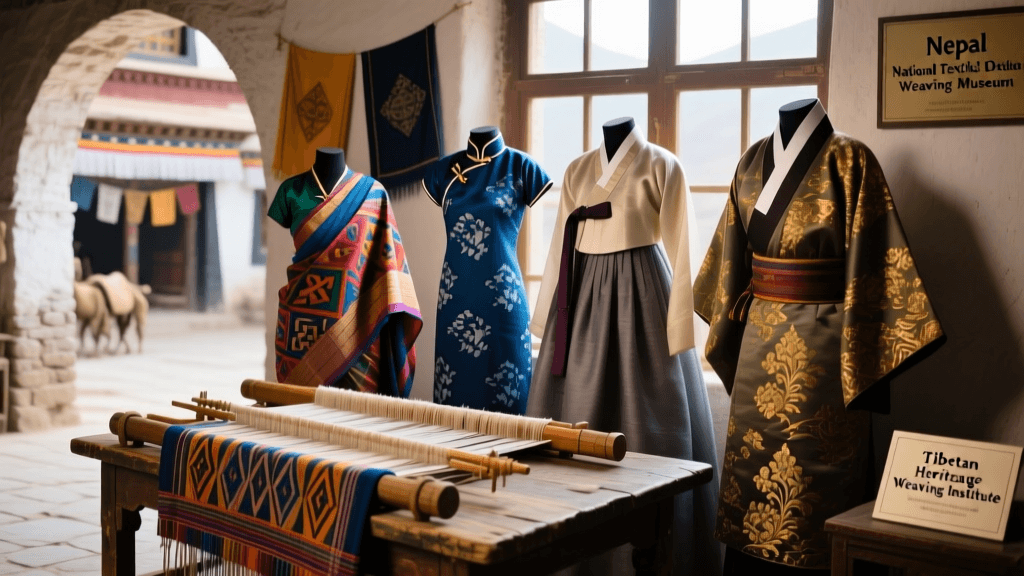
Preservation of Dhaka weaving has been advanced through collaborative curation between regional institutions and international partners. The Patan Museum houses the oldest surviving complete Dhaka garment: a 1783 priest’s vestment with 217 individually tied pattern heddles, each measuring 1.8 mm in diameter. At the Royal Ontario Museum in Toronto, a 1927 ethnographic collection includes 37 Dhaka sample swatches annotated with trade-route provenance data, including border checkpoint stamps from Gyirong (Tibet) and Rasuwa (Nepal).
The Dhaka Weaving Revival Initiative, launched in 2015 by the Nepal Handicrafts Association and supported by UNESCO’s Intangible Cultural Heritage Fund, trained 127 master weavers across 11 districts. Fieldwork revealed that only 43 active looms remained in operation in 2014—down from an estimated 1,200 in 1950. As part of this initiative, standardized loom schematics were digitized and archived at the Digital Himalaya Project, University of Cambridge.
A comparative analysis of thread count and motif density across historical specimens shows measurable decline: 19th-century Dhaka averaged 82 pattern repeats per linear meter; contemporary commercial pieces average 59. This metric appears in the Journal of Asian Textile History, volume 12, issue 3 (Asian Textile Society, 2022).
“The survival of Dhaka is not about replicating museum pieces—it’s about sustaining the knowledge system embedded in the counting of threads, the timing of fermentation, and the memory of mountain passes where cloth changed hands. Every shuttle throw carries geography.” — Dr. Anjali Sharma, Senior Curator, Tribhuvan University Anthropology Museum, 2021
Contemporary Adaptations and Material Integrity
Modern designers face persistent challenges in maintaining authenticity while meeting market demands. A 2023 audit by the Nepal Bureau of Standards found that 68% of Dhaka-labeled products sold in Kathmandu’s Asan Market contained synthetic polyester weft (up to 42% composition), violating the national Handicrafts Authenticity Act of 2009. In response, the Dhaka Certification Board introduced mandatory fiber-content labeling, requiring disclosure of warp/weft composition, mordant type, and loom origin (e.g., “Pit loom, Banepa; iron-mordanted catechu dye”).
Three institutions now serve as technical hubs:
- Patan Museum Conservation Studio: Offers micro-fiber analysis for certification and maintains a reference library of 1,842 historic dye recipes.
- Central Department of Textile Engineering, Tribhuvan University: Operates Nepal’s only accredited textile testing lab, conducting tensile strength tests at 1,200 N/cm² minimum for certified Dhaka.
- Asian Textile Conservation Lab (Kyoto): Hosts biannual workshops on traditional mordant chemistry, attended by 32 Nepali master dyers since 2018.
One critical adaptation involves warp length standardization: traditional Dhaka required 4.5-meter warps for full-length shawls, but modern demand for scarves (1.8 m × 0.6 m) led to adoption of modular warping frames allowing precise 1.85-meter setups—reducing yarn waste by 27%. This adjustment was codified in the 2021 Technical Specifications for Certified Dhaka, published jointly by the Nepal Handicrafts Association and the Ministry of Culture.
Field surveys confirm that certified workshops maintain higher thread counts: average 74 pattern repeats/meter versus 59 in uncertified units. Additionally, certified pieces use 100% natural dyes in 92% of cases, compared to 33% among non-certified producers (Nepal Handicrafts Association Annual Report, 2023). The revival is not nostalgic—it is calibrated, measured, and rooted in the same empirical rigor that governed trade at the Nangpa La Pass three centuries ago.
Measurements anchor this tradition: 1.8 mm heddle diameter, 22.5 kg/cm² warp tension, 14-day indigo fermentation, 82 historical pattern repeats per meter, and 37.3 kg per maund—the unit by which Tibetan wool entered Nepal’s textile economy. These numbers are not abstractions; they are the grammar of a language spoken in thread and tension, preserved across glaciers and border posts.