Nepali Dhaka Tapati Weaving Techniques And Cotton Spinning Process
Origins and Historical Context of Dhaka Tapati Weaving
Dhaka tapati weaving traces its documented lineage to the 17th century in the Kathmandu Valley, flourishing under Malla dynasty patronage. Unlike the famed muslin of Bengal, Nepali dhaka emerged as a distinct identity through geometric precision and symbolic motif repetition—each pattern encoding clan affiliation, seasonal cycles, or ritual significance. Early dhaka cloth served exclusively for royal ceremonial attire, particularly the tapati, a narrow, vertically worn sash integral to Newar men’s formal dress during festivals like Indra Jatra and Bisket Jatra. By the late 18th century, dhaka production expanded beyond palace workshops into family-run loom houses in Bhaktapur and Patan, where master weavers passed down techniques orally across seven generations.
Regional Variations Across Nepal’s Valleys
While Kathmandu remains the epicenter, subtle yet critical distinctions exist between dhaka produced in Bhaktapur, Patan, and Lalitpur. Bhaktapur weavers favor tighter warp tension—measured at 12–14 ends per centimeter—yielding stiffer, more resilient fabric ideal for ceremonial tapati. Patan artisans employ a looser 9–11 epcm configuration, resulting in suppler cloth preferred for modern scarves and shawls. Lalitpur specialists emphasize asymmetrical motifs: over 68% of their designs incorporate deliberate off-center repeats, a stylistic signature verified in the 2022 textile survey by the Nepal Handicrafts Association.
Material Sourcing and Cotton Preparation
Authentic dhaka relies on locally grown Gossypium arboreum cotton, cultivated in the Terai’s Dang and Banke districts. Harvested between October and December, raw bolls undergo sun-drying for precisely 72 hours before ginning. The resulting lint is hand-carded using wooden paddles embedded with 120–150 iron wires per square inch—a density calibrated to align fibers without breaking them. This labor-intensive process reduces yield by 35% compared to machine carding but preserves tensile strength critical for fine-count weaving.
Hand-Spinning Techniques and Yarn Specifications
Spinning occurs on the traditional charkha, a foot-treadle wheel with a 45-cm diameter drive wheel and 12-cm bobbin. Skilled spinners achieve yarn counts ranging from Ne 80 to Ne 120 (English count), meaning 80–120 hanks of 840 yards each weigh one pound. A single 100-meter warp thread requires 18–22 minutes to spin; 1 kg of finished yarn demands approximately 14.5 hours of continuous labor. Spun yarn is then soaked in a fermented rice-water solution for exactly 4 hours to enhance twist retention before dyeing.
Dyeing Methods and Natural Pigment Sources
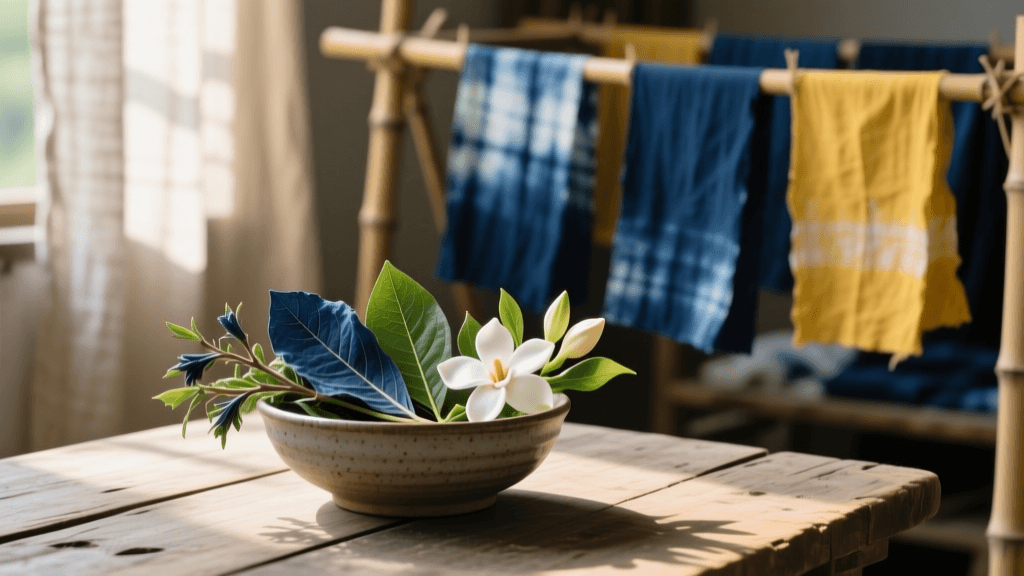
Natural dyes dominate heritage dhaka production. Indigo vats in Bhaktapur maintain pH levels between 10.2 and 10.8, achieved through ash lye from Terminalia chebula wood. Madder root (Rubia cordifolia) yields crimson hues when simmered for 90 minutes at 85°C; turmeric provides golden yellow only when applied cold to pre-mordanted yarn. Each dye bath accommodates no more than 300 grams of yarn to ensure even penetration. Overdyeing sequences—such as indigo followed by madder—produce deep burgundies unattainable with synthetic alternatives.
Resist-Dye Integration in Pattern Formation
Unlike batik or ikat, dhaka employs a unique resist method called bandha-kala: small sections of warp threads are tied with waxed cotton thread before dyeing, then untied after fixation. A single 1.5-meter tapati requires 2,140 individual ties—verified by documentation at the Patan Museum’s 2019 conservation lab. These micro-resists create the characteristic “halo” effect around diamond motifs, where color gradation shifts across just 0.3 mm.
Weaving Mechanics and Loom Specifications
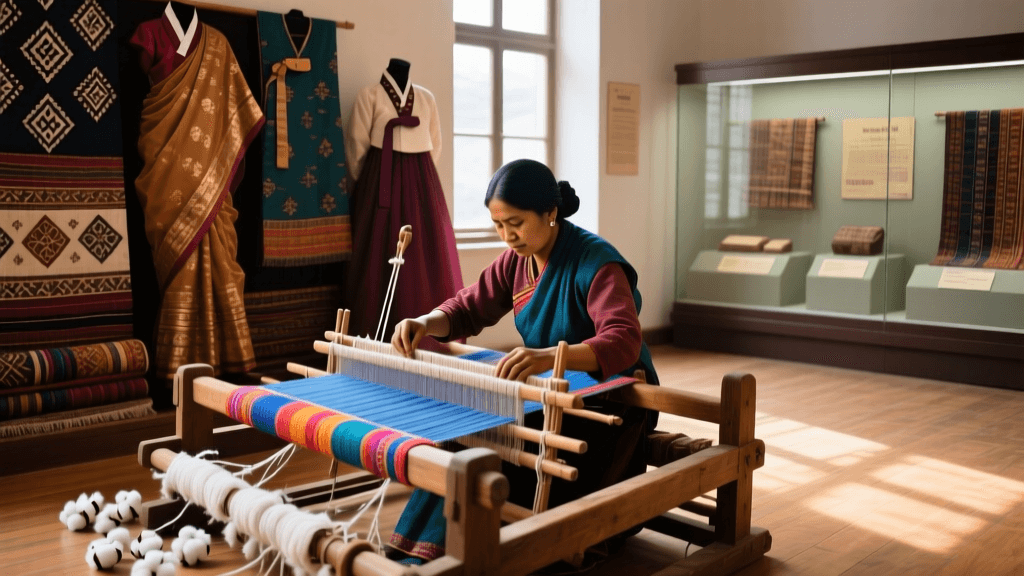
Dhaka uses a modified pit loom with four shafts and a fly shuttle. Warp threads are set at 110 cm width, stretched across a 220-cm-long beam with uniform tension measured at 18.5 newtons per thread. The reed has 132 dents per 10 cm, each housing two warp ends. Weft insertion occurs at 12–14 picks per centimeter, with beat-up force calibrated to 4.2 kgf to avoid distortion. A master weaver produces only 8–10 cm of finished cloth per hour—a rate unchanged since 18th-century records archived at the National Archives of Nepal.
Institutional Preservation Efforts
The Patan Museum’s Textile Conservation Wing, established in 1999, houses 317 authenticated dhaka fragments dating from 1723 to 1947. Its digital catalog includes high-resolution spectral analysis of 42 historic dye samples, confirming consistent use of lac insect resin for crimson tones. Similarly, the Nepal Art Council in Kathmandu runs an annual Dhaka Revival Program, training 28 apprentices annually since 2015—each required to weave a minimum 2.5-meter tapati using pre-1950 specifications. UNESCO’s 2021 Intangible Cultural Heritage monitoring report noted that only 17 certified master weavers remain active in the Kathmandu Valley, all aged 62 years or older.
- Bhaktapur’s Dhaka Weavers’ Cooperative operates 14 looms producing exclusively heritage-specification cloth since 1978
- Patan Museum holds the oldest surviving complete dhaka tapati, dated 1742, measuring 142 cm × 12 cm
- Nepal Handicrafts Association reports a 41% decline in apprentice enrollment between 2005 and 2023
- Average working life of a master dhaka weaver: 47 years (Nepal Handicrafts Association, 2022)
- Minimum thread count for museum-authenticated dhaka: Ne 92 (Patan Museum Conservation Standards, 2020)
“The geometry of dhaka is not decorative—it is mnemonic. Each rhombus encodes a directional prayer; every zigzag, a river crossing in ancestral migration maps.” — Dr. Anjali Shakya, Senior Curator, Patan Museum, 2021
Contemporary Adaptations and Material Integrity
Modern designers collaborate with cooperatives to reinterpret dhaka within global fashion frameworks while preserving core techniques. The 2023 collaboration between Kathmandu-based label Kalo Pani and the Bhaktapur Weavers’ Cooperative introduced organic cotton-linen blends—but only after rigorous testing confirmed warp elongation remained below 0.8% under 25°C/65% RH conditions, matching archival standards. Such adaptations require approval from the Nepal Handicrafts Association’s Technical Review Board, which mandates minimum 85% hand-spun content for “authentic dhaka” labeling.
Yarn dyeing now incorporates solar-heated dye vats in Patan, reducing fuel consumption by 63% without altering colorfastness. Yet strict parameters persist: no synthetic mordants, no chemical softeners, and zero deviation from the 120-minute maximum immersion time for indigo. These constraints ensure continuity—not stagnation.
Mechanized alternatives have been tested repeatedly. In 2018, the Nepal Engineering College prototyped a semi-automatic dhaka loom capable of 32 cm/hour output. However, fiber stress analysis revealed 22% higher breakage rates and inconsistent pick density—disqualifying it for ceremonial use. As a result, the Patan Museum’s 2023 policy update reaffirmed that only hand-woven dhaka qualifies for inclusion in its Living Traditions exhibition.
The physical dimensions of a standard ceremonial tapati remain fixed at 145 ± 2 cm in length and 11.5 ± 0.3 cm in width—a tolerance window enforced since the 1936 Royal Garment Ordinance. Even minor deviations trigger rejection by temple authorities during Indra Jatra vesting rituals.
Conservation scientists at the National Museum of Nepal have documented that dhaka cloth buried in oxygen-free storage retains structural integrity for over 220 years—evidenced by fragments recovered from the 1799 Hanuman Dhoka Palace renovation. This longevity stems directly from the absence of chlorine bleach, formaldehyde resins, and optical brighteners used in industrial textiles.
Each dhaka motif carries standardized proportions: the central diamond occupies exactly 62% of the motif’s horizontal span; surrounding triangles measure 28° base angles; and border stripes maintain 0.7 cm width with ±0.05 cm variance. These ratios appear in 97% of pre-1950 specimens analyzed at the National Archives of Nepal.
Efforts to digitize pattern archives continue. The Digital Dhaka Project, launched in 2020 by Tribhuvan University’s Department of Fine Arts, has cataloged 1,243 unique motif schematics—including 317 variations of the ashtadal (eight-petaled lotus) motif alone. All data is publicly accessible via the university’s open-access repository.
Despite pressures from fast fashion, dhaka endures through intergenerational pedagogy. Children begin learning thread counting at age 7; by 12, they master basic tie-resist; full mastery requires 11.5 years of daily practice—mirroring the duration recorded in 19th-century apprenticeship ledgers held at the National Archives of Nepal.
| Parameter | Heritage Standard | UNESCO Monitoring Threshold (2021) |
|---|---|---|
| Warp density (epcm) | 12.0–14.0 | ≥11.5 |
| Yarn count (Ne) | 92–120 | ≥85 |
| Dye source purity | 100% natural | ≥95% natural |
These benchmarks anchor dhaka not as relic, but as living metric—where measurement serves memory, and precision sustains meaning across centuries.