How Global Fashion Media Covers Neo-Hanfu and Qipao in 2026
The landscape of global fashion media has undergone a profound transformation by 2026. Once relegated to the realm of exoticized costumes or superficial trend pieces, traditional Asian garments—specifically the Neo-Hanfu movement and the archival Qipao—have firmly taken their place as foundational luxury pillars in top-tier editorials. Publications like Vogue, Harper's Bazaar, and the Business of Fashion are no longer treating these garments as mere seasonal novelties. Instead, they are engaging in deep, historically grounded storytelling that honors the intricate construction, regional textile heritage, and contemporary relevance of Asian dress. This shift marks a definitive departure from the controversial era of Orientalism in fashion, moving toward a paradigm of authentic collaboration, archival preservation, and sophisticated modern styling.
The Editorial Shift: From Exoticism to Archival Authenticity
To understand the magnitude of the 2026 media landscape, one must look back at the historical context of Western fashion coverage. For decades, Asian garments were frequently filtered through a lens of fantasy rather than historical reality. As noted in the retrospective analyses of The Metropolitan Museum of Art's Costume Institute, early 21st-century exhibitions and subsequent media coverage often blurred the lines between distinct cultural artifacts, prioritizing cinematic glamour over sartorial accuracy.
Today, the editorial standard has drastically evolved. Fashion journalists and stylists in 2026 are collaborating directly with cultural historians, textile conservators, and Asian heritage brands. When a major fashion house features a Mamianqun (horse-face skirt) or a bias-cut Qipao in a September issue, the accompanying editorial copy meticulously details the garment's lineage. The media now highlights the engineering of the flat-cut patterns, the socio-historical significance of the motifs, and the sustainable practices inherent in traditional sericulture. This intellectual rigor has elevated Asian traditional garments from 'ethnic inspiration' to respected masterclasses in garment construction.
Key Silhouettes Dominating 2026 Fashion Editorials
The Modern Mamianqun (Horse-Face Skirt)
The Mamianqun has become the undisputed darling of 2026 global street style and high-fashion editorials. Characterized by its flat front and back panels (guangmian) and intricately pleated sides (zhemian), this Ming Dynasty silhouette offers a masterful blend of structural volume and fluid movement. Global fashion media has championed the Mamianqun not just for its visual drama, but for its ingenious zero-waste pattern cutting.
In recent 2026 editorials, top stylists are pairing heavyweight Song brocade Mamianqun with sharply tailored, oversized wool blazers and minimalist cashmere knits. This juxtaposition of historical grandeur with contemporary minimalism has been widely praised by critics for making the garment wearable for the modern cosmopolitan wardrobe. Furthermore, the media has heavily spotlighted the use of Xiangyunsha (gambiered Canton gauze), a heritage silk dyed with plant juices and river mud, praising its eco-friendly credentials and unique, leather-like patina that develops over time.
The Bias-Cut Archival Qipao
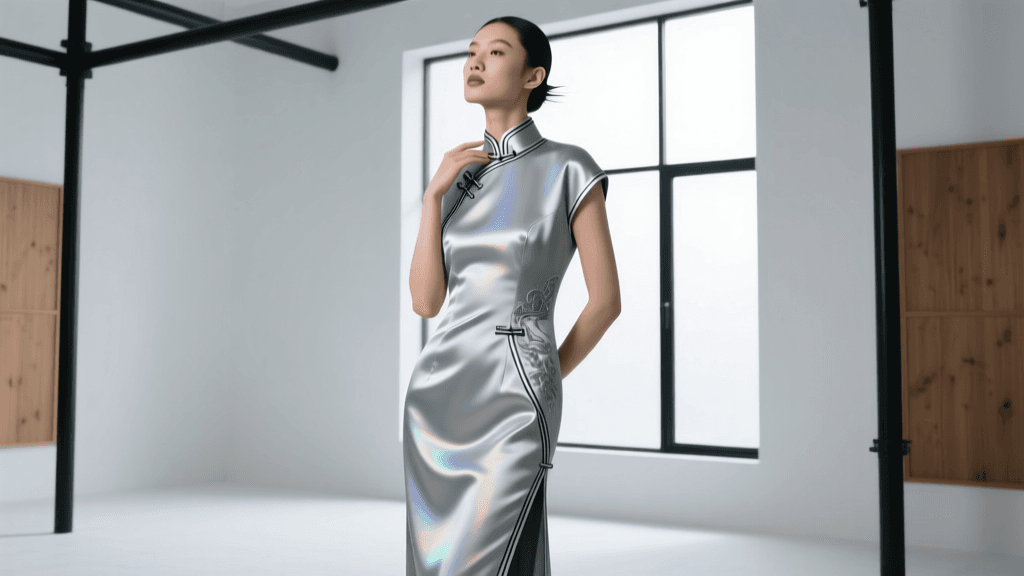
While the Qipao (or Cheongsam) has been a staple in Western media since the mid-20th century, the 2026 coverage focuses entirely on the 'Archival Qipao'—specifically the 1930s Shanghai bias-cut techniques that eschew Western darts in favor of flat-pattern drafting and strategic seam placement. Fashion critics are lauding designers who utilize the traditional Y-shaped collar and intricate pankou (frog fasteners) not as decorative afterthoughts, but as functional, structural elements.
Media coverage now frequently dissects the 'Hua' (flower) knotting techniques used in pankou, treating them with the same reverence as French lace or Italian leatherwork. The narrative has shifted from the hyper-sexualized, body-con interpretations of the 1990s to a celebration of the Qipao's original intent: a garment that skims the body, allowing for ease of movement while projecting an aura of quiet, intellectual elegance.
Media Framing: Past vs. 2026 Editorial Standards
The evolution in how global fashion media approaches Asian traditional garments is best understood through a comparative analysis of editorial practices.
| Editorial Aspect | Pre-2020 Media Approach | 2026 Editorial Standard |
|---|---|---|
| Sourcing & Credits | Vague attributions; 'Asian-inspired' fast fashion or theatrical costume houses. | Direct credits to heritage artisans, specific regional ateliers, and Neo-Hanfu designers. |
| Styling Context | Exoticized sets, bamboo forests, or stereotypical cinematic tropes. | Integrated into modern urban environments, brutalist architecture, and contemporary art spaces. |
| Terminology | Interchangeable use of 'Kimono', 'Cheongsam', and generic 'Oriental dress'. | Precise terminology (e.g., Mamianqun, Ruqun, Qipao) with phonetic guides and historical context. |
| Textile Focus | Superficial focus on bright colors and dragon/phoenix motifs. | Deep dives into Xiangyunsha mud-dyeing, Kesi tapestry weaving, and Song brocade loom tech. |
Designer Spotlights: Who the Media is Championing
The 2026 fashion media landscape is heavily focused on designers who bridge the gap between historical fidelity and modern luxury.
Samuel Gui Yang continues to receive widespread acclaim for his innovative approach to the Qipao. By merging Savile Row-level tailoring with traditional Chinese flat-cutting and rubber-infused silk textiles, his work is frequently cited by the Business of Fashion as a prime example of cross-cultural sartorial excellence.
Meanwhile, the Neo-Hanfu movement has been propelled into the global spotlight by brands like Ming Ma and independent ateliers featured on platforms like Xiaohongshu (Red). These designers are praised for adapting the voluminous sleeves and layered collars of the Tang and Song dynasties into structured taffeta and organza pieces that hold their own on the Paris and Milan runways. Furthermore, institutions like the Victoria and Albert Museum have increasingly collaborated with contemporary media to showcase how these modern designers reference historical archives, further legitimizing their work in the eyes of global fashion critics.
Buyer's Guide: Sourcing Media-Featured Neo-Hanfu and Qipao
For readers inspired by the 2026 editorials, acquiring authentic, high-quality pieces requires navigating a market that ranges from mass-produced costumes to museum-grade couture. Here is an actionable guide to sourcing the silhouettes currently dominating the fashion press.
Where to Source Authentic Pieces
- Heritage Brands: For archival Qipao, look to established houses like Shanghai Tang's heritage lines or bespoke tailors in Shanghai's French Concession that still employ 1930s bias-cut methods.
- Independent Neo-Hanfu Ateliers: Platforms like Taobao and Xiaohongshu host premier Hanfu studios (e.g., Shisan Yu, Zhongling). In 2026, cross-border logistics have made it seamless to order directly from these artisans, with global shipping taking under a week.
- Textile Specialists: For Xiangyunsha silk, seek out certified vendors from the Lingnan region, ensuring the fabric has undergone the traditional 30-step mud and sun-dyeing process.
2026 Pricing Tiers
- Entry-Level ($150 - $350): Machine-woven brocade Mamianqun and basic cotton-linen Ruqun sets. Excellent for daily wear and initial wardrobe integration.
- Mid-Tier Artisan ($400 - $900): Hand-loomed Song brocade skirts, genuine Xiangyunsha silk blouses, and custom-fitted Qipao with hand-knotted pankou fasteners.
- Couture & Archival ($1,500 - $5,000+): Bespoke Qipao from master tailors featuring Kesi (cut silk) tapestry panels, and limited-edition runway Neo-Hanfu pieces with hand-embroidered goldwork.
Care and Maintenance for Heritage Textiles
Global fashion media in 2026 places a heavy emphasis on garment longevity and sustainability. When investing in these pieces, proper care is non-negotiable. Xiangyunsha silk should never be machine washed; it requires gentle hand washing in cool water with a pH-neutral silk detergent, followed by shade drying to preserve its unique crackled patina. Heavy brocade Mamianqun should be spot-cleaned or professionally dry-cleaned by specialists familiar with metallic threads to prevent tarnishing. Always store flat-cut garments folded with acid-free tissue paper to maintain the sharp, structural integrity of the pleats.
Conclusion
The year 2026 represents a golden era for Asian traditional garments in global fashion media. By abandoning the superficial tropes of the past and embracing the profound structural, historical, and textile complexities of the Neo-Hanfu and archival Qipao, the fashion press has finally granted these garments the respect they have always deserved. For the modern consumer, this media renaissance offers more than just aesthetic inspiration; it provides a roadmap to participating in a living, breathing sartorial tradition that is as intellectually rich as it is visually breathtaking.