2026 Fashion Media Trends: Styling Neo-Hanbok & Sari Editorials
The 2026 Editorial Shift: From Costume to Couture
In 2026, the global fashion media landscape has undergone a profound and necessary transformation. Leading publications such as Vogue, Harper's Bazaar, and Numéro have moved decisively away from superficial cultural borrowing, embracing instead a model of deep, collaborative editorial storytelling. Asian traditional garments are no longer treated as exotic props for seasonal themed issues; they are recognized as foundational pillars of the global sartorial lexicon. This year, the spotlight is firmly on the architectural brilliance of the Neo-Hanbok and the fluid, cinematic draping of the contemporary Sari-gown hybrid.
This shift is heavily informed by institutional research and historical preservation. Curators and stylists are increasingly referencing archival textiles to inform modern editorial shoots. For instance, the extensive textile archives housed within the Victoria and Albert Museum's Asian collections have served as a vital mood board for 2026's top fashion directors, bridging the gap between centuries-old weaving techniques and avant-garde studio lighting. By understanding the historical weight of these garments, modern stylists are able to manipulate their structures in ways that honor their origins while pushing the boundaries of high-fashion photography.
Deconstructing the Neo-Hanbok Editorial Look
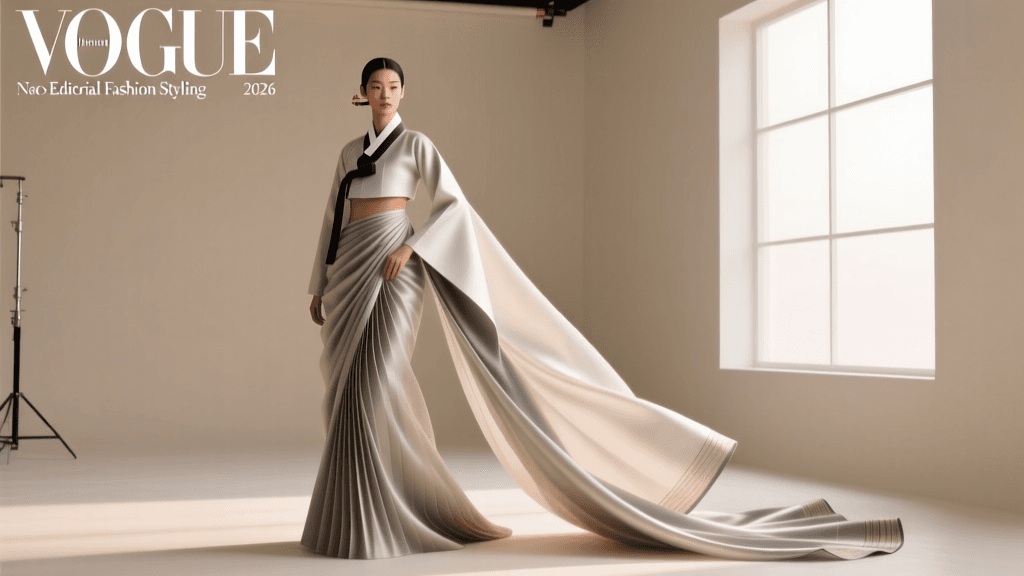
The traditional Hanbok, characterized by its vibrant colors and simple lines without pockets, has evolved into the 'Neo-Hanbok' for high-fashion editorials. In 2026, global stylists are deconstructing the jeogori (traditional jacket) and chima (wrap skirt) to create striking, avant-garde silhouettes that photograph beautifully in both motion and stillness.
Structural Hacks for the Chima
To achieve the dramatic, gravity-defying bell-shape seen in 2026 editorial spreads without relying on traditional, bulky undergarments, stylists are employing modern theatrical tailoring techniques. The most effective method involves sewing a 3-inch wide horsehair braid (crinoline tape) directly into the inner hem of the chima. This provides immense structural rigidity, allowing the skirt to hover slightly above the floor and catch studio wind machines perfectly.
- Fabric Selection: Silk gazar and metallic organza are the preferred choices for 2026. They hold creases sharply and reflect light dynamically.
- Hem Circumference: For a full editorial spread, request a custom hem circumference of at least 45 to 50 inches. This ensures the skirt blooms outward when the model spins.
- Embellishment: Traditional geumbak (gold leaf imprinting) is being applied in asymmetric, fragmented patterns rather than traditional borders, creating a sense of movement in static images.
Reimagining the Jeogori
The jeogori is being cropped even further in 2026, often ending just below the bust line to emphasize the high waist of the chima. Stylists are pairing these cropped silk jackets with structured, tailored corsetry underneath, blending historical Korean modesty with contemporary European couture silhouettes. The traditional goreum (chest tie) is frequently elongated and weighted at the tips to create sweeping, linear elements in the frame.
The Sari-Gown Hybrid on Global Red Carpets
While the Hanbok dominates structural editorials, the Sari remains the undisputed queen of fluid, cinematic fashion media in 2026. The traditional six-to-nine yards of unstitched fabric has been re-engineered by master couturiers into the 'Sari-gown' hybrid—a pre-draped, structurally secured garment that offers the visual poetry of the sari with the reliability of a red-carpet gown.
Securing the Drape for High-Movement Shoots
One of the greatest challenges in styling a sari for an outdoor, high-wind editorial shoot is maintaining the integrity of the pallu (the decorative end of the sari draped over the shoulder). In 2026, safety pins are strictly forbidden on high-fashion sets, as they distort heavy zari (metallic thread) embroidery and catch the light awkwardly.
- Micro-Snap Tape: Stylists now use flesh-toned micro-snap tape, sewn directly into the blouse and the corresponding edge of the pallu. This allows for instant, invisible repositioning between frames.
- Silicone Grip Tape: Applied to the inner edge of the sari where it tucks into the petticoat or underskirt, medical-grade silicone grip tape prevents the heavy silk from slipping during dynamic posing.
- Weighted Hems: To ensure the pallu falls with a luxurious, heavy swing when the model walks toward the camera, a 2-ounce flat lead weight is sewn into the bottom corner of the drape. This creates a pendulum effect that slow-motion cameras capture beautifully.
The Organza Underskirt Technique
Rather than traditional cotton petticoats, 2026 editorial stylists use silk organza underskirts with built-in thigh slits. This provides the necessary opacity while allowing the sheer, net-based saris (a massive trend this year) to float over the legs without bunching or clinging to the skin under hot studio lights.
2026 Media Styling Comparison: Neo-Hanbok vs. Sari-Gown
Understanding the distinct editorial applications of these two garments is crucial for fashion directors and stylists planning 2026 campaigns. Below is a comparative breakdown of their structural and stylistic profiles.
| Feature | Neo-Hanbok Editorial | Sari-Gown Hybrid |
|---|---|---|
| Primary Silhouette | A-line volume, cropped torso, architectural | Column drape, asymmetric shoulder, fluid |
| Fabric of Choice (2026) | Silk Gazar, Metallic Organza, Stiff Brocade | Liquid Crepe, Heavy Silk Satin, Sheer Net |
| Hidden Hardware | Horsehair braid, internal corsetry, magnetic snaps | Silicone grip tape, micro-snap tape, lead weights |
| Editorial Vibe | Avant-garde, structural, high-contrast studio | Cinematic, romantic, wind-swept outdoor/location |
| Movement Dynamics | Blooms and hovers; relies on spin and wind | Clings and flows; relies on walking and gravity |
Sourcing and Commissioning Media-Ready Pieces
For editorial teams looking to source authentic, media-ready Neo-Hanbok or Sari-gowns in 2026, off-the-rack options are rarely sufficient. High-fashion editorials require bespoke commissioning to accommodate the specific lighting, movement, and thematic requirements of the shoot.
When commissioning a Neo-Hanbok from contemporary Seoul-based ateliers, expect lead times of 8 to 12 weeks. The cost for an editorial-grade, hand-embellished set typically ranges from $1,800 to $4,500, depending on the complexity of the geumbak work and the grade of silk used. It is imperative to provide the atelier with the exact lighting temperature (e.g., 5600K daylight vs. 3200K tungsten) of your studio, as master dyers will adjust the fabric's undertones to prevent color muddying on camera.
For Sari-gowns, commissioning from master weavers in regions like Varanasi or Kanchipuram, in collaboration with modern fashion houses, requires a lead time of 12 to 16 weeks. Prices for heavily embroidered, pre-draped editorial saris start at $2,500 and can exceed $10,000 for pieces incorporating genuine gold and silver zari. Always request a 'calico drape' (a muslin prototype) via courier before the final silk is cut, ensuring the weight distribution of the pallu behaves correctly on the model's specific frame.
Ethical Styling and Cultural Attribution in Media
As the integration of Asian traditional garments into global fashion media deepens, so does the responsibility of accurate cultural attribution. The days of labeling all Asian-inspired drapery as generic 'oriental' are long past. In 2026, editorial teams are expected to provide meticulous credit to the specific regional artisans, weaving cooperatives, and historical consultants involved in the creation of the garments.
Institutions like the Fashion Institute of Technology (FIT) Museum have consistently highlighted the importance of tracing the lineage of textile techniques in their exhibitions, setting a standard that fashion magazines are now adopting in their digital and print credits. When styling a Banarasi sari, the editorial copy must explicitly name the weaving technique (such as kadwa or fenkua) and credit the specific cooperative or master weaver. Similarly, when featuring a Hanbok, acknowledging the hanbokjang (master artisan of traditional Korean clothing) who consulted on the structural integrity of the piece is now an industry standard.
By prioritizing ethical styling, precise structural tailoring, and deep historical respect, the 2026 fashion media landscape is not just showcasing Asian traditional garments; it is elevating them to their rightful place at the absolute pinnacle of global couture. Whether manipulating the rigid silk gazar of a Neo-Hanbok or engineering the liquid drape of a modern Sari-gown, today's stylists are writing a new, respectful, and breathtaking chapter in fashion history.