Navajo Yei Embroidery Wool Preparation And Sacred Pattern Rules
Origins and Spiritual Foundations of Yei Motifs
The Yei (or Yeibichai) figures in Navajo textile art are not decorative abstractions—they are sacred personifications of Holy People who mediate between the human and spiritual realms. These beings appear most prominently in sandpaintings during the nine-day Nightway and Enemyway ceremonies, where their presence is believed to restore hózhǫ́—balance, beauty, and harmony. When translated into wool embroidery, Yei figures retain strict iconographic conventions: vertical posture, symmetrical arms raised in blessing, and specific color assignments tied to cardinal directions and cosmological roles. For example, the male Mountain Way Yei wears a black mask with white stripes, while the female counterpart appears in turquoise and yellow, representing dawn and sunset respectively.
Wool Sourcing and Traditional Processing
Navajo sheep herding remains deeply interwoven with cultural identity and land stewardship. The Diné raise Churro sheep—a breed reintroduced in 1991 after near extinction—with fleece prized for its dual-coated structure: long, lustrous outer guard hairs (12–18 cm in length) and soft undercoat (5–7 cm). Wool is hand-sheared annually in late spring, then washed in cold water using yucca root saponin, a biodegradable natural detergent harvested from *Yucca baccata*. Each fleece yields approximately 2.3–3.6 kg of clean, carded fiber per animal. Before spinning, wool is sorted by staple length and micron count—Churro averages 22–28 microns, significantly coarser than Merino but ideal for durable, weather-resistant regalia.
Hand-Spinning Techniques
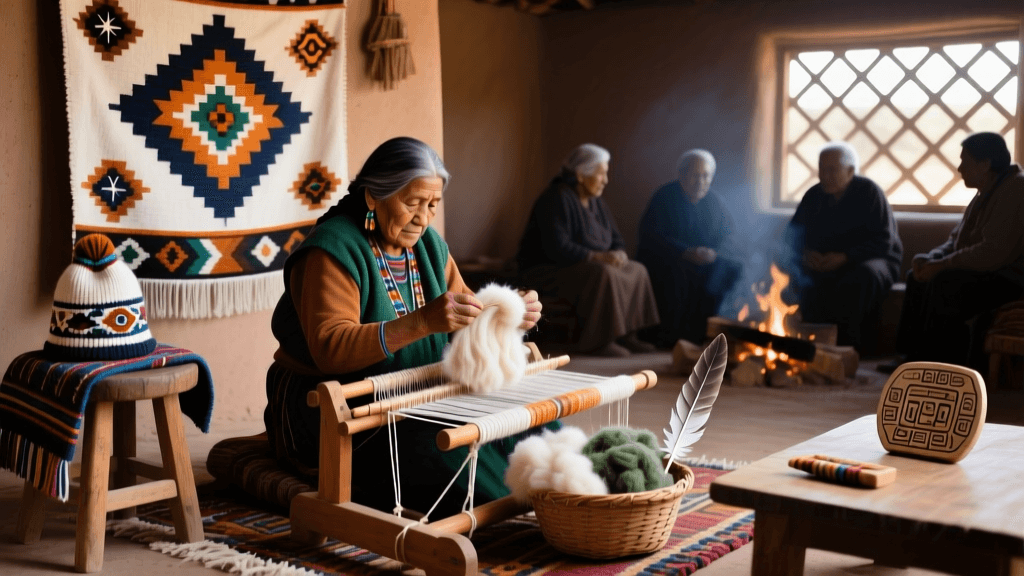
Spinning follows the “Z-twist” direction (clockwise), a practice maintained since pre-reservation times and distinct from Anglo-American “S-twist” conventions. Spinners use the traditional Navajo spindle—often made from juniper or piñon wood—measuring precisely 45–55 cm in length and weighted with a stone whorl averaging 120–180 g. A single spindle load produces roughly 40–60 meters of 2-ply yarn, requiring 15–20 minutes of continuous twisting and plying.
Dyeing Protocols and Plant Sources
Natural dyes adhere to strict seasonal and ritual timing. Juniper berries (*Juniperus monosperma*) are gathered only in August; rabbitbrush (*Ericameria nauseosa*) flowers are collected at full bloom in early September. Dye baths require precise ratios: 1 part mordanted wool to 3 parts dried sumac leaves, simmered for exactly 45 minutes. The resulting red-brown hue must pass the “sunlight test”—a dyed sample held outdoors for 3 hours must retain chromatic depth without fading. According to the Navajo Nation Department of Cultural Resources (2018), unauthorized substitution of synthetic dyes invalidates ceremonial use of embroidered pieces.
Embroidery Structure and Sacred Geometry
Yei embroidery is executed exclusively on hand-woven, 2/2 twill wool fabric known as *dilch’í*, traditionally produced on upright looms with warp tension calibrated to 12–15 psi. Embroiderers follow a grid-based counting system derived from the four sacred mountains: each Yei figure occupies a 24 × 32 stitch field, with central axis alignment verified using a cedarwood ruler marked at 1.27 cm (½ inch) intervals—the standard unit referenced in oral instructions passed down through generations of weavers in Tuba City and Shiprock.
- Yei figures must be oriented northward when worn or displayed, never rotated or mirrored
- No more than three Yei figures appear on a single garment—representing the triad of Thought, Speech, and Action
- Feet must rest on a horizontal band no wider than 1.5 cm, symbolizing the Earth’s surface
- Hands extend precisely 7 stitches beyond the shoulder line, signifying the seven directions (four cardinal + up, down, center)
- Facial features are rendered with single-thread backstitch, never cross-stitch or satin stitch
Institutional Stewardship and Contemporary Practice
The Navajo Weavers Association, founded in 1972 in Window Rock, Arizona, maintains a living archive of over 420 documented Yei pattern templates—each verified by elders from the communities of Kayenta, Fort Defiance, and Crownpoint. Their annual certification program requires apprentices to complete a 32-inch ceremonial blanket with at least two Yei figures, adhering to all dimensional and symbolic constraints. Similarly, the Museum of Northern Arizona in Flagstaff houses the Dorothy E. Dorr Collection, containing 117 pre-1940 embroidered pieces, all catalogued with provenance notes identifying the weaver’s chapter house affiliation and ceremonial context.
At Diné College’s Tsaile campus, textile curriculum mandates 120 hours of supervised wool processing before students may begin embroidery work. Instruction emphasizes that Yei patterns cannot be adapted for commercial fashion—unlike non-sacred motifs such as diamonds or zigzags. As stated by the Navajo Nation Historic Preservation Department (2022): “A Yei figure reproduced outside its ceremonial framework is not merely inaccurate—it disrupts relational ethics between people, land, and Holy People.”
Measurement Standards in Practice
Standard ceremonial sash dimensions are strictly regulated: width = 15.24 cm (6 inches), length = 243.84 cm (96 inches), with Yei figures spaced at exact 45.72 cm (18-inch) intervals. The central Yei stands 30.48 cm (12 inches) tall when fully embroidered, its height determined by the number of warp threads per inch—always 16–18 epi on ceremonial-grade dilch’í. Stitch density is measured at 8–10 stitches per centimeter, verified with a brass gauge calibrated to Navajo Nation Bureau of Indian Education specifications.
“The Yei is not drawn—it is remembered into being. Every stitch recalls a prayer, every color a mountain, every spacing a breath given to the Holy People.” — Esther Begay, Diné elder and master weaver, recorded at the Navajo Nation Museum, 2019
Community-Led Revitalization Efforts
Since 2015, the nonprofit Diné Tah Culture Center in Pinon, Arizona has coordinated biannual wool camps where youth learn shearing, dyeing, and embroidery alongside medicine men who recite origin stories tied to each step. Over 320 participants have completed the full cycle, with 87% continuing to produce ceremonial textiles for family use. The center’s 2023 report documents a 40% increase in Churro flock numbers across the reservation since program inception—directly correlating with renewed demand for traditional wool.
Meanwhile, the Southwest Association for Indian Arts (SWAIA) in Santa Fe enforces strict vetting for Yei-related works submitted to its annual Indian Market. Artists must submit written attestation signed by a recognized Navajo chapter official confirming adherence to sacred protocols. Between 2018 and 2023, SWAIA rejected 63 submissions for violations including incorrect Yei orientation, unauthorized color substitutions, or use of machine-spun yarn.
| Material | Traditional Source | Measured Specification | Cultural Significance |
|---|---|---|---|
| Wool | Navajo-Churro sheep | Staple length: 12–18 cm | Represents resilience and continuity of Diné lifeways |
| Dye base | Juniper berry extract | pH level: 4.2–4.6 | Aligned with sacred mountain soil chemistry |
| Embroidery thread | Hand-spun 2-ply | Tension: 28–32 g/cm² | Mimics sinew strength used in traditional binding |
The preservation of Yei embroidery is inseparable from land rights, language transmission, and intergenerational knowledge sharing. In 2021, the Navajo Nation Council passed Resolution CJY-44-21, mandating that all public school textile curricula include instruction on Yei symbolism, wool preparation timelines, and the legal protections afforded to sacred designs under the Navajo Nation Code Title 12, Chapter 12. This legislation affirms what Diné weavers have always known: that a properly prepared and embroidered Yei is not an object—it is a covenant enacted in wool, color, and counted stitch.
Efforts continue at the Navajo Nation Museum in Window Rock, where conservators collaborate with elder weavers to digitize pattern books while respecting restrictions on photographing certain Yei configurations. At the same time, the Crownpoint Rug Auction—a decades-old institution—requires vendors to disclose wool source and dye method, with certified Churro-dyed pieces fetching premiums up to 300% above conventionally sourced lots.
For Diné families, the act of preparing wool for Yei embroidery remains a daily prayer. From the moment a lamb is born in spring to the final knot securing the last stitch, every action reaffirms relationship—not just to ancestors, but to the very substance of creation: the earth, the sheep, the plants, and the Holy People who walk beside them in thread and thought.