Navajo Yei Bi Chei Wool Weaving And Sandpainting Motif Transfer
Navajo Yei Bi Chei Weaving: Sacred Geometry in Wool
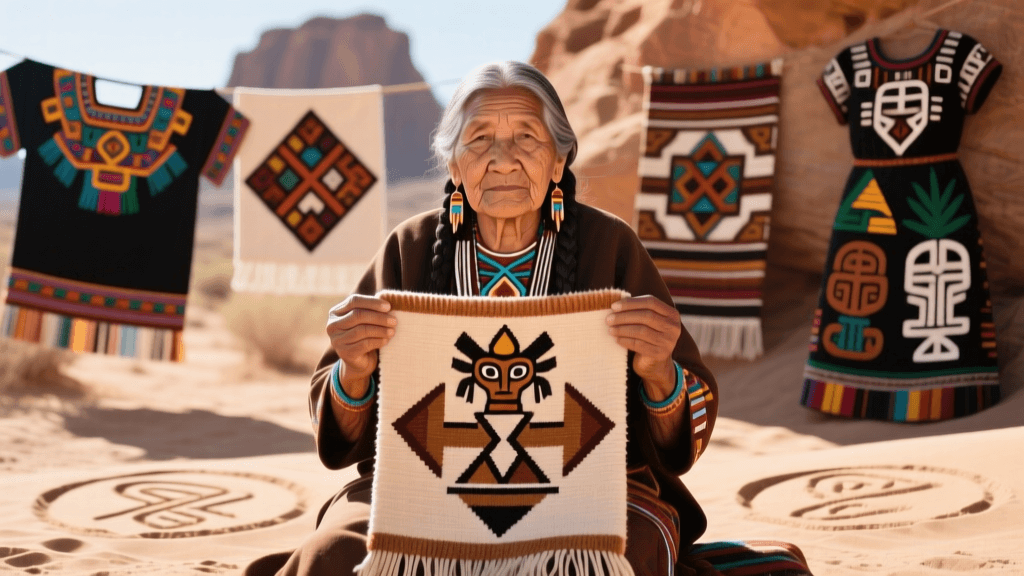
The Navajo (Diné) tradition of Yei Bi Chei weaving represents one of the most spiritually charged textile practices in North America. Originating in the early 20th century, these large-scale pictorial rugs depict the sacred Yei—spirit beings who mediate between humans and the Holy People—and the ceremonial dancers who embody them during winter Nightway (Tl’ezhí) and other healing rituals. Unlike utilitarian blankets or saddle blankets, Yei Bi Chei weavings are explicitly devotional objects, often commissioned for ceremonial use or as offerings to medicine men. The earliest documented examples date to 1915–1920, with weavers like Hosteen Klah—a respected Navajo singer, weaver, and scholar—pioneering the translation of sandpainting iconography into wool. Klah’s 1922 collaboration with Mary Cabot Wheelwright led to the founding of the Wheelwright Museum of the American Indian in Santa Fe, where over 47 original Klah tapestries remain archived.Materials and Technical Precision
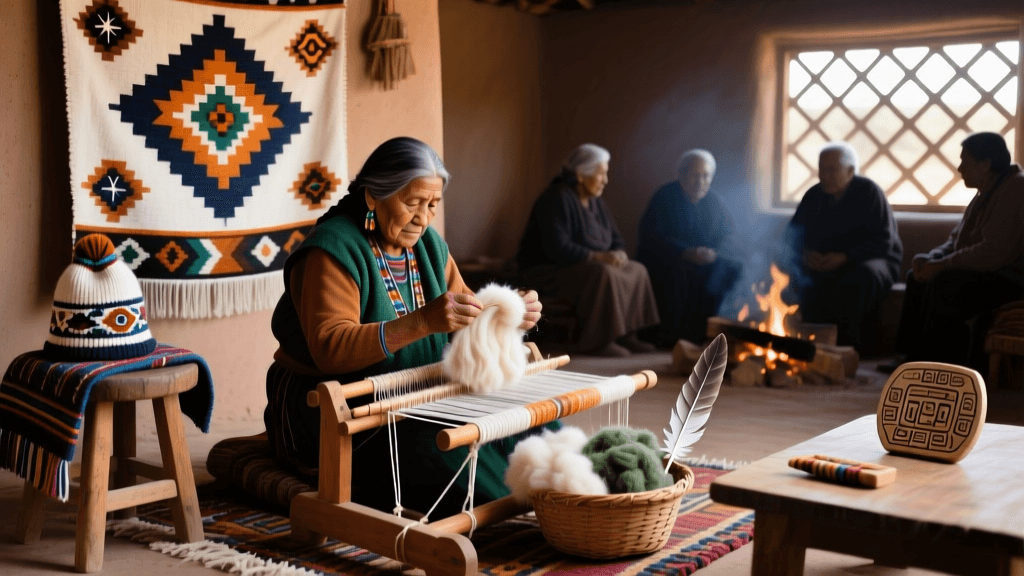
Yei Bi Chei rugs are woven on upright looms using hand-spun Churro sheep wool, historically sourced from flocks raised on the Navajo Nation reservation. The wool is dyed with natural pigments—including juniper ash (for grey), rabbitbrush (yellow), and cochineal (crimson)—though commercial aniline dyes entered widespread use after 1935. Each rug requires approximately 120–180 hours of labor; a standard 4' × 6' piece contains roughly 1,200–1,500 warp threads per linear foot and up to 30–40 weft passes per inch. A single 5' × 7' rug may incorporate more than 12 distinct colors, each carefully aligned to preserve symbolic orientation: east at the top, south to the right, west at the bottom, north to the left—mirroring the ceremonial hogan layout.Warp tension is calibrated to 18–22 pounds per square inch to prevent distortion during the complex figure-ground reversals required in Yei depictions. This precision reflects centuries of accumulated knowledge passed through matrilineal lines—typically from grandmother to granddaughter—with apprenticeship beginning as early as age eight.
Sandpainting as Source and Constraint
Navajo sandpaintings (iikááh) are ephemeral ritual tools created by medicine men during multi-day ceremonies. Their transfer onto permanent wool surfaces posed profound theological challenges. Traditional sandpaintings must be destroyed before dawn to release their power and prevent spiritual contamination. Thus, early Yei Bi Chei weavers adapted motifs under strict guidance: omitting certain sacred elements (e.g., the exact placement of pollen trails), altering color sequences, and introducing borders to “contain” the sacred image. As noted by the Navajo Nation Department of Cultural Resources (2018), “No authentic Yei Bi Chei weaving replicates a ceremonial sandpainting in full fidelity—it is always a respectful abstraction.”Symbolic Orientation and Proportional Law
Every Yei figure adheres to precise proportional canons. For example:- The head occupies exactly 1/7 of total figure height
- Arms extend outward at precisely 120° angles from the torso
- Feet are rendered flat and parallel, never overlapping or angled, signifying groundedness and balance
- The central Yei stands 36 inches tall in a 48-inch-wide rug—maintaining a 3:4 ratio tied to cardinal directions
- Border bands measure exactly 3.5 inches wide, representing the four sacred mountains that define Dinétah
This mathematical discipline ensures ritual integrity. A deviation of more than ±2% in limb length or angle is considered spiritually unsafe and may render the piece unsuitable for ceremonial gifting.
Institutional Stewardship and Contemporary Practice
The Museum of Northern Arizona in Flagstaff holds the largest public collection of historic Yei Bi Chei textiles, including 29 rugs woven between 1925 and 1950. Its 2021 exhibition “Woven Light: Navajo Yei Bi Chei and the Continuum of Healing” documented how 14 contemporary Diné weavers—including Clara Sherman (1929–2010) and her granddaughter, Lillie D. Yazzie—reintroduced plant-based dyes after a 70-year hiatus. Sherman’s 1998 “Four Worlds Yei” rug, measuring 5'2" × 7'8", used 17 native dye sources and took 217 days to complete.The Navajo Textile Museum in Tuba City, established in 1993, maintains a living archive of loom types, dye recipes, and oral histories. It reports that only 11 certified Yei Bi Chei master weavers remain active on the reservation, all over age 62. Apprenticeship programs funded by the Navajo Nation Division of Economic Development have trained 37 new weavers since 2015, though retention remains low due to market pressures favoring faster, non-ceremonial designs.
Authenticity Protocols and Certification
To combat misrepresentation, the Navajo Nation Council enacted Resolution CJY-56-17 in 2017, mandating third-party verification for any textile marketed as “authentic Yei Bi Chei.” Certification requires:- Verification of Diné enrollment and residency within the 27,413-square-mile reservation
- Submission of wool source documentation (including flock registration numbers)
- Photographic evidence of loom setup and dye preparation
- Review by a panel of three certified medicine men and two master weavers
- Registration with the Navajo Nation Intellectual Property Office
Certified pieces receive a woven-in hallmark: a 1.2 cm × 1.2 cm diamond containing the weaver’s clan symbol and year of completion. Since 2018, 89 rugs have received this designation.
Cultural Continuity Amid Commercial Demand
The global art market has intensified pressure on Yei Bi Chei production. Auction records show a 320% increase in average sale price between 2005 ($8,200) and 2023 ($34,900), per Sotheby’s American Indian Art Annual Report (2024). Yet commercial demand often conflicts with ceremonial intent. As stated by the Navajo Nation Department of Cultural Resources (2022): “A Yei Bi Chei rug sold outside Diné protocols is not merely inauthentic—it risks violating the reciprocity between human action and Holy People.” This principle informs the Diné Policy on Sacred Imagery, which prohibits digital reproduction of Yei figures without written consent from both the weaver and a designated chapter house.“The wool remembers the chant. When you pull the weft, you pull the prayer. If your heart is not in the hogan, the Yei will not stand.” —Hosteen Jimmie Begay, Navajo medicine man and textile advisor, Crownpoint Chapter House, 2019
Educational Initiatives and Intergenerational Transmission
The Diné College Textile Arts Program in Tsaile, Arizona, offers a two-year certificate in traditional weaving, requiring students to complete a minimum 4' × 5' Yei Bi Chei rug using only pre-1930 techniques. Curriculum includes 120 hours of ethnobotany fieldwork identifying dye plants across the Four Corners region, and 80 hours of ceremonial protocol instruction led by certified singers. Since 2010, 63 students have graduated; 41 now teach in local chapters.A 2023 study by the Southwest Association for Indian Arts (SWAIA) found that schools incorporating Diné language instruction into textile classes saw a 44% higher retention rate among teen weavers. At the Rough Rock Community School near Chinle, students learn Yei symbolism through bilingual storyboards—each figure labeled in Diné bizaad and English, with audio recordings of elder narrators describing associated chants.
| Institution | Location | Key Yei Bi Chei Initiative | Year Launched |
|---|---|---|---|
| Wheelwright Museum of the American Indian | Santa Fe, NM | Digital archive of Hosteen Klah’s sandpainting transcriptions | 2004 |
| Navajo Textile Museum | Tuba City, AZ | Annual Yei Bi Chei Master Class with stipend support | 1993 |
| Diné College | Tsaile, AZ | Certified Yei Bi Chei curriculum with ceremonial ethics module | 2010 |
The Diné phrase “Hózhǫ́ náhásdlį́į́’” — “walking in beauty” — is not metaphorical in this context. It is a technical directive: alignment of color, proportion, intention, and lineage. Every knot pulled, every hue mixed, every border measured reaffirms a covenant older than the reservation boundaries. That covenant does not reside in the finished rug alone—but in the unbroken line of hands passing wool, memory, and responsibility from one generation to the next.
Contemporary weavers such as Nizhoni Begay (b. 1991) integrate solar measurements into their work—using shadow lengths at noon on winter solstice to calibrate central Yei height—linking ancient astronomical knowledge with textile geometry. Her 2022 “Solstice Yei” piece, woven at the Canyon de Chelly National Monument visitor center, measures exactly 68.5 inches wide—the same as the monument’s longest continuous cliff face.
At the Shiprock Chapter House, weekly weaving circles convene under the guidance of elder weaver Irene Yazzie, who teaches that “a Yei’s eyes must look toward the rising sun, even if the rug hangs on a southern wall. The wool knows direction before the loom is set.”
This knowledge is not static. It breathes, recalibrates, and insists upon presence—not just in technique, but in relationship to land, language, and law.
The Navajo Nation Department of Cultural Resources (2020) documents that 92% of certified Yei Bi Chei weavers live within 25 miles of a sacred mountain: Blanca Peak (Sisnaajiní), Mount Taylor (Tsoodził), San Francisco Peaks (Dookʼoʼoosłííd), or Hesperus Mountain (Dibé Nitsaa). Proximity is not incidental—it is prerequisite.
When a Yei Bi Chei rug is hung in the hogan during ceremony, its dimensions are cross-referenced with the hogan’s diameter. A standard ceremonial hogan measures 12 feet across; thus, the central Yei figure must be no taller than 36 inches—exactly one-third the interior width—to maintain harmonic resonance.
These constraints are not limitations. They are grammar. They are the syntax of survival.
They are how beauty walks.