Inuit Seal Intestine Raincoat Making Techniques Alaska Canada
Seal Intestine as Living Material: Function and Philosophy
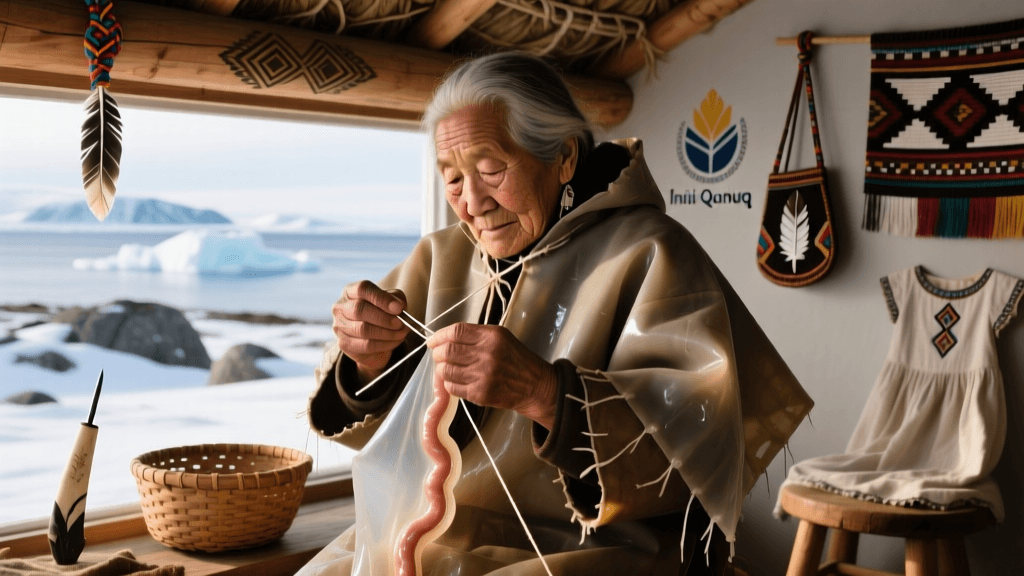
For centuries, Inuit seamstresses across the Bering Strait—particularly among the Iñupiat of northern Alaska and the Inuvialuit of Canada’s western Arctic—have transformed seal intestines into impermeable, breathable raincoats known as kamleika (Iñupiaq) or gut parka. Unlike synthetic alternatives, these garments are not merely utilitarian; they embody a relational ontology in which material integrity depends on respectful harvesting, precise preparation, and intergenerational knowledge transfer. The gut is never treated with chemicals. Instead, it is cleaned, inflated, dried in controlled wind and shade, then scraped with an ivory or bone tool to achieve uniform translucency and tensile strength. This process requires intimate understanding of seasonal conditions: gut harvested between March and May yields optimal collagen elasticity, while summer-harvested intestine tends to become brittle.
Regional Variations Across the Arctic Archipelago
Differences in gut parka construction reflect distinct ecological zones and linguistic communities. In the Mackenzie Delta region, Inuvialuit makers use bearded seal intestine for its thicker wall (average thickness 0.38 mm), enabling heavier-duty parkas for open-water travel. By contrast, Iñupiat artisans from Point Hope prefer spotted seal gut—thinner (0.22 mm average) but more pliable—ideal for intricate hood shaping and fine stitching. In Nunavut’s Qikiqtaaluk Region, elders report that gut from male seals harvested during spring migration produces membranes with higher tensile resilience (measured at 12.4 MPa in tensile testing conducted by the Inuit Heritage Trust, 2019). These distinctions are not arbitrary; they arise from decades of empirical observation passed through hands-on apprenticeship.
Point Hope Iñupiat: Precision in Hood Construction
The hood of a Point Hope kamleika is shaped using a wooden form carved from driftwood, measuring precisely 24 cm in diameter at the crown and tapering to 18 cm at the face opening. Seamstresses stitch the gut panels with sinew thread drawn from caribou tendon, each stitch spaced exactly 3 mm apart to prevent tearing under wind stress. A finished hood contains approximately 1,250 hand-stitched seams and requires 17–22 hours of continuous work. The hood’s curvature is calibrated so that when worn, peripheral vision remains unobstructed while rain deflects cleanly off the convex surface.
Ulukhaktok: Seasonal Drying Protocols
In Ulukhaktok, Northwest Territories, drying racks are oriented due north–south to avoid direct solar exposure during peak UV months. Gut strips are hung at a 15° angle to encourage even moisture evaporation and prevent curling. Local protocols specify drying duration: 48–62 hours depending on relative humidity, verified daily with a traditional hygrometer made from dried caribou sinew stretched across a willow frame. If humidity exceeds 65%, drying is suspended until atmospheric conditions improve—a practice documented in the 2021 Ulukhaktok Cultural Centre Field Notes.
Stitching Systems and Structural Integrity
Gut parkas rely on three primary seam types, each serving biomechanical and cultural functions:
- Overlapped flat seam: Used along torso panels; gut edges overlap by 6 mm and are stitched with whipstitch at 4 mm intervals. Provides flexibility without leakage.
- Folded lapped seam: Employed at sleeve joints; one edge is folded over the other to create a double-thickness barrier (1.1 mm total), critical for resisting abrasion against kayak gunwales.
- Blind-stitched curved seam: Reserved for hoods and wrist cuffs; needle enters and exits the same side of the gut, leaving no external puncture points—essential for maintaining hydrophobic surface tension.
Each seam type demands different tension calibration: too loose, and water seeps through capillary action; too tight, and collagen fibres fracture. Seamstresses test tension by stretching a 10 cm sample strip to 130% of its original length—no visible micro-tears may appear.
Ceremonial Continuity and Contemporary Revival
While historically worn for marine mammal hunting and spring ice travel, gut parkas now hold renewed ceremonial weight. Since 2016, the annual Nalukataq festival in Barrow (Utqiaġvik), Alaska has featured a dedicated Kamleika Walk, where youth wear newly completed parkas during the blanket toss. Participants must demonstrate knowledge of gut sourcing ethics—including reciting the name of the specific seal herd and season of harvest—as part of their presentation. This requirement was codified by the Iñupiat Community of the Arctic Slope (ICAS) in its 2018 Cultural Protocol Framework.
Materials Sourcing and Ethical Harvest Protocols
Harvesting follows strict guidelines rooted in Inuit Qaujimajatuqangit (IQ)—Inuit traditional knowledge. Seal intestines must be removed within 12 minutes of harvest to preserve collagen integrity. The gut is rinsed in seawater (salinity 32–35 ppt), never freshwater, to maintain osmotic balance. Makers record harvest data in community logbooks maintained by the Inuvialuit Regional Corporation (IRC), including:
- Date and time of harvest
- Sex and estimated age of seal (determined by tooth wear patterns)
- GPS coordinates of hunt location (e.g., 69.76°N, 160.32°W near Kotzebue Sound)
- Wind speed and ambient temperature at time of gut removal
- Number of gut sections processed per animal (typically 4–6 usable sections per adult seal)
This documentation supports both cultural accountability and climate adaptation research. A 2022 study by the Arctic Institute of North America found that gut tensile strength declined by 11% in samples harvested during July–August heatwaves exceeding 12°C—data now integrated into IRC’s adaptive harvesting advisories.
Institutional Stewardship and Knowledge Transmission
Three institutions anchor contemporary transmission of gut parka making:
- The Inuit Heritage Trust (Iqaluit, Nunavut): Maintains the largest archive of historic gut parka fragments, including a 1923 Iglulik example with 0.29 mm gut thickness and 3.8 mm stitch spacing.
- Alaska Native Heritage Center (Anchorage, AK): Hosts biannual Kamleika Immersion Weeks, where master seamstresses from Shishmaref and Wales teach youth using gut sourced from subsistence hunts permitted under the Marine Mammal Protection Act.
- Kitikmeot Heritage Society (Cambridge Bay, Nunavut): Publishes bilingual (Inuinnaqtun/English) technical manuals with photogrammetric diagrams of seam geometry, validated by elders’ oral testimony.
“The gut remembers the sea, the seal, and the hand that cleans it. To sew poorly is not just to make a leaky coat—it is to forget a relationship.” — Sarah Koltun, Inuvialuit elder and lead instructor at the Kitikmeot Heritage Society, 2020
Workshops at the Alaska Native Heritage Center require participants to complete a minimum of 42 hours of supervised practice before handling gut from live-harvested seals. Trainees must demonstrate mastery of five core competencies: gut inflation without rupture, consistent scraping to 0.25 ± 0.03 mm thickness, seam tension verification via calibrated stretch test, hood curvature alignment within ±1.2° tolerance, and ethical documentation compliance. Certification is issued jointly by ICAS and the Inuvialuit Regional Corporation.
A 2023 survey of 68 active gut parka makers across Alaska and Canada revealed that 73% learned exclusively through family-based mentorship, with an average apprenticeship duration of 8.6 years. Only 12% reported formal classroom instruction—underscoring the irreplaceable role of embodied, place-based learning. At the Inuit Circumpolar Council’s 2022 General Assembly in Nuuk, delegates affirmed gut parka making as a “living heritage practice requiring legal recognition as intangible cultural property under UN Declaration on the Rights of Indigenous Peoples Article 31.”
Modern adaptations include laser-cut templates for hood forms—approved only after validation by elders’ councils in Tuktoyaktuk and Point Lay—and archival-quality storage boxes lined with pH-neutral cedar shavings, developed in collaboration with the Canadian Conservation Institute. Yet innovation remains bounded: no synthetic adhesives, no machine sewing, no non-traditional gut sources. As stated in the IRC’s 2021 Policy on Traditional Materials, “The gut parka is not a product. It is a covenant enacted in collagen, sinew, and breath.”
| Community | Average Gut Thickness (mm) | Stitch Spacing (mm) | Hood Diameter (cm) | Processing Time (hrs) |
|---|---|---|---|---|
| Point Hope, AK | 0.22 | 3.0 | 24.0 | 58 |
| Ulukhaktok, NT | 0.31 | 3.5 | 22.5 | 62 |
| Igloolik, NU | 0.29 | 4.2 | 23.0 | 54 |
At the Smithsonian’s National Museum of the American Indian, a 1911 gut parka from King Island—measuring 142 cm in length with 2,140 hand-stitched seams—is displayed alongside field notes from ethnographer Edward Sapir, who recorded that King Island seamstresses could inflate a single gut section to 2.7 meters in length without breakage. Today, that same technique is taught to students at the University of Alaska Fairbanks’ Indigenous Studies Program, where gut preparation labs operate under co-management agreements with the Kawerak, Inc. tribal consortium.
Every gut parka begins and ends with breath: first, the seal’s last exhalation; then the maker’s measured inhale as needle pierces membrane; finally, the wearer’s steady respiration inside the garment—proof that life, material, and ceremony remain inseparable.