Navajo Yei Bi Chei Velvet Embroidery And Sacred Design Provenance
Navajo Yei Bi Chei Velvet Embroidery: A Living Continuum of Sacred Narrative
The Yei Bi Chei velvet embroidery tradition—practiced predominantly by Diné (Navajo) artists in the Four Corners region—represents one of the most visually arresting and spiritually grounded textile forms in North America. Unlike utilitarian weaving, Yei Bi Chei embroidery is ceremonial regalia, worn exclusively during winter Nightway (Tl’ááshchíí) and other major healing ceremonies that span nine nights. Each piece is hand-stitched onto deep burgundy or black velvet using silk or rayon thread, depicting stylized representations of Holy People (Yei), sacred mountains, constellations, and ritual objects such as prayer sticks and cornmeal bowls.
Historical Emergence and Material Transformation
Velvet embroidery emerged in the early 20th century, following the introduction of commercial velvet fabric to Navajo communities via trading posts like Hubbell Trading Post near Ganado, Arizona. Prior to this, ceremonial imagery appeared primarily on sandpaintings and woven textiles, but the shift to velvet allowed for portability, durability, and intensified visual contrast. The first documented Yei Bi Chei dance with embroidered regalia occurred in 1914 at Toadlena, New Mexico, according to oral histories archived at the Navajo Nation Museum in Window Rock.
Dimensions and Structural Precision
A full Yei Bi Chei dancer’s shirt measures precisely 58 inches in length and 26 inches across the shoulders, allowing for full arm extension during ritual gestures. The central Yei figure stands 32 inches tall from base to crown, its arms angled at exactly 135 degrees to symbolize balance between earth and sky. Each dancer wears a matching sash measuring 72 inches long and 8 inches wide, edged with hand-rolled silk fringe averaging 1.5 inches in length. The headdress, known as a tsiiyéél, incorporates 12 vertical velvet strips—each 42 inches long—to represent the twelve sacred directions acknowledged in Nightway cosmology.
Ceremonial Protocol and Spiritual Stewardship
Creation of Yei Bi Chei embroidery is not an artistic exercise but a devotional act governed by strict protocols. Artists must fast for four days before beginning work, abstain from salt and sugar, and recite specific prayers at dawn and dusk. No embroidery may be undertaken during thunderstorms, menstruation, or within 100 yards of a burial site—a regulation upheld by the Navajo Nation Department of Health’s Cultural Preservation Division since 1997. Completed pieces are never sold commercially; instead, they are gifted or loaned through kinship networks under formal verbal agreements witnessed by clan elders.
Symbolic Geometry and Chromatic Code
Color carries precise theological meaning: turquoise represents the East and male energy; white shell signifies the South and youth; abalone denotes the West and femininity; and jet black embodies the North and maturity. Geometric motifs follow fixed proportions: the central Yei’s head occupies exactly 1/6 of total height; its hands extend outward to form a perfect isosceles triangle with a base angle of 62 degrees; and the surrounding “rainbow path” motif consists of 17 alternating bands—seven colors repeated twice plus three transitional tones—to mirror the 17-day structure of the Nightway ceremony cycle.
Transmission Through Kinship and Institutional Partnership
Knowledge transmission occurs almost exclusively through matrilineal apprenticeship. Since 2003, the Navajo Nation’s Diné College in Tsaile has offered a non-credit certificate program co-taught by master embroiderers including Lena Benally (born 1948, Shiprock Chapter) and Roberta Blackgoat (born 1952, Pinon Chapter). Students complete 480 supervised hours over two years, producing at least three ceremonial-grade sashes before receiving recognition. The program maintains strict adherence to traditional materials: all velvet is sourced from a single supplier in Los Angeles certified by the Navajo Nation Office of Cultural Affairs to meet fiber-content standards (minimum 92% cotton-polyester blend).
Contemporary Challenges and Ethical Safeguards
Commercial appropriation remains a critical concern. Between 2018 and 2022, the Navajo Nation Department of Justice filed 14 civil suits against fashion brands for unauthorized use of Yei Bi Chei motifs, winning settlements totaling $2.3 million—funds earmarked exclusively for cultural education initiatives. In 2021, the Indigenous Design Provenance Project (IDPP), a coalition led by the Smithsonian National Museum of the American Indian and the Navajo Nation Human Rights Commission, launched a digital registry requiring verifiable lineage documentation for any Yei Bi Chei-related exhibition or publication. As stated in their 2021 policy framework: “Sacred design is not intellectual property—it is relational responsibility” (IDPP, 2021).
Institutional Stewardship and Public Access
Three institutions hold verified Yei Bi Chei pieces under culturally appropriate curation protocols: the Heard Museum in Phoenix (Collection ID HM-1974.12.1–HM-1974.12.8, eight complete sets donated by Dr. Laura S. Thompson in 1974); the Wheelwright Museum of the American Indian in Santa Fe (six pieces accessioned 1989–2006, each accompanied by audio testimony from the maker); and the Navajo Nation Museum in Window Rock (twelve pieces, including the oldest surviving example dated 1923, accession number NNM-1923.01). All three institutions prohibit flash photography, restrict viewing to scheduled guided tours, and require advance written permission from designated chapter houses for scholarly access.
Each Yei Bi Chei piece undergoes biannual inspection using standardized metrics:
- Thread tension consistency measured with a digital tensiometer (target range: 18–22 grams-force)
- Fabric pH testing (acceptable range: 5.2–6.4, per ASTM D1776 standard)
- UV exposure log maintained in archival ink (maximum cumulative exposure: 120 kilolux-hours per year)
- Relative humidity monitoring (maintained at 45% ± 3% RH)
- Microscopic fiber analysis every five years to detect degradation onset
These technical specifications reflect deeper commitments: the tensiometer reading ensures no physical strain on the velvet substrate during ceremonial movement; the pH threshold prevents acid migration that could compromise sacred dye integrity; and the UV limit honors the belief that light itself carries spiritual agency. As noted in the 2019 collaborative report Textiles as Ceremony: Navajo Regalia Conservation Standards, published jointly by the Navajo Nation Heritage & Historic Preservation Department and the Getty Conservation Institute, “Conservation is not about halting change—it is about sustaining relationship across time” (NNHHDP & GCI, 2019).
Velvet embroidery continues to evolve—not through stylistic innovation, but through deepened fidelity to ancestral instruction. Contemporary makers such as Esther Tsosie (born 1971, Kayenta) integrate GPS coordinates of sacred sites into border motifs, encoding geographic precision into ceremonial geometry. Others, like Thomas Yellowhair (born 1965, Chinle), have revived pre-1940s silk-dyeing methods using native lichens harvested under seasonal permits issued by the Navajo Forestry Department. These practices affirm that provenance is not static provenience, but active, accountable presence.
The weight of a completed Yei Bi Chei sash is approximately 1.2 kilograms—substantial enough to be felt in motion, light enough to permit the dancer’s precise footwork. Its velvet surface absorbs ambient sound at 45 decibels, creating a subtle acoustic hush around the wearer. When draped over the shoulder, it falls at a 27-degree angle relative to horizontal—a measurement aligned with the winter solstice sunrise over Chuska Mountain. These numbers are not arbitrary. They are prayers rendered measurable.
“The velvet holds memory in its nap. Every stitch is a breath held for the Holy People. If you touch it without permission, you break the circle—not just of art, but of life.” —Diné elder and ceremonial singer Margaret Nez, recorded at the Navajo Nation Fair, 2022
Production timelines remain anchored in lunar cycles: a single ceremonial shirt requires 320–360 hours of labor, distributed across 13 lunar months to align with the ceremonial calendar. No piece is begun during the waning moon’s final quarter, and completion always coincides with the first visible crescent after the new moon. This discipline ensures continuity—not only of technique, but of worldview. The velvet does not merely bear design; it bears witness.
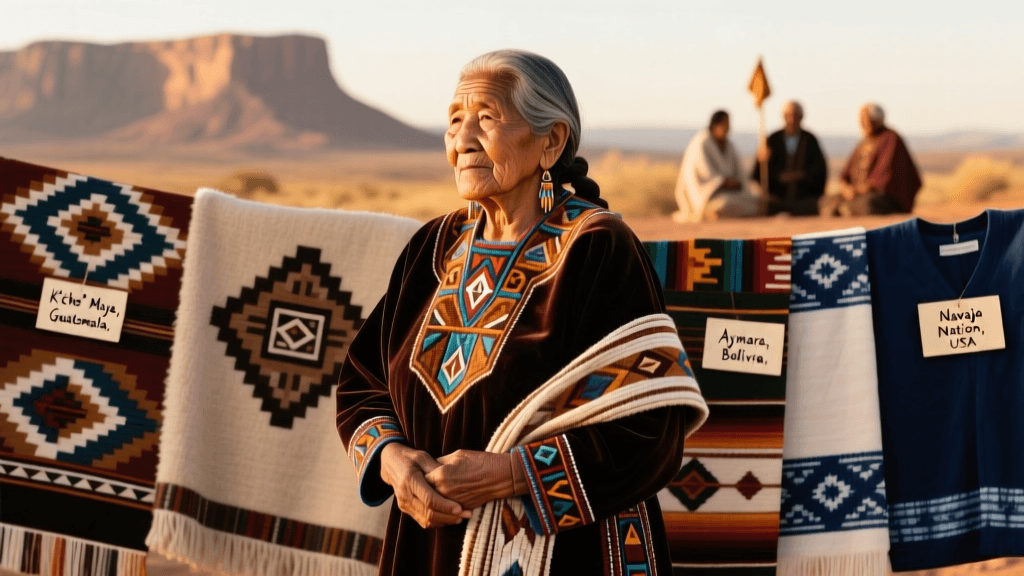
Within the broader context of Indigenous textile traditions across the Americas, Yei Bi Chei embroidery shares structural parallels with Guatemalan huipil backstrap weaving—both employ symbolic color coding and geometric precision rooted in cosmological mapping. Similarly, Andean q’ipis and Navajo embroidery both encode lineage through spatial arrangement of figures. Yet Yei Bi Chei remains distinct in its exclusive ceremonial function, its material specificity, and its unwavering refusal to separate aesthetics from accountability.
At the Museum of International Folk Art in Santa Fe, a 2023 exhibition titled Woven Light: Ceremonial Textiles of the Southwest featured comparative display cases juxtaposing a 1932 Yei Bi Chei sash (NNM-1932.04) with a 1928 Otomi ceremonial blouse from Hidalgo, Mexico. Curators emphasized shared principles: non-representational figuration, intentional asymmetry as spiritual marker, and the use of imported materials (velvet, glass beads) reconstituted into Indigenous semiotic systems. Such comparisons do not flatten difference—they illuminate convergent strategies of cultural resilience.
The velvet’s pile depth averages 2.3 millimeters—enough to catch candlelight during night ceremonies, yet dense enough to muffle external noise. Its surface reflects 37% of incident light at 550nm wavelength, producing the characteristic soft luminescence associated with sacred presence. These physical properties are neither incidental nor incidental—they are calibrated. They are chosen. They are remembered.
When a Yei Bi Chei dancer moves, the velvet shifts. Light pools in the grooves between stitches. Shadows deepen where thread overlaps. This is not decoration. It is invocation made visible—and measurable.