Nanjing Yunjin Drawloom Weaving Guide 2026: Ancient Silk Techniques
The Resurgence of Nanjing Yunjin in 2026
Nanjing Yunjin, translating poetically to 'cloud brocade,' represents the absolute pinnacle of Chinese silk weaving and textile artistry. As we navigate the fashion landscape of 2026, the explosive growth of the Xin Zhongshi (new Chinese style) movement has catapulted this ancient textile back into the global luxury spotlight. No longer confined to museum archives or ceremonial robes, authentic Yunjin is now being integrated into high-end contemporary wardrobes, avant-garde runway pieces, and exclusive interior design projects. However, the true magic of Yunjin does not lie merely in its visual splendor; it is rooted in the colossal wooden drawlooms and the grueling, ancient weaving techniques that have been passed down through generations of master artisans.
Recognized globally for its cultural significance, Yunjin was inscribed on the UNESCO Intangible Cultural Heritage list, cementing its status as a living treasure. In 2026, as consumers become increasingly discerning about provenance, craftsmanship, and sustainable heritage practices, understanding the mechanics of the traditional Hua Loom is essential for collectors, designers, and cultural enthusiasts alike.
Anatomy of the Giant Wooden Drawloom (Hua Loom)
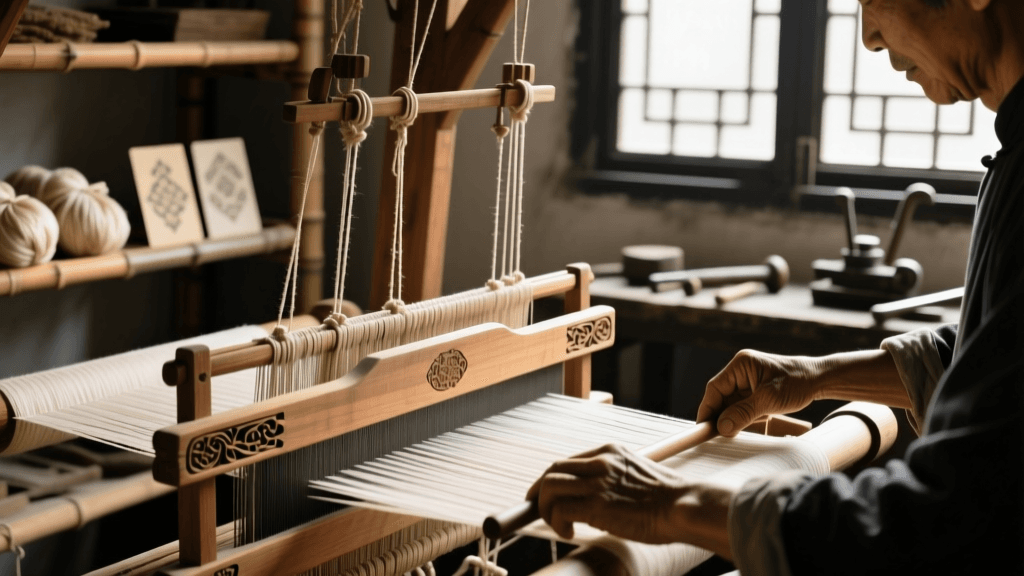
To appreciate Yunjin, one must first understand the magnificent machine that creates it. The traditional Hua Loom (drawloom) is a marvel of ancient engineering, predating the European Jacquard loom by centuries. Unlike modern, compact weaving apparatuses, the Hua Loom is a massive, room-dominating structure crafted from durable hardwoods.
Dimensions and Structure
A standard traditional Yunjin drawloom measures approximately 5.6 meters in length, 1.4 meters in width, and towers an impressive 4 meters in height. The sheer scale of the loom is necessary to accommodate the complex warp systems and the multiple weavers required to operate it. The loom consists of several critical components:
- The Warp Beam and Cloth Beam: Positioned at opposite ends of the 5.6-meter frame, these heavy wooden cylinders hold the tension of the thousands of silk warp threads.
- The Heddles and Quills: Used to separate the warp threads and create the 'shed' through which the weft is passed.
- The Pattern Tower (Hualou): The elevated platform at the top of the 4-meter structure where the pattern-puller sits, managing the intricate harness cords that dictate the design.
The Two-Weaver Synchronization: A Dance of Precision
Operating a Hua Loom is impossible for a single person. It requires a highly synchronized duo: the weaver (who sits at the bottom) and the pattern-puller (who sits atop the 4-meter tower). In 2026, heritage workshops in Nanjing emphasize the telepathic-like communication required between these two artisans.
The pattern-puller is responsible for pulling the specific harness cords that raise the correct warp threads according to the complex, pre-programmed pattern. Historically, this 'program' was stored in a physical sequence of knotted cords, functioning as an ancient, analog binary code. Today, while some master weavers still rely on traditional cord sequences, many 2026 heritage studios utilize digital archiving to preserve these ancient codes, translating them into physical setups on the loom with zero loss of historical accuracy. Once the puller lifts the harness, they call out a rhythmic chant to signal the weaver below.
The weaver, sitting at the base, then uses a wooden shuttle to pass the weft threads through the newly opened shed. They simultaneously use a heavy wooden batten to beat the weft tightly into place. This process is agonizingly slow; a master duo can produce a mere 5 to 6 centimeters of authentic Yunjin brocade per day.
The 'Tong Jing Duan Wei' Technique Explained
The defining characteristic of Nanjing Yunjin is the 'Tong Jing Duan Wei' technique, which translates to 'continuous warp and discontinuous weft.' According to textile conservation experts at The Metropolitan Museum of Art, this method is what allows Yunjin to feature incredibly vibrant, multi-colored patterns without the structural compromises seen in standard tapestries or power-loomed fabrics.
How Discontinuous Weft Works
In standard weaving, a single weft thread runs continuously from one edge of the fabric to the other. In the 'Tong Jing Duan Wei' method, the weaver uses small, individual bobbins (often made of bamboo or wood) for each specific color or material in a given section of the pattern. When a color is no longer needed in a specific motif, the thread is simply cut off and the next color is introduced.
This technique allows for the integration of wildly different materials within the same row of weaving. A single pass might include dyed mulberry silk, flattened gold leaf wrapped around a silk core, and iridescent peacock feather filaments. Because the weft threads do not cross the entire width of the fabric, the reverse side of authentic Yunjin remains remarkably clean, free from the messy, floating threads that plague imitation brocades.
2026 Market Comparison: Authentic vs. Power-Loom Yunjin
As the Xin Zhongshi trend dominates 2026 fashion weeks, the market has been flooded with 'Yunjin-style' fabrics. It is crucial for buyers to distinguish between authentic, hand-loomed heritage pieces and modern power-loom imitations. As reported by China Daily Culture, the proliferation of high-speed digital looms has made imitation brocades cheaper and more accessible, but they entirely lack the structural integrity and material value of the real article.
| Feature | Authentic Hand-Woven Yunjin (2026) | Power-Loom Imitation (2026) |
|---|---|---|
| Production Time | 2 to 3 months per meter | Seconds per meter |
| Price per Meter | $4,500 to $12,000+ USD | $40 to $150 USD |
| Primary Materials | Grade 6A mulberry silk, real gold leaf, ethically sourced peacock feathers | Synthetic blends, metallic polyester, rayon |
| Reverse Side | Clean, discontinuous weft (no loose floating threads) | Messy, continuous weft floats and tangled jumps |
| Drape and Weight | Heavy, sculptural, holds structured silhouettes perfectly | Lightweight, flimsy, requires synthetic interfacing |
| Investment Value | Appreciates as a collectible heritage art asset | Depreciates rapidly as fast-fashion commodity |
Sourcing Authentic Yunjin in 2026
For designers and collectors looking to source authentic Nanjing Yunjin in 2026, provenance is everything. The most reliable method is to purchase directly from the Nanjing Yunjin Institute or certified heritage workshops located in the Qinhuai District of Nanjing. When commissioning a piece, buyers should request a certificate of authenticity that details the specific master weavers involved, the exact materials used (especially the karat and origin of the gold thread), and the number of labor hours invested.
When integrating Yunjin into modern Xin Zhongshi garments, designers in 2026 are moving away from full-body robes and instead utilizing the brocade for structural accents: mandarin collars, wide cuff bands, corset bodices, and structured handbags. This approach respects the astronomical cost of the fabric while maximizing its visual impact.
Care, Storage, and Preservation
Owning authentic Yunjin requires a commitment to meticulous preservation. The organic nature of the mulberry silk and the delicate gold leaf threads demand specific environmental controls.
- Climate Control: Store garments in a climate-controlled environment with a relative humidity of 45% to 55%. Fluctuations in humidity can cause the silk warp to expand and contract, potentially snapping the delicate gold-wrapped weft threads.
- Light Exposure: UV radiation is the enemy of natural dyes and silk proteins. Never display or store Yunjin in direct sunlight. When exhibited, museum-grade LED lighting with zero UV emission must be used.
- Physical Storage: Never hang heavy Yunjin garments on standard hangers, as the immense weight of the brocade will distort the warp over time. Garments should be padded with acid-free tissue paper and stored flat in archival-grade, breathable cotton boxes.
- Cleaning: Authentic Yunjin must never be dry-cleaned or washed. The chemical solvents used in modern dry cleaning will strip the natural sericin from the silk and dissolve the adhesives binding the gold leaf to its core. Surface dust should be gently removed using a soft, natural-bristle brush or a low-suction conservation vacuum.
The Future of the Ancient Loom
As we look through 2026 and beyond, the survival of the Nanjing Yunjin drawloom relies on a delicate balance between strict historical preservation and modern economic viability. While the grueling physical toll of the Hua Loom deters many young artisans, a new wave of state-sponsored apprenticeships and luxury brand partnerships is providing the financial incentives needed to keep the looms clattering. For the global fashion community, Yunjin remains a profound reminder that true luxury is not defined by a logo, but by the irreplaceable human time, ancient engineering, and cultural memory woven into every single millimeter of the cloth.