Mastering the Hualou Drawloom: Yunjin Weaving in 2026
The Resurgence of Yunjin Brocade in 2026
In 2026, the global fascination with the Xin Zhongshi (new Chinese style) movement has propelled traditional textiles from museum displays into contemporary high fashion and bespoke interior design. At the pinnacle of this textile renaissance is Nanjing Yunjin, or 'Cloud Brocade,' renowned for its intricate patterns, vibrant colors, and the use of luxurious materials like gold leaf and peacock feathers. Unlike modern mass-produced fabrics, authentic Yunjin can only be woven on the traditional Hualou drawloom, a massive wooden apparatus that requires a two-person team and operates without electricity. According to the UNESCO Intangible Cultural Heritage registry, the complexity of Yunjin weaving remains unmatched by modern machinery, making the preservation and mastery of the Hualou loom a critical endeavor for today's textile artisans and academic researchers.
Anatomy of the Traditional Hualou Loom
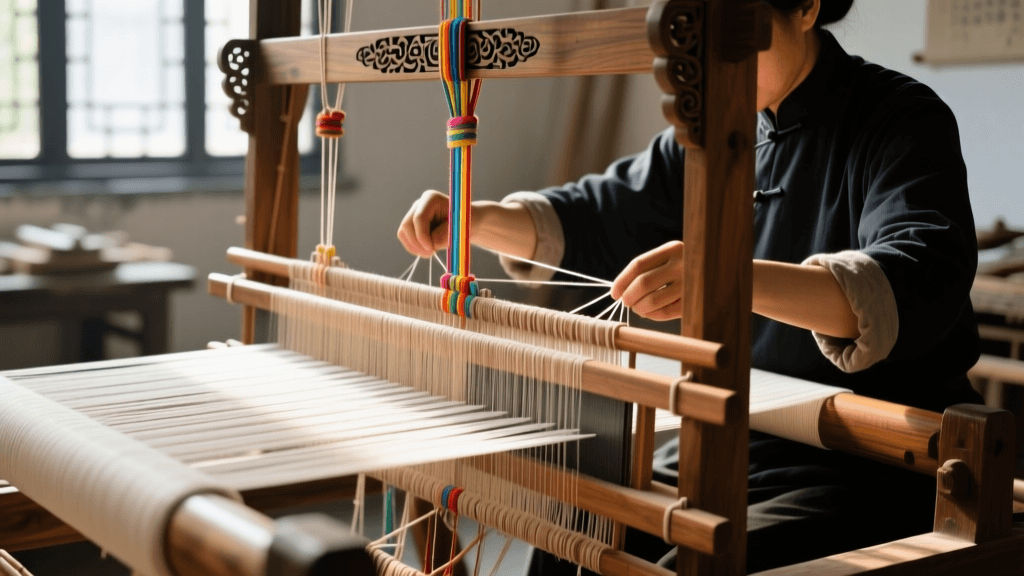
To understand the weaving process, one must first understand the sheer scale and mechanical brilliance of the Hualou drawloom. Measuring approximately 5.6 meters in length, 1.4 meters in width, and a towering 4.0 meters in height, the loom is constructed from over 10,000 individual wooden and bamboo components. It is essentially a mechanical computer built from timber and cordage.
Key Structural Components
- The Hualou (Flower Tower): The upper section of the loom where the drawboy (known as the tiaohua) sits. This elevated platform houses the complex harness system that controls the warp threads.
- The Yaxian (Warp Beam) and Buzhou (Cloth Beam): Located at the rear and front of the loom respectively, these massive wooden rollers maintain the immense tension required for weaving dense brocade.
- The Jiaobing (Pattern Harness): A sophisticated network of knotted cords that acts as the loom's 'memory.' Instead of digital punch cards or CAD files, the intricate patterns of Yunjin are encoded into the physical knots of the Jiaobing, which dictate which warp threads are raised for each pass of the weft.
- The Bamboo Reed (Kou): Used by the weaver (zhihua) on the ground to beat the weft threads tightly into place, ensuring the dense, tapestry-like structure of the brocade.
The Jiaobing: Ancient Binary Memory
Long before the advent of the Jacquard loom or modern binary code, Chinese weavers developed the Jiaobing system. Creating a Jiaobing harness for a new Yunjin design in 2026 remains a painstaking process that can take several months. Master knot-tiers translate grid-based design drafts into a sequence of cord loops. Each loop corresponds to a specific warp thread. When the drawboy pulls a specific cord bundle, it raises the exact combination of warp threads needed to form a single row of the pattern. This physical programming ensures that centuries-old motifs, such as the five-clawed dragon or the auspicious cloud, are replicated with mathematical precision.
Sourcing Authentic Materials in the 2026 Market
Authentic Yunjin is defined by its opulent materials. For artisans and boutique studios operating in 2026, sourcing these raw materials requires navigating a specialized supply chain, primarily centered around Jiangsu and Zhejiang provinces.
- Grade 6A Mulberry Silk: The foundation of both warp and weft. In 2026, premium Grade 6A raw silk from Huzhou trades at approximately ¥850 per kilogram. It must be degummed and dyed using traditional plant-based or high-grade synthetic dyes to achieve the signature Yunjin color palette.
- Gold and Silver Threads: Authentic Yunjin utilizes real gold foil. Artisans purchase 98% pure gold leaf, which is then meticulously applied to a prepared animal glue and paper base, cut into micro-millimeter strips, and wrapped around a silk core. Expect to pay upwards of ¥15,000 per kilogram for genuine gold-wrapped thread in 2026.
- Cuiyu (Peacock Feather Yarn): One of the most prized and difficult materials to work with. The iridescent barbs of peacock feathers are spun with silk and gold threads. Due to ethical sourcing regulations and the intense labor required, authentic Cuiyu yarn is exceptionally rare, costing over ¥25,000 per kilogram. The China National Silk Museum frequently hosts exhibitions detailing the microscopic structure and conservation of these fragile feather threads.
The Two-Person Weaving Technique
Operating the Hualou is a synchronized dance between two highly skilled individuals. The weaver (zhihua) sits on the ground level, managing the shuttle, the reed, and the foot pedals for the ground weave. The drawboy (tiaohua) sits atop the 4-meter-high Flower Tower.
Step-by-Step Operation
- Pattern Calling: The weaver at the bottom calls out the pattern sequence based on the design draft.
- Drawing the Harness: The drawboy pulls the specific Jiaobing cords, lifting the designated warp threads to create the 'shed' (the opening through which the shuttle passes).
- Shuttle Passing: The weaver passes the shuttle carrying the weft thread (often a supplementary colored silk or gold thread) through the shed.
- Beating the Weft: The weaver pulls the heavy bamboo reed forward to pack the weft tightly against the previous row. Yunjin requires an incredibly dense beat, sometimes up to 100 weft threads per centimeter.
- Resetting: The drawboy releases the cords, dropping the warp threads, and prepares the next cord bundle for the subsequent row.
Because of this intricate coordination, a skilled two-person team can only weave about 5 to 6 centimeters of authentic Yunjin brocade per day. This extreme time investment is why genuine Hualou-woven garments remain ultra-luxury items in 2026.
Comparison: Hualou Drawloom vs. 2026 Digital Jacquard
While modern textile mills utilize advanced digital Jacquard looms to replicate Yunjin patterns for the mass market, connoisseurs and heritage preservationists maintain that the Hualou produces a fundamentally superior fabric. Below is a comparison of the two methods as they stand in 2026.
| Feature | Traditional Hualou Drawloom | 2026 Digital Jacquard Loom |
|---|---|---|
| Production Speed | 5-6 cm per day (approx. 2 inches) | 15-20 meters per day |
| Material Compatibility | Handles fragile peacock feathers, thick gold foil, and uneven hand-spun silk without breakage. | Requires uniform, machine-spun threads; high tension often snaps delicate Cuiyu or gold leaf. |
| Pattern Memory | Jiaobing (knotted cords); physical, repairable, lasts for decades. | Digital CAD files; requires electronic sensors and server maintenance. |
| Market Value (per meter) | ¥40,000 - ¥150,000+ (Heritage/Bespoke) | ¥800 - ¥3,000 (Commercial Fashion) |
| Environmental Impact | Zero electricity; relies on human kinetic energy and sustainable timber. | High electricity consumption; relies on automated servo motors. |
Studio Setup and Climate Control for Silk
For those setting up a Hualou studio in 2026, environmental control is non-negotiable. Raw silk and gold-wrapped threads are highly sensitive to atmospheric changes. If the air is too dry, the silk warp threads will snap under the immense tension of the Yaxian beam. If the air is too humid, the threads will swell, stick together, and ruin the shed clarity.
Optimal 2026 Studio Specifications
- Temperature: Maintain a constant 20°C to 22°C (68°F - 71°F).
- Humidity: Strictly control relative humidity between 65% and 70%. Modern studios use ultrasonic humidifiers integrated with IoT hygrometers to automatically adjust moisture levels without wetting the loom's wooden joints.
- Lighting: Direct sunlight will fade the natural dyes and degrade the silk proteins over time. Studios must utilize UV-filtered LED lighting with a Color Rendering Index (CRI) of 95+ to ensure the weaver can accurately distinguish between subtle shades of crimson and vermilion.
Troubleshooting Warp Tension Issues
One of the most common challenges for apprentices learning the Hualou in 2026 is managing warp tension across the 1.4-meter width of the loom. Uneven tension leads to 'draw-in,' where the fabric edges pull inward, causing the gold threads to pucker.
Solution: Utilize a traditional wooden temple (miao), an adjustable stretcher placed at the fell line of the fabric. The temple's small metal pins grip the outermost edge threads, maintaining the exact width of the warp. Additionally, the weaver must apply a natural rice-starch sizing (jiangsha) to the warp threads every few hours. This temporary coating reduces friction against the bamboo reed and prevents the silk filaments from fraying during the heavy beating process.
Conclusion: Preserving the Threads of History
Mastering the Hualou drawloom is not merely about operating a machine; it is about embodying a living history. As the 2026 fashion industry increasingly values sustainability, artisanal craftsmanship, and cultural authenticity, the Yunjin weavers sitting at their towering wooden looms are more relevant than ever. Whether you are a textile student, a heritage conservator, or a designer seeking to incorporate genuine Cloud Brocade into your collections, understanding the profound mechanics and material demands of the Hualou is the first step toward honoring this magnificent Asian tradition.