Ancient Chinese Drawloom Techniques: 2026 Weaver Guide
The Resurgence of the Dahualou in 2026
In the landscape of Asian traditional garments, few textiles command the reverence and technical awe of Nanjing Yunjin, or "cloud brocade." As we navigate the fashion landscape of 2026, the Xin Zhongshi (new Chinese style) movement has evolved beyond mere aesthetic homage; it now demands structural and historical authenticity. This renaissance has brought the ancient Chinese drawloom, known as the Dahualou, back into the spotlight. Recognized by the UNESCO Intangible Cultural Heritage list, the techniques required to operate these massive wooden structures represent the pinnacle of pre-industrial textile engineering. For modern artisans, heritage weavers, and textile historians, understanding the mechanics of the drawloom is no longer just an academic exercise—it is a vital, living practice that bridges centuries of silk road history with contemporary 2026 design studios.
Anatomy of the Traditional Drawloom
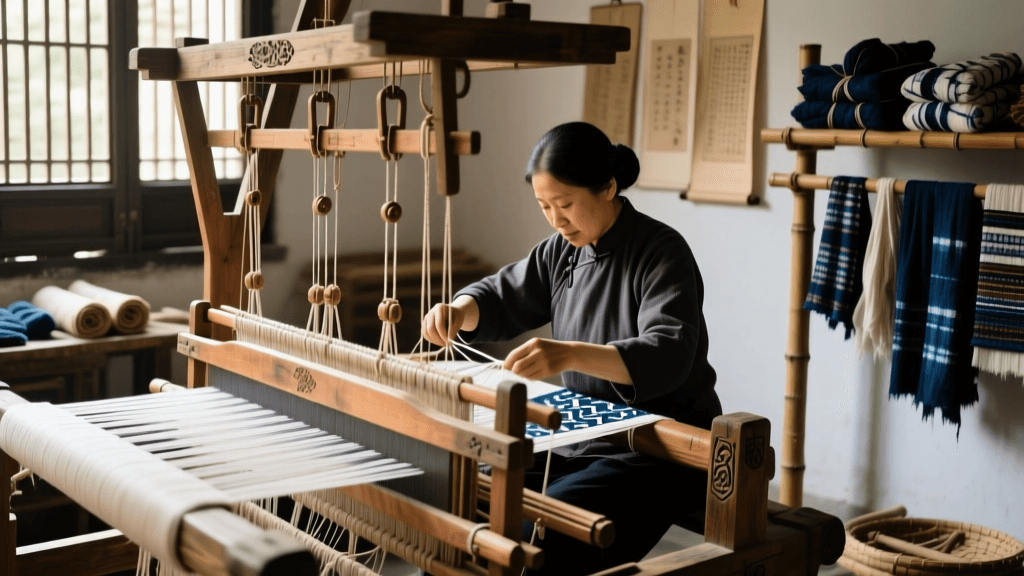
The traditional Nanjing drawloom is an imposing masterpiece of woodworking and mechanical logic. A full-sized antique or faithfully reproduced Dahualou typically measures over five meters in length and four meters in height. Constructed primarily from dense, aged elm or pine to withstand the immense tension of silk warps, the loom requires a two-person operation. The primary weaver sits at the front of the loom, managing the shuttle and the reed to beat the weft threads into place. However, the true magic occurs above. Elevated on a specialized wooden platform at the top of the loom sits the pattern picker, or Tiaohua artisan. This individual is responsible for manipulating the complex harness system that lifts specific warp threads to create the intricate, multi-colored brocade patterns. According to historical analyses by the Metropolitan Museum of Art, this division of labor allowed Chinese weavers to achieve a level of pattern complexity and color integration that was unmatched globally until the invention of the Jacquard loom in 19th-century France.
The Hualou: The Ancient "Punch Card" System
The defining feature of the Chinese drawloom is the Hualou, or pattern harness. Long before computers or even the Jacquard punch cards, Chinese weavers developed a system of knotted cords to store complex weaving algorithms. The Hualou consists of thousands of individual vertical cords, each corresponding to a specific warp thread. By tying intricate sequences of knots along these cords, the pattern picker creates a physical, tactile program. When the weaver below signals the need for the next row of the pattern, the picker pulls the corresponding cord bundle, instantly lifting only the exact warp threads required for that single pass of the shuttle. This binary system of lifted and unlifted threads is the direct ancestor of modern computing logic, making the drawloom a marvel of ancient technology that remains highly relevant in 2026 textile education.
Sizing Your Loom: Full-Size vs. 2026 Tabletop Replicas
For contemporary weavers and design schools looking to integrate Yunjin techniques into their 2026 curriculum or studio practice, sourcing a loom requires careful spatial and financial planning. While traditional full-sized looms are still crafted by master woodworkers in Jiangsu province, modern engineering has introduced highly accurate tabletop study looms. Below is a comparison of the options available in the current market.
| Loom Type | Footprint (L x W x H) | Warp Capacity | Est. 2026 Price (USD) | Primary Use Case |
|---|---|---|---|---|
| Traditional Full-Size Dahualou | 5.0m x 2.0m x 4.0m | 10,000+ threads | $18,500 - $25,000 | Master artisans, museum demonstrations, commercial Yunjin production |
| Artisan Tabletop Study Drawloom | 1.2m x 0.8m x 1.5m | 400 - 800 threads | $2,200 - $3,500 | University textile programs, independent weavers, pattern prototyping |
| 2026 Digital-Hybrid Jacquard Loom | 1.5m x 1.0m x 1.8m | 2,400 - 4,800 threads | $8,500 - $12,000 | Modern Xin Zhongshi fashion studios, rapid brocade sampling |
Step-by-Step: Executing the Tiaohua Technique
Mastering the Tiaohua (pattern picking) process requires immense patience and a deep understanding of textile geometry. For those operating a tabletop study loom or apprenticing on a full-size frame, the workflow follows a strict ancestral sequence:
- Step 1: Design Translation (Yi Jiang Tu) - The intended motif, often a traditional cloud, dragon, or peony, is mapped onto a specialized grid paper where each square represents the intersection of one warp and one weft thread. In 2026, many studios use specialized CAD software to generate these grids before translating them to physical cords.
- Step 2: Cord Tying (Jie Ben) - The pattern picker ties knots on the vertical Hualou cords according to the grid. A knot represents a "lift" instruction. This is the most time-consuming phase; a complex Yunjin motif can require weeks of cord-tying before weaving even begins.
- Step 3: Pattern Picking (Tiao Hua) - During the weaving process, the picker reads the knotted sequence row by row. Using a specialized bamboo hook, they pull the active cord bundle toward the front of the harness, engaging the heddles that lift the designated warp threads.
- Step 4: Shuttle and Beat - With the shed open, the primary weaver passes the shuttle carrying the weft thread (often supplemented with metallic or peacock feather threads). The weaver then pulls the heavy wooden reed forward to beat the weft tightly against the previous row, ensuring the dense, tapestry-like structure of the brocade.
Sourcing Authentic Materials in 2026
The structural integrity of Yunjin brocade relies heavily on the quality of the raw materials. In 2026, the global silk market has seen a stabilization in premium grades, but authentic drawloom weaving requires specific specifications. Artisans must source Grade 6A raw mulberry silk for the warp threads to withstand the extreme friction and tension of the Hualou harness. As of early 2026, premium 6A raw silk retails for approximately $85 to $110 per kilogram from verified suppliers in Zhejiang and Jiangsu. For the supplementary weft threads that give Yunjin its signature shimmer, traditionalists eschew modern synthetic Lurex in favor of authentic gold-leaf-wrapped silk threads. These are created by adhering microscopically thin layers of 24k gold leaf to animal hide or specialized paper, which is then sliced into hair-thin strips and spiraled around a core silk thread. Sourcing authentic peacock feather threads—another hallmark of imperial-grade Yunjin—requires connecting with specialized avian conservation farms in Yunnan that ethically molt and spin the iridescent barbs into usable yarn.
Loom Maintenance and Environmental Control
Operating a wooden drawloom requires strict environmental management. Silk is a highly hygroscopic protein fiber, meaning it absorbs and releases moisture from the air, which directly affects its tension and tensile strength. Furthermore, the massive wooden frames of the Dahualou are susceptible to warping if humidity fluctuates wildly. Textile conservation guidelines, such as those outlined by the Victoria and Albert Museum's Asian textile archives, emphasize the necessity of climate control. In 2026, modern weaving studios housing traditional looms utilize smart HVAC systems to maintain a strict relative humidity (RH) of 50% to 55%, and a stable temperature of 20°C to 22°C (68°F to 72°F). Additionally, the wooden pulleys and friction points of the loom must be treated monthly with natural tung oil or specialized camellia oil to prevent the wood from drying out and splintering, which could catastrophically snap a taut silk warp. By respecting both the mechanical genius of the ancient drawloom and the precise environmental needs of its materials, today's weavers ensure that the cloud brocades of the past continue to weave their way into the future of Asian traditional garments.