Nanjing Yunjin Drawloom Weaving: 2026 Preservation Guide
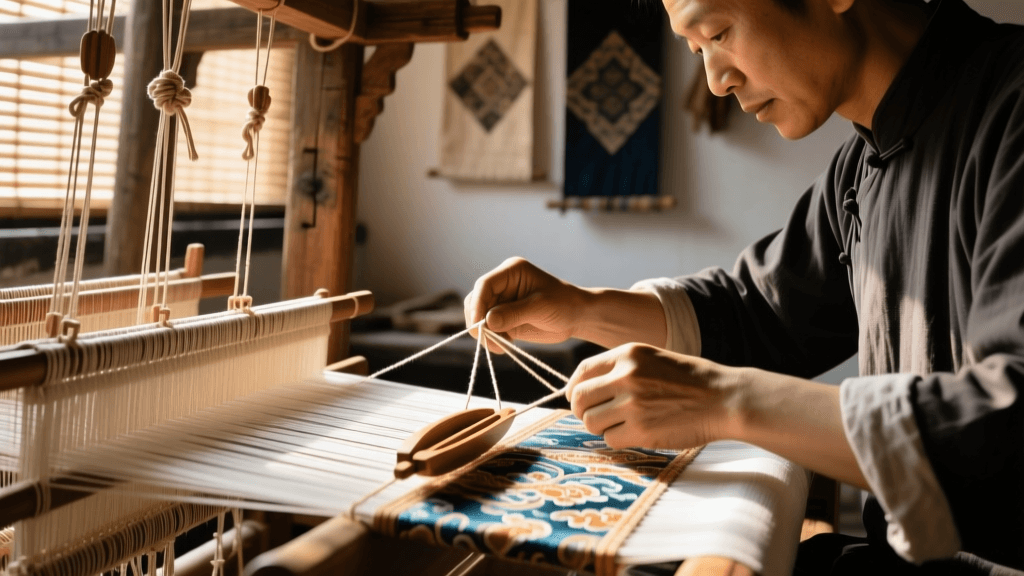
The Legacy of the Hua Lo (Drawloom) in Modern China
The history of Chinese textile artistry is inextricably linked to the evolution of the loom. Among the most magnificent and complex of these ancient machines is the Hua Lo, or traditional drawloom, specifically engineered for the creation of Nanjing Yunjin (Cloud Brocade). As of 2026, the Yunjin drawloom remains a towering testament to pre-industrial engineering, requiring a level of human coordination and mathematical precision that modern automated jacquard looms still struggle to replicate authentically. For textile historians, garment preservationists, and enthusiasts of Asian traditions, understanding the mechanics of this ancient technology is crucial for appreciating the immense value of surviving historical garments and the ongoing cultural preservation efforts in China.
Yunjin, which translates to 'cloud brocade,' earned its name due to the fabric's luminous, sunset-like appearance. Originating over 1,600 years ago and reaching its zenith during the Ming and Qing dynasties, this fabric was strictly reserved for imperial dragon robes and high-ranking court officials. Today, in 2026, the traditional drawloom techniques used to create Yunjin are recognized globally as a masterpiece of human ingenuity, blending art, mathematics, and physical endurance into a single weaving process.
Anatomy of the Nanjing Yunjin Drawloom
The traditional Nanjing drawloom is a massive, imposing structure that dominates the weaving hall. Unlike standard floor looms used for basic tabby or twill weaves, the Yunjin drawloom is designed to handle complex, large-scale figurative patterns interwoven with metallic threads. The loom operates on a two-tier system: the lower tier for the primary weaving and the upper tier for pattern drafting and warp manipulation.
To understand the sheer scale and technical requirements of this ancient machine, we must look at its precise specifications. In 2026, preservation workshops in Nanjing maintain these looms using traditional mortise-and-tenon joinery, strictly avoiding modern metal fasteners to preserve the historical integrity of the equipment.
| Loom Component | Function | Standard Dimensions / Metrics |
|---|---|---|
| Main Frame (Loom Body) | Provides structural stability for high-tension warps | 5.6 meters long, 4.2 meters high, 1.4 meters wide |
| Pattern Tower (Hualou) | Elevated platform for the drawboy to manipulate pattern cords | Located 3 meters above the ground |
| Heddle Shafts (Zeng) | Separates warp threads to create the shed for the weft | Varies; up to 14,000 individual warp threads per loom |
| Pattern Cords (Erzi) | Memory system tying pattern logic to specific warp threads | Thousands of cotton cords, manually tied in binary-like logic |
| Reed (Kou) | Beats the weft thread tightly against the fell of the cloth | Custom bamboo, weighted for dense brocade compression |
The Two-Person Weaving Technique: Weaver and Drawboy
The most defining characteristic of the Yunjin drawloom is that it cannot be operated by a single person. It requires a highly synchronized duo: the master weaver seated at the lower level, and the 'drawboy' (or pattern puller) seated in the elevated pattern tower. In 2026, while the term 'drawboy' remains in historical texts, the role is filled by highly trained artisans of all genders who have undergone years of specialized apprenticeship.
The process begins with Tiaohua, the ancient method of pattern programming. Before weaving commences, a master designer translates the visual motif (such as a five-clawed dragon or auspicious clouds) into a grid. This grid is then converted into a physical 'program' of knotted cords in the pattern tower. During the weaving process, the master weaver calls out a specific rhythmic chant or sequence. The artisan in the tower hears the call and pulls the exact bundle of pattern cords required to lift the specific warp threads for that single pick of the weft.
This communication loop happens continuously. The weaver below passes the shuttle—often loaded with delicate gold foil thread or vibrant silk—through the shed created by the puller above. Because the weft threads are often discontinuous (a technique known as zhuanghua or 'swivel weaving'), the weaver below must manually interlock multiple colored shuttles within the same row, creating a tapestry-like effect on a loom. This painstaking coordination means that a master team can produce a maximum of five to six centimeters of Yunjin fabric per day.
Yunjin Cloud Brocade: Materials and Thread Preparation
The visual impact of Yunjin is heavily reliant on its extraordinary materials. The ancient techniques demand threads that catch the light and convey imperial authority. In 2026, sourcing authentic materials for traditional looms has become a specialized industry in itself, with strict quality controls enforced by the Nanjing Yunjin Research Institute.
- Mulberry Silk: The foundation of both warp and weft. Only the highest grade, unbleached, long-staple mulberry silk is used, providing a tensile strength capable of withstanding the immense tension of the drawloom.
- Gold and Silver Foil Threads: Artisans meticulously cut ultra-thin sheets of gold or silver leaf into microscopic strips. These strips are then spirally wrapped around a core of red or green silk thread. This technique ensures the metallic thread remains flexible enough to pass through the bamboo reed without snapping or shedding the foil.
- Peacock Feather Threads: A hallmark of the most luxurious Yunjin pieces. The iridescent 'eye' fibers of peacock feathers are carefully stripped, spliced, and twisted with silk. In 2026, ethical sourcing and specialized breeding farms supply these feathers, with genuine peacock thread costing upwards of $400 USD per 100 grams.
2026 Preservation Efforts and Academic Research
The survival of the Nanjing Yunjin drawloom technique is a triumph of modern cultural preservation. Recognized by UNESCO as an Intangible Cultural Heritage of Humanity, the technique has received significant state and private funding to ensure its transmission to the next generation. In 2026, preservation is no longer just about maintaining physical looms; it involves advanced digital archiving.
Academic researchers at institutions like Donghua University and the China National Silk Museum are currently utilizing 3D spatial scanning to map the exact tension and geometry of antique drawlooms. Furthermore, AI-assisted pattern recognition is being used to digitize fragile Qing dynasty Tiaohua pattern books, allowing modern artisans to recreate lost imperial motifs on physical looms. However, experts are quick to note that while digital tools can archive the 'code' of the fabric, the physical execution on the wooden drawloom remains entirely reliant on human muscle memory and tactile feedback. The mechanical nuances of beating the weft with a bamboo reed to achieve the precise density of Cloud Brocade cannot be automated.
For a deeper historical context on the evolution of these silk technologies, The Metropolitan Museum of Art's Heilbrunn Timeline of Art History provides extensive documentation on how Chinese silk weaving techniques, including complex brocades, influenced global trade and textile development along the Silk Road.
Where to Experience and Study Yunjin in 2026
For textile enthusiasts, fashion historians, and students of Asian traditions planning to study or witness the drawloom in action in 2026, several key institutions offer unparalleled access:
- Nanjing Yunjin Museum (Nanjing, China): The premier destination. In 2026, the museum features live demonstration halls where visitors can watch master weavers and pullers operate the massive 5-meter drawlooms. They also offer short-term, intensive workshops for international textile students focusing on basic Tiaohua pattern logic.
- China National Silk Museum (Hangzhou, China): While focused on broader silk history, their 2026 exhibition wing features fully restored Ming dynasty drawlooms and interactive digital displays that break down the binary logic of the pattern cords.
- University Textile Archives (Shanghai & Beijing): Graduate programs in textile conservation now include mandatory modules on Yunjin structural analysis, allowing researchers to study microscopic cross-sections of gold-wrapped threads under laboratory conditions.
Understanding the Chinese traditional drawloom is essential for anyone dedicated to the study of Asian garments. The Yunjin technique is not merely a method of making cloth; it is a physical manifestation of ancient mathematics, imperial history, and enduring human craftsmanship. As we move through 2026, the dedication of the artisans sitting atop and beneath the Hua Lo ensures that the clouds of Nanjing will continue to be woven for centuries to come.