Ancient Chinese Drawloom Weaving: Yunjin Revival 2026
The Architectural Marvel of the Yunjin Drawloom
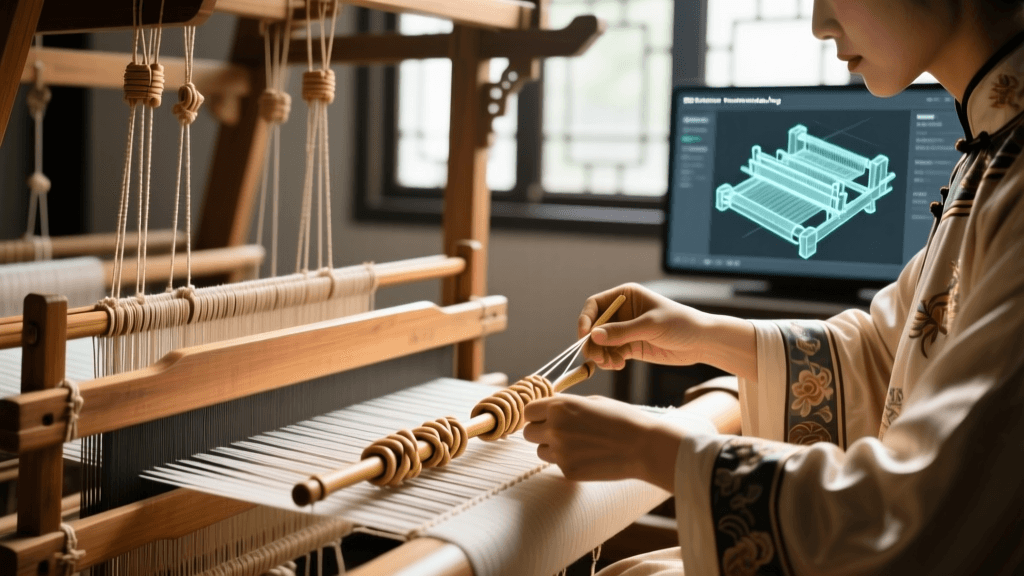
The Nanjing Yunjin (cloud brocade) drawloom, known in Chinese as the tihua ji, is not merely a tool for weaving; it is a monumental feat of ancient engineering and a cornerstone of Asian textile traditions. Standing roughly 4 meters high, 5 meters long, and 1.4 meters wide, this massive wooden structure requires the precision of a master carpenter to assemble. In 2026, authentic replicas and restored antique looms utilized in heritage workshops are primarily constructed from aged nanmu (phoebe zhennan) or dense elm. This specific timber selection ensures the frame can withstand the immense tension of up to 20,000 silk warp threads without warping over decades of continuous use.
Unlike standard pedal looms used for basic tabby or twill weaves, the Yunjin drawloom is a complex, multi-story apparatus that requires two highly skilled artisans to operate simultaneously. The structure is divided into two main operational zones: the elevated platform at the top, where the zhuaji (pattern puller) sits, and the ground-level bench, where the zhiji (main weaver) works. This vertical separation of labor is what allows for the creation of the incredibly dense, multi-colored, and metallic-threaded brocades that historically adorned Chinese imperial dragon robes.
Decoding the Huaben: Ancient Binary Programming
Long before the invention of the Jacquard loom in 19th-century France or the advent of modern computing, Chinese weavers developed a sophisticated method of storing complex pattern data. This system is known as the huaben (pattern book). Suspended from the top of the drawloom, the huaben is a massive, intricate bundle of knotted silk and cotton cords that dictates exactly which warp threads must be raised for every single pass of the weft shuttle.
According to the UNESCO Intangible Cultural Heritage registry, the creation of a huaben is a specialized art form in itself, mastered by a craftsman known as the daohua gong (pattern designer). The designer translates a visual painting or motif into a physical binary code. A knot in the cord represents a "1" (raise the warp thread), while the absence of a knot represents a "0" (leave the thread down). A single complex imperial robe pattern can require a huaben containing over 100,000 individual knots. In 2026, heritage institutes in Nanjing are utilizing advanced AI-driven optical scanners to digitize these physical knot matrices, preserving the ancient binary code in cloud databases before the organic silk cords degrade.
The Weaving Process: Tong Jing Duan Wei
The actual weaving of Yunjin brocade relies on a highly synchronized technique called Tong Jing Duan Wei (passing the warp and breaking the weft). The process is a mesmerizing dance of communication between the two weavers. The zhuaji at the top reads the huaben cords, pulling the specific bundle required for that exact row of the pattern. This action raises a precise shed (the gap between warp threads).
Once the shed is open, the zhiji below passes the shuttle carrying the weft thread. However, Yunjin is not a continuous weft weave. Because the patterns are highly localized and feature vibrant color changes, the weaver uses dozens of small, individual bobbins (called xiao guan) to "paint" the weft threads only where the specific color is needed in the pattern. This discontinuous weft technique is what gives Yunjin its incredible density and allows for the integration of heavy materials without weighing down the entire fabric. To maintain rhythm and ensure perfect synchronization over the deafening clatter of the wooden loom, the weavers traditionally chant rhythmic work songs, a practice still maintained in 2026 cultural exhibitions.
Traditional vs. Modern 2026 Loom Specifications
While the traditional wooden drawloom remains the gold standard for authentic, museum-grade Yunjin, modern textile engineering has introduced digital-aided Jacquard looms for commercial brocade production. Below is a comparison of the traditional apparatus versus the modern 2026 heritage-grade digital loom.
| Feature | Traditional Wooden Drawloom (Antique/Replica) | 2026 Digital-Aided Jacquard Loom |
|---|---|---|
| Dimensions | 5m L x 1.4m W x 4m H | 3m L x 2m W x 2.5m H |
| Operators Required | 2 (Pattern Puller and Weaver) | 1 (Automated Pattern Shedding) |
| Pattern Storage | Huaben (Knotted Silk/Cotton Cords) | Cloud-based CAD / AI Vector Mapping |
| Daily Output | 5 to 6 centimeters | 15 to 20 meters |
| Primary Frame Material | Nanmu Wood, Bamboo, Hemp | Carbon Fiber, Aerospace Aluminum |
| Authenticity Grade | Imperial / Museum Heritage | Commercial / High-End Fashion |
Sourcing Authentic Materials in 2026
The true magic of Yunjin lies in its opulent materials. The Metropolitan Museum of Art notes that Chinese silk weaving historically pushed the boundaries of material science, and this remains true today. For artisans and serious collectors looking to source authentic Yunjin materials in 2026, the market is highly specialized and tightly regulated.
- Mulberry Silk Warp: The foundation of the brocade requires ultra-fine, high-tensile mulberry silk. In 2026, premium Grade 6A raw silk thread sourced from the Jiangsu province costs approximately $85 USD per kilogram.
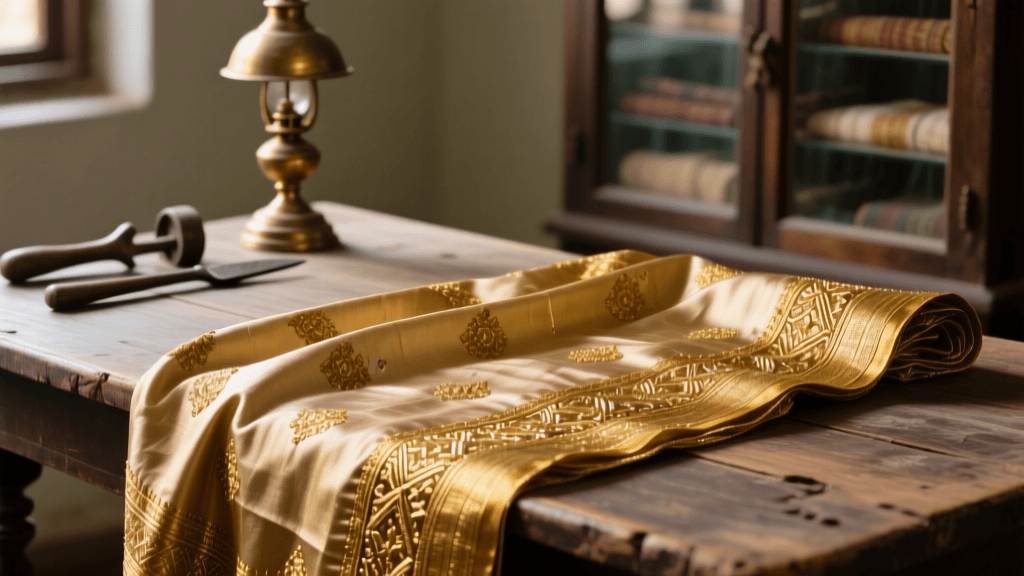
- Pianjin (Gold Thread): Authentic Yunjin utilizes real gold leaf. Artisans hammer 24-karat gold into microscopically thin sheets, which are then glued to a specialized paper backing and sliced into hair-thin strips before being spirally wrapped around a silk core. Due to fluctuating precious metal markets in 2026, genuine Pianjin thread costs roughly $1,400 USD per 50 meters.
- Peacock Feather Yarn: A hallmark of the most luxurious Yunjin pieces is the integration of peacock feather filaments. The iridescent barbs are carefully stripped and twisted with silk. Because of the immense labor required to harvest and spin this material, authentic peacock feather yarn commands a premium of $550 USD per 100 grams on the 2026 heritage textile market.
Preservation, Digital Archiving, and Apprenticeships
As of 2026, the survival of the Yunjin drawloom technique relies heavily on a hybrid approach of physical apprenticeship and digital preservation. The Nanjing Yunjin Research Institute has recently launched an initiative utilizing 3D motion-capture technology to record the exact biomechanical movements of the remaining master weavers. This data is being used to create haptic-feedback training gloves for new apprentices, helping them build the necessary muscle memory for throwing the shuttle and beating the weft with the correct force.
For those looking to study the craft, traditional apprenticeships remain grueling. A novice must spend a minimum of three years solely learning to read and tie the huaben knots before they are ever allowed to sit at the main weaving bench. Despite the physical toll and the slow pace of production, a new generation of young Chinese designers in 2026 is embracing the drawloom, integrating small panels of authentic, hand-woven Yunjin into contemporary haute couture and the burgeoning Xin Zhongshi (new Chinese style) fashion movement. This fusion of ancient binary programming and modern aesthetic sensibilities ensures that the rhythmic clatter of the wooden drawloom will continue to echo through the centuries.