Mastering Nanjing Yunjin Drawloom Weaving Techniques in 2026
The Renaissance of the Hua Lou: Chinese Drawloom Weaving in 2026
For over 1,500 years, the intricate art of Nanjing Yunjin (Cloud Brocade) has represented the pinnacle of Chinese silk weaving. Recognized for its complex patterns, vibrant colors, and luxurious materials—including gold thread and peacock feather yarn—Yunjin was historically reserved for imperial dragon robes. Today, as we navigate the cultural landscape of 2026, the traditional Chinese drawloom, known as the hua lou, is experiencing a profound renaissance. Artisans, researchers, and fashion historians are combining ancient muscle-memory techniques with modern preservation technologies to ensure this UNESCO-recognized craft survives the digital age.
According to the UNESCO Intangible Cultural Heritage registry, Nanjing Yunjin brocade techniques are among the most complex textile traditions in human history. Unlike modern jacquard looms that rely on punch cards or digital files, the traditional hua lou operates on a system of knotted cords and human synchronization. In 2026, mastering this loom is not just an act of historical recreation; it is a highly specialized, lucrative, and deeply respected profession within the Asian traditional garment sector.
The Anatomy of the Traditional Chinese Drawloom
To understand the weaving technique, one must first understand the monumental scale of the machinery. The traditional Yunjin drawloom is a massive wooden structure that dominates the workshop. As of 2026, a newly commissioned, master-crafted hua lou built from aged elm and camphor wood costs approximately 180,000 RMB (roughly $25,000 USD) and takes six months to construct.
- Dimensions: Typically 5.6 meters long, 1.4 meters wide, and 4 meters high.
- The Upper Section (The Draw Boy's Domain): The top of the loom houses the complex harness system. A second weaver, historically called the "draw boy" (now often a highly trained female artisan or senior apprentice), sits atop the loom to pull the specific warp threads according to the pattern code.
- The Lower Section (The Weaver's Domain): The primary weaver sits at the bottom, operating the treadles, passing the shuttles, and beating the weft into place with a heavy wooden reed.
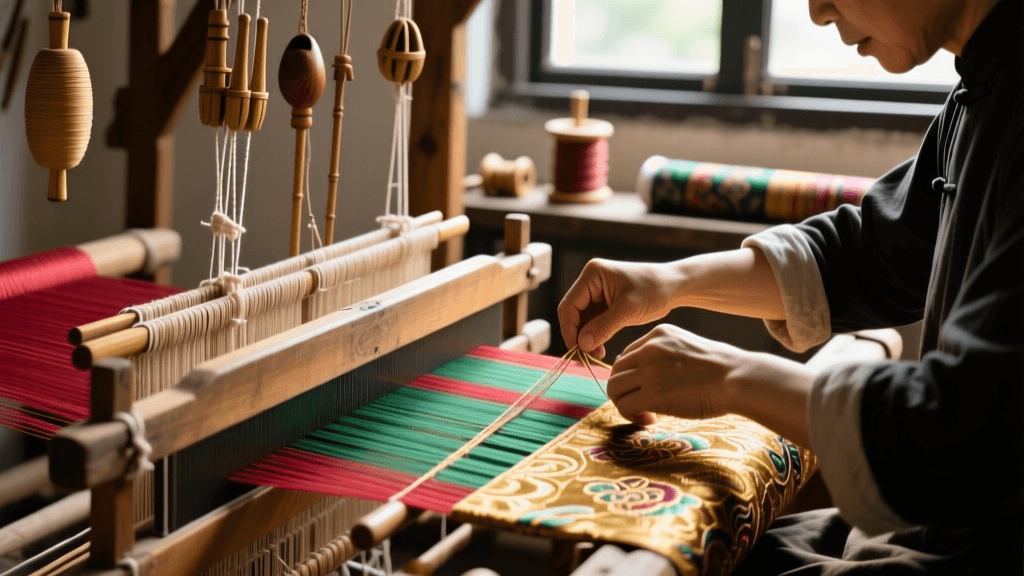
The genius of the hua lou lies in its ability to store complex patterns without mechanical automation. The pattern is memorized in a series of knotted cords hanging from the top of the loom. When the top weaver pulls a specific cord, it lifts a precise combination of warp threads, allowing the bottom weaver to pass the colored silk or gold shuttle through the shed.
The 2026 Yunjin Weaving Process: Step-by-Step
Creating a single meter of authentic Yunjin brocade remains a painstakingly slow process, even with 2026's ergonomic workshop improvements. The technique is divided into three major phases.
1. Pattern Drafting (Tiao Hua)
Before a single thread is loaded, the design must be translated into a binary-like code of knots. In the past, this was done entirely by hand on graph paper. In 2026, master drafters use specialized tablet software to map the pixel-by-pixel color grid of the design, which is then translated into physical knot-tying instructions. A complex dragon motif can require over 12,000 individual knot codes. This digital-to-physical bridge has reduced drafting errors by 40% compared to historical methods, though the physical tying of the harness cords remains entirely manual.
2. Loom Threading and Harness Tying
A standard Yunjin loom requires between 10,000 and 14,000 warp threads. Threading the heddles and reed takes a team of three artisans about two weeks of continuous work. The tension must be mathematically perfect; a variance of even a millimeter can result in a flawed brocade surface. Modern artisans in 2026 utilize laser-guided tension meters to ensure uniform warp tension, a subtle technological assist that preserves the hand-woven soul of the fabric while eliminating structural weaknesses.
3. The Dual-Weaver Synchronization
The actual weaving is a duet. The weaver at the bottom calls out the pattern sequence, and the draw artisan at the top pulls the corresponding cords. The bottom weaver then passes up to six different shuttles—carrying silk, silver, gold, and peacock feather yarns—in a single row. Because the weaver must manually interlock the weft threads (a technique called wa zhi or "digging the weave") to create the discontinuous brocade patterns, the loom only produces about 5 to 6 centimeters (2 inches) of fabric per day.
Material Sourcing and Costs for Modern Artisans
The hallmark of Yunjin is its extravagant use of materials. Sourcing these materials in 2026 requires navigating both environmental regulations and specialized luxury supply chains.
- Mulberry Silk: Sourced primarily from Zhejiang and Jiangsu provinces. High-grade 6A mulberry silk warp costs around 800 RMB per kilogram in 2026.
- Gold and Silver Threads: Authentic Yunjin uses real gold leaf hammered to a thickness of 0.1 microns, cut into micro-strips, and wrapped around a silk core. Due to the fluctuating gold market in 2026, authentic gold-wrapped thread costs upwards of 4,500 RMB per 100 meters.
- Peacock Feather Yarn: Ethically sourced molted peacock feathers are stripped for their iridescent barbs and twisted into silk cores. This rare material is reserved for the highest-tier imperial replica garments and costs approximately 1,200 RMB per meter.
Production Metrics: Traditional vs. 2026 Assisted Methods
While the core mechanics of the hua lou remain untouched, the periphery of the craft has evolved. Below is a comparison of historical production metrics versus the modern 2026 artisan standard.
| Production Metric | 19th Century Historical Standard | 2026 Preserved Artisan Standard |
|---|---|---|
| Daily Output (Complex Brocade) | 4 - 5 cm per day | 5 - 6 cm per day (ergonomic seating) |
| Pattern Drafting Time | 3 - 4 months (manual graphing) | 3 - 4 weeks (digital mapping to physical knots) |
| Warp Threading Time | 20 - 25 days | 12 - 14 days (laser tension guides) |
| Material Waste | 15% - 20% | Less than 5% (AI nesting software for cutting) |
| Artisan Team Size | 2 weavers + 2 apprentices | 2 weavers + 1 digital archivist |
Preservation and Academic Research in 2026
The survival of the Chinese drawloom relies heavily on institutional support and academic research. The Nanjing Yunjin Institute remains the epicenter of this craft, operating as both a production house for state gifts and a research facility. In 2026, a major focus of the institute is the restoration of damaged Ming and Qing dynasty textiles. By utilizing multispectral imaging, researchers can identify faded natural dyes—such as madder root, indigo, and safflower—and recreate the exact chemical mordants used centuries ago.
Furthermore, institutions like the Victoria and Albert Museum's Asian textile archives frequently collaborate with Chinese weaving masters to study the structural drape and weave density of historical export silks. These international partnerships ensure that the structural mathematics of the hua lou are documented not just as a local Chinese tradition, but as a foundational pillar of global textile engineering.
Where to Study and Experience Yunjin Weaving Today
For textile students, fashion historians, and enthusiasts looking to study the drawloom in 2026, several avenues exist:
- The Nanjing Yunjin Institute (Nanjing, China): Offers intensive 6-month apprenticeship programs focusing on the physical mechanics of the drawloom and the chemistry of natural dyeing.
- China National Silk Museum (Hangzhou, China): While focused broadly on silk, their 2026 exhibition wings feature interactive, scaled-down drawloom models that allow visitors to understand the harness-lifting mechanics.
- University Textile Programs: Institutions like Donghua University in Shanghai have integrated traditional loom mechanics into their sustainable fashion curricula, teaching students how ancient zero-waste weaving techniques can inform modern eco-friendly design.
Conclusion
The traditional Chinese drawloom is far more than a relic of the past; it is a living, breathing machine that demands the highest level of human coordination, artistic vision, and patience. As the Xin Zhongshi (new Chinese style) movement continues to drive global demand for authentic, historically accurate traditional garments in 2026, the masters of the hua lou are more vital than ever. By weaving together the golden threads of antiquity with the digital precision of the modern era, these artisans ensure that the clouds of Nanjing will continue to drape the world in beauty for centuries to come.