Nanjing Yunjin Loom Weaving: 2026 Ancient Techniques Revived
The Renaissance of the Drawloom in 2026
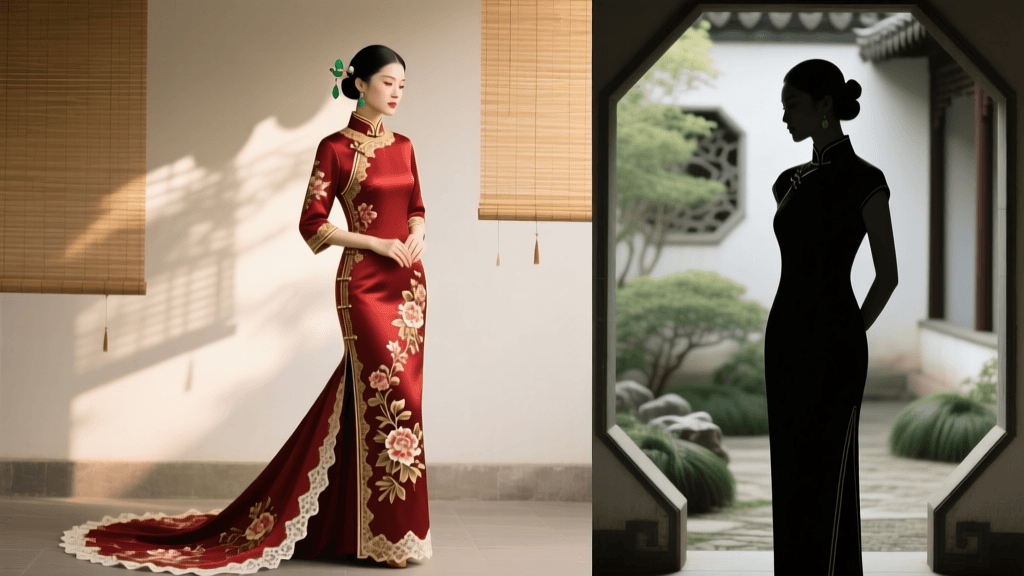
As the global fashion industry pivots toward hyper-artisanal craftsmanship and cultural authenticity, the ancient Chinese drawloom has experienced an unprecedented renaissance. In 2026, the Xin Zhongshi (new Chinese style) movement has evolved beyond mere aesthetic appropriation, demanding structural and material authenticity. At the forefront of this revival is Nanjing Yunjin, or 'Cloud Brocade,' a textile so complex that it cannot be replicated by modern computerized Jacquard looms. Today, high-end designers and heritage preservationists are turning back to the massive wooden Hualou (floral) looms to create garments that bridge millennia of Chinese textile engineering with contemporary sustainable fashion.
Recognized by the UNESCO Intangible Cultural Heritage list, the technique of weaving Yunjin represents the pinnacle of ancient Chinese silk weaving. In 2026, the demand for authentic, hand-woven Yunjin has surged, driven by a new generation of collectors and fashion houses who view these textiles not merely as fabric, but as wearable architectural artifacts.
Anatomy of the Nanjing Hualou Drawloom
To understand the complexity of Yunjin, one must first understand the machine that creates it. The traditional Hualou loom is a colossal wooden structure, typically measuring four meters in length, 1.4 meters in width, and over two meters in height. Unlike standard pedal looms operated by a single weaver, the Hualou requires a synchronized two-person operation.
The 'Human Jacquard' Mechanism
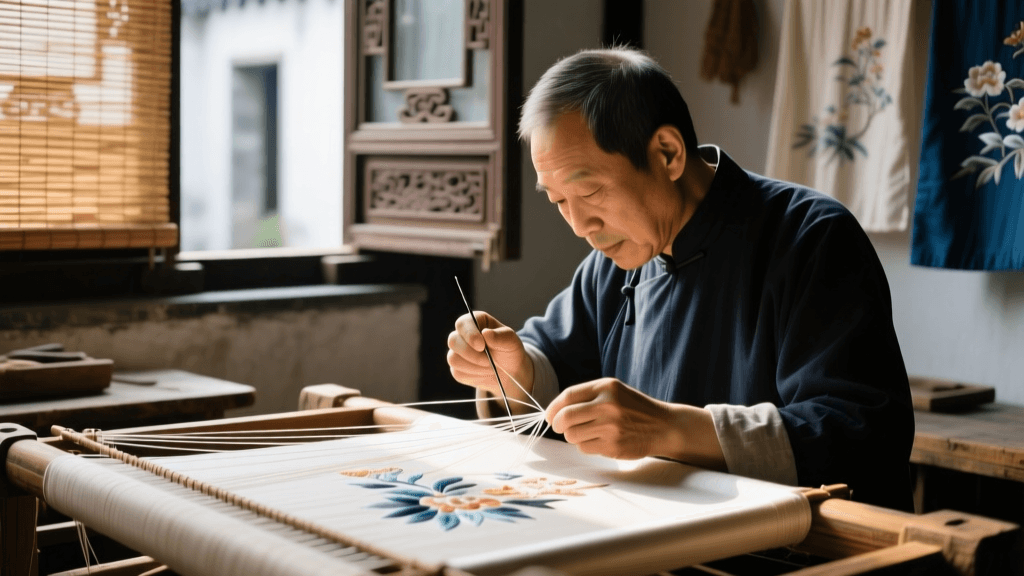
The weaver sits at the front of the loom, managing the shuttle and the intricate interlacing of the weft threads. Above them, perched on the top of the loom, sits the 'drawboy' (or in modern 2026 studios, a highly trained pattern-puller). This second operator is responsible for pulling the specific warp threads upward according to a complex, knot-based pattern memory system known as the 'Jie Ben' (pattern book). This ancient binary code of knotted cords predates the French Jacquard punch-card system by centuries. As noted by the Metropolitan Museum of Art in their historical analysis of Chinese silk, the drawloom's invention allowed for the creation of large, complex, and asymmetrical repeating patterns that defined imperial Chinese textiles.
The Zhuanghua Technique: Digging Flowers and Branching
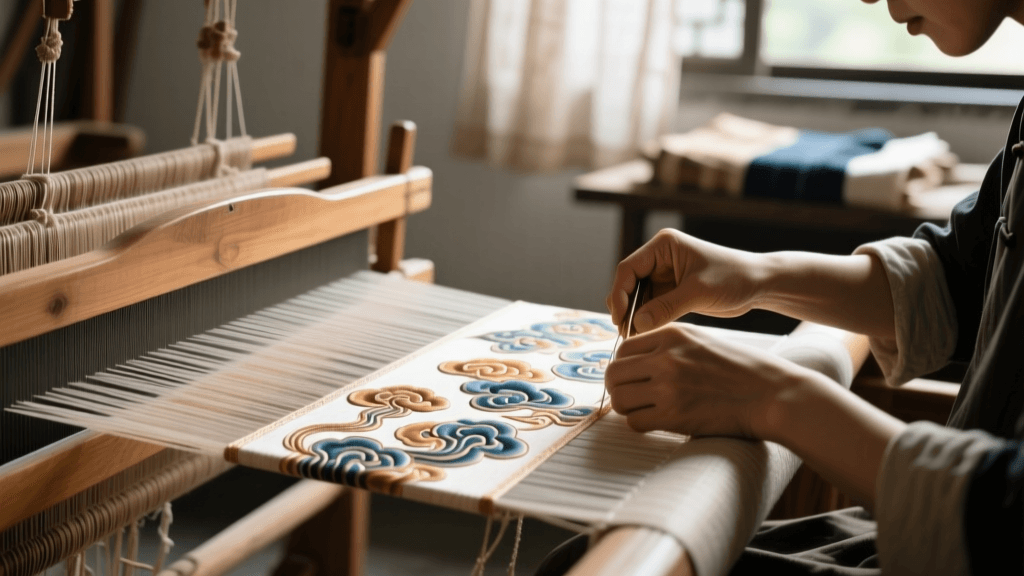
The true magic of the Nanjing drawloom lies in the 'Zhuanghua' (妆花) technique. Unlike standard brocades where the colored weft thread runs entirely from one edge of the fabric to the other (selvedge to selvedge), Zhuanghua utilizes a method called 'Tong Jing Duan Wei' (through the warp and broken weft). The weaver uses dozens of small, individual bobbins, each carrying a different colored silk or metallic thread, weaving them only into the specific areas of the pattern where that color is needed.
This technique allows for an infinite color palette within a single repeating motif, creating the signature 'cloud-like' gradients and vivid, multi-colored floral patterns that give Yunjin its name. In 2026, master weavers are pushing this technique further by integrating micro-gradients using naturally dyed threads, achieving photographic levels of detail in traditional motifs like the mang (python) dragon and phoenix.
2026 Material Innovations: Lotus Fiber and Peace Silk
While traditional Yunjin relies heavily on cultivated mulberry silk, peacock feather yarn, and real gold and silver foil strips, the 2026 Xin Zhongshi market has introduced a demand for ethical and sustainable luxury. Contemporary heritage studios in Nanjing and Suzhou are now adapting the ancient drawlooms to handle alternative, eco-conscious fibers.
- Lotus Stem Fiber: Extracted from the stems of lotus plants, this naturally cooling and incredibly rare fiber is being spun into fine yarns and used as the warp base for lightweight, summer-weight Yunjin garments.
- Ahimsa (Peace) Silk: Allowing the silkworm to emerge from the cocoon before harvesting, peace silk yields a slightly slubbier, more textured thread. Weavers in 2026 have recalibrated the tension of the Hualou loom to accommodate this irregularity, resulting in a Cloud Brocade with a distinctly organic, wabi-sabi aesthetic that appeals to modern luxury buyers.
- Recycled Metallic Yarns: Instead of pure gold leaf wrapped around silk cores, modern studios are utilizing tarnish-resistant, recycled copper and silver alloys, reducing the environmental impact of mining while maintaining the iconic metallic shimmer of imperial brocades.
Comparative Analysis: Heritage vs. Modernized 2026 Looms
While the fundamental mechanics of the drawloom remain untouched, the peripherals of the weaving studio have modernized. Below is a comparison of traditional historical setups versus the optimized heritage studios operating in 2026.
| Feature | 19th Century Imperial Setup | 2026 Heritage Studio Setup |
|---|---|---|
| Pattern Memory | Hand-tied cotton Jie Ben (knot books) | Laser-verified knot books backed by digital 3D archives |
| Dye Sources | Local botanical and heavy mineral pigments | Lab-tested, non-toxic botanical dyes with UV stabilizers |
| Daily Output | 2 to 3 inches (5-7 cm) per day | 3 to 4 inches (7-10 cm) per day (optimized ergonomics) |
| Lighting | Natural sunlight (limited weaving hours) | Full-spectrum, color-accurate LED studio lighting |
| Primary Market | Imperial court and aristocracy | Haute couture, Xin Zhongshi collectors, museums |
Commissioning Custom Yunjin in 2026
For designers and collectors looking to commission authentic Nanjing Yunjin in 2026, the process is an exercise in patience and investment. Because a single Hualou loom can only produce a few inches of fabric per day, and the preparation of the pattern book can take months, the lead time for a custom commission is typically between eight and fourteen months.
Pricing reflects the intense human labor and material costs. As of early 2026, standard Yunjin fabric woven with high-grade mulberry silk and synthetic metallic threads starts at approximately 15,000 RMB (roughly $2,100 USD) per meter. However, commissions utilizing the traditional 'Zhuanghua' technique with real gold foil threads and peace silk warp can easily exceed 80,000 RMB ($11,200 USD) per meter. Despite the high cost, waitlists at premier Nanjing studios are booked out through late 2027, driven by international fashion houses seeking authentic heritage collaborations.
Preserving the Intangible Heritage
The survival of the Nanjing drawloom technique relies on the transmission of knowledge. In 2026, the Chinese government and private cultural foundations have launched aggressive apprenticeship stipends to attract younger generations to the physically demanding role of the pattern-puller and weaver. By integrating ancient weaving techniques with the modern ethos of sustainability and ethical luxury, the Hualou loom is no longer just a museum relic. It is a living, breathing engine of the 2026 Xin Zhongshi movement, proving that the most advanced technology in fashion is sometimes centuries old.