Ancient Chinese Drawlooms: 2026 Yunjin Weaving Revival
The Resurgence of Cloud Brocade in Modern Couture
In the ever-evolving landscape of global fashion, the Xin Zhongshi (New Chinese Style) movement has reached a sophisticated zenith in 2026. At the very heart of this sartorial renaissance lies Nanjing Yunjin, or 'Cloud Brocade'—a textile so exquisite it was historically reserved for imperial dragon robes. Today, contemporary couturiers and heritage artisans are collaborating to bring this ancient craft out of the museum archives and onto the runways of Shanghai and Paris. Unlike mass-produced jacquard fabrics, authentic Yunjin is woven on massive, traditional wooden drawlooms, utilizing techniques that have remained largely unchanged for over 1,600 years. As recognized by UNESCO's Representative List of the Intangible Cultural Heritage of Humanity, the craft represents a pinnacle of human ingenuity, blending complex mathematics, artistic vision, and unparalleled manual dexterity.
The Engineering Marvel of the Yunjin Drawloom
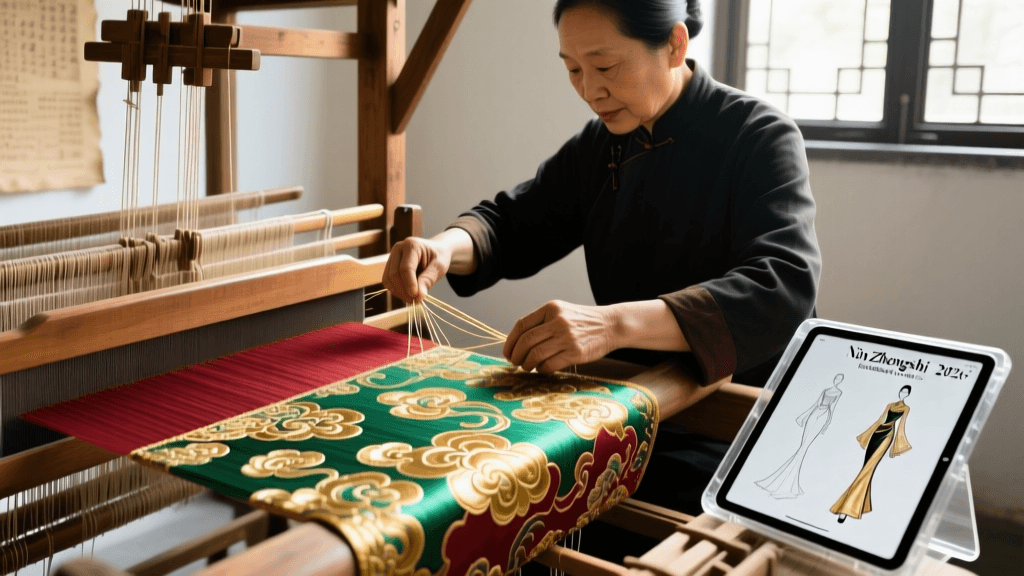
To understand the value of Yunjin, one must first understand the formidable machinery required to create it. The traditional Nanjing drawloom is an architectural marvel of ancient engineering, typically measuring over five meters in length and four meters in height. Constructed entirely from wood and bamboo, the loom operates without electricity or modern mechanical punch cards. Instead, it relies on a sophisticated 'knot memory' system.
The upper section of the loom, known as the Hua Lou (pattern tower), houses thousands of individually tied silk cords. These cords act as the physical programming of the loom, dictating the intricate, multi-colored patterns that give Cloud Brocade its name. The complexity of the pattern directly correlates to the number of cords; a single garment panel may require a memory system of over 10,000 distinct knots. According to historical textile analyses documented by institutions like The Metropolitan Museum of Art's Heilbrunn Timeline of Art History, this manual programming predates the Jacquard loom by centuries, showcasing a profound early understanding of binary logic and automated weaving principles.
A Symphony of Two Artisans: The Weaving Process
Operating a Yunjin drawloom is an intensely collaborative physical endeavor that requires two highly skilled artisans working in perfect synchronization. The process is divided into two distinct roles:
- The Drawboy (Tiao Hua): Seated at the top of the four-meter-high pattern tower, this artisan is responsible for pulling the specific silk cords according to the pattern sequence. By lifting the precise combination of warp threads, they create the 'shed' (the space through which the weft is passed) for the next row of the design.
- The Weaver (Zhi Hua): Seated at the base of the loom, the master weaver manages the shuttle, beats the weft into place with a heavy wooden reed, and intricately interlocks the multi-colored weft threads. The weaver must also seamlessly integrate supplementary materials like gold foil and peacock feather yarns into the silk foundation.
Due to the painstaking nature of this manual coordination, a master weaving team can produce only about five to six centimeters of authentic Yunjin fabric per day. This extreme scarcity is what drives the 2026 market value of the textile, making it one of the most expensive and sought-after materials in luxury fashion.
2026 Couture: Yunjin Meets the Xin Zhongshi Movement
In 2026, the integration of Yunjin into modern wardrobes has moved far beyond traditional ceremonial wear. The Xin Zhongshi movement emphasizes structural tailoring, minimalist silhouettes, and the juxtaposition of ancient textiles with contemporary cuts. Designers are strategically utilizing Cloud Brocade as accent elements rather than full garments, ensuring the fabric's visual weight does not overwhelm the wearer.
Current trends from the Spring/Summer 2026 fashion weeks highlight several innovative applications:
- Structured Blazers: Yunjin panels are being inset into the lapels and cuffs of sharply tailored, wool-blend blazers, creating a striking contrast between matte modern suiting and lustrous, metallic brocade.
- Mamianqun Accents: The traditional horse-face skirt (Mamianqun) remains a staple of the New Chinese Style. In 2026, designers are using narrow, vertically woven strips of Yunjin to border the pleats, allowing the intricate patterns to flash dynamically as the wearer moves.
- Corsetry and Bodices: The inherent stiffness and structural integrity of heavily woven Cloud Brocade make it an ideal material for modern corsetry and structured bodices, providing support while displaying the textile's three-dimensional relief.
Material Sourcing: Traditional vs. 2026 Sustainable Alternatives
Historically, Yunjin relied on heavily processed mulberry silk, real gold leaf, and exotic bird feathers. However, the 2026 luxury market demands strict adherence to ethical sourcing and environmental sustainability. Artisans and material scientists have developed remarkable alternatives that maintain the visual splendor of Cloud Brocade while aligning with modern ecological standards.
| Material Component | Traditional Historical Source | 2026 Sustainable Couture Alternative | Visual & Tactile Impact |
|---|---|---|---|
| Warp Foundation | Degummed Mulberry Silk | Peace Silk (Ahimsa) & Lotus Fiber Blends | Slightly softer drape, matte finish, highly breathable |
| Metallic Threads | Real Gold/Silver Foil on Paper | Recycled PVD-Coated Copper Yarns | Identical luster, tarnish-resistant, cruelty-free |
| Iridescent Accents | Wild Peacock Feather Filaments | Lab-Grown Cellulose Iridescent Fibers | Shifts color in light, zero wildlife impact, durable |
| Dyes | Heavy Metal Mordants & Indigo | Microbial Pigments & Plant-Based Mordants | Vibrant, colorfast, zero toxic water runoff |
These material innovations have allowed heritage workshops in Nanjing to scale their production slightly without compromising the integrity of the drawloom technique. The use of microbial pigments, for instance, has introduced new, vivid colorways that were previously impossible to achieve with traditional botanical dyes, giving 2026 collections a distinctly modern palette.
Archival Storage and Maintenance for Cloud Brocade
Investing in a Yunjin garment requires a commitment to proper archival storage. Because the fabric incorporates diverse materials—including metallic threads and dense silk weaves—it is highly susceptible to environmental degradation if not cared for correctly. For collectors and couture clients in 2026, the following maintenance protocols are essential:
- Humidity Control: Store garments in a climate-controlled environment maintaining a relative humidity of exactly 45% to 55%. Fluctuations can cause the silk to expand and contract, leading to the snapping of delicate metallic wefts.
- Acid-Free Buffering: Never fold Yunjin directly. Garments should be stuffed with unbuffered, acid-free archival tissue paper to maintain their three-dimensional shape and prevent hard creases that can permanently fracture the gold-wrapped threads.
- Light Exposure: Display pieces must be kept away from direct sunlight and high-UV artificial lighting. Even with modern colorfast dyes, the silk protein will degrade and yellow under prolonged UV exposure.
- Pest Deterrence: Avoid chemical mothballs, which can react with metallic yarns and cause severe tarnishing. Instead, utilize sealed cedar wood storage chests and natural dried neem leaves to deter textile pests.
Sourcing and Investing in Authentic Yunjin in 2026
As the demand for authentic Xin Zhongshi garments surges, the market has seen an influx of machine-made jacquard imitations falsely marketed as hand-woven Yunjin. For serious collectors and designers, verifying authenticity is paramount. Genuine Cloud Brocade is certified by the Nanjing Yunjin Research Institute, which issues a digital blockchain-backed certificate of authenticity for every meter of fabric produced on a traditional drawloom.
In 2026, the market pricing for authentic, hand-woven Nanjing Yunjin reflects its extreme labor intensity. Standard patterns utilizing sustainable silk and metallic alternatives start at approximately $800 to $1,200 USD per linear meter. Complex, custom-commissioned patterns requiring the programming of a new Hua Lou knot memory system can easily exceed $5,000 USD per meter, factoring in the weeks of loom-setup time required before weaving can even begin.
For those looking to acquire these masterpieces, direct commissions through heritage workshops in the Qinhuai District of Nanjing remain the most reliable avenue. Additionally, select luxury consignment houses and specialized Asian textile galleries in London and New York have begun curating verified vintage and contemporary Yunjin pieces, bridging the gap between ancient Chinese heritage and the future of global sustainable couture.