Ming Dynasty Hanfu: Decoding Rank Badges and Color Codes
The Zenith of Sartorial Regulation
The Ming Dynasty (1368–1644) represents a golden era of traditional Chinese clothing, characterized by the restoration of Han Chinese cultural identity following the Mongol-led Yuan Dynasty. When the Hongwu Emperor established the Ming court, he instituted rigorous sumptuary laws that dictated every aspect of dress, from the weave of the silk to the exact shade of dye used. These regulations were not merely aesthetic choices; they were profound expressions of Confucian social hierarchy, cosmological philosophy, and political authority. Understanding Ming Dynasty Hanfu requires a deep dive into its complex color codes and the iconic rank badges, known as buzi, which served as a visual language of power.
According to the Metropolitan Museum of Art's Heilbrunn Timeline of Art History, the Ming era saw an unprecedented refinement in silk weaving techniques and textile symbolism. The clothing of officials was designed to reflect the cosmic order, ensuring that every court gathering was a living map of the empire's administrative and spiritual hierarchy.
The Five Elements and Ming Color Codes
Color in Ming Dynasty official dress was inextricably linked to the Wuxing (Five Elements) theory and the principles of Yin and Yang. The state strictly controlled the production and distribution of dyes, reserving specific hues for distinct social strata.
Imperial Yellow (Ming Huang)
Bright, sunlit yellow was the exclusive prerogative of the Emperor and the Crown Prince. Symbolizing the Earth element and the Center of the cosmos, this hue was traditionally derived from the dried flower buds of the pagoda tree (Sophora japonica). The imperial Gunlongpao (dragon robe) utilized this vibrant yellow as a canvas for intricate gold-woven dragons. Any unauthorized use of bright yellow by commoners or officials was considered treasonous.
Crimson Red (Fei Hong)
High-ranking officials (typically 1st to 4th rank) were permitted to wear crimson and deep reds. Red symbolized Fire, the South, and summer, representing prosperity and high status. Authentic Ming reds were achieved through labor-intensive dyeing processes using madder root or safflower. When sourcing modern replicas, buyers should look for plant-dyed silks that exhibit a rich, slightly uneven depth of color, as opposed to the flat, synthetic brightness of chemical dyes.
Blue and Green (Qing and Lu)
Mid-to-lower-ranking officials (5th to 9th rank) wore various shades of blue and green. Blue, associated with Wood and the East, was derived from indigo fermentation. Green represented growth and renewal. Commoners, meanwhile, were largely restricted to duller, undyed, or lightly tinted fabrics in shades of off-white, pale brown, or muted gray, though wealthy merchants often found loopholes to wear luxurious fabrics in permitted colors.
Buzi (Rank Badges): The Animal Hierarchy
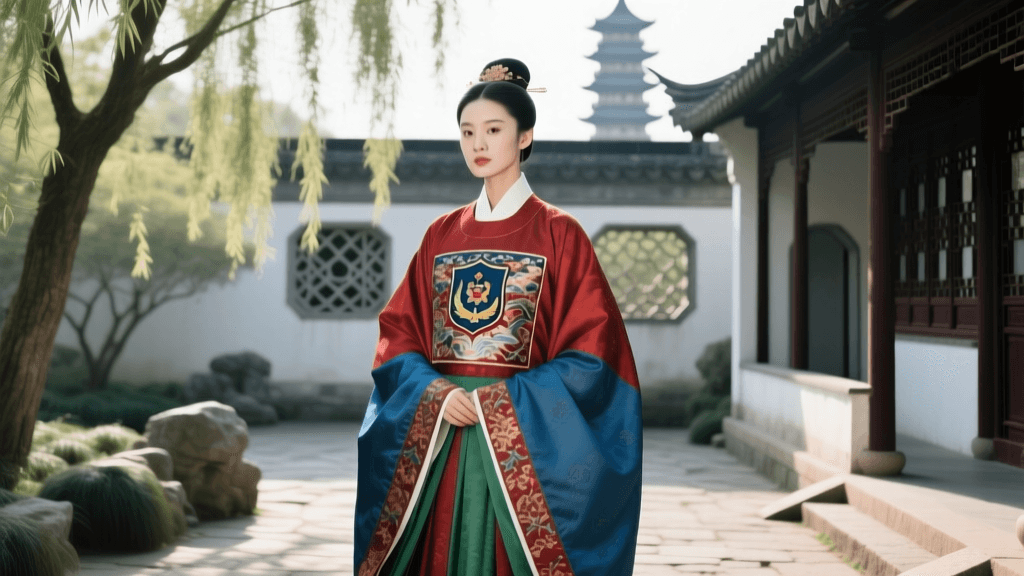
Perhaps the most recognizable element of Ming official dress is the buzi, or rank badge. Instituted in 1391, these square or round embroidered patches were affixed to the front and back of the official's outer robe. As documented in the Metropolitan Museum of Art's collection of Ming Dynasty rank badges, these textiles were masterpieces of embroidery, often utilizing peacock feather threads and gold leaf to catch the candlelight of the imperial court.
The badges followed a strict dichotomy: Civil officials wore birds to symbolize literary elegance and administrative grace, while Military officials wore beasts to represent courage, strength, and martial prowess. The Smithsonian National Museum of Asian Art notes that these badges were not just decorative; they were essential tools for court protocol, allowing officials to instantly recognize the seniority of their peers and determine the correct order of bowing and seating.
Ming Dynasty Official Rank Chart
| Rank | Civil Official (Birds) | Military Official (Beasts) |
|---|---|---|
| 1st | Crane (Xianhe) | Lion (Shi) |
| 2nd | Golden Pheasant (Jinji) | Lion (Shi) |
| 3rd | Peacock (Kongque) | Tiger (Hu) |
| 4th | Wild Goose (Yan) | Leopard (Bao) |
| 5th | Silver Pheasant (Baijing) | Bear (Xiong) |
| 6th | Egret (Bailu) | Panther (Biao) |
| 7th | Mandarin Duck (Xichi) | Rhinoceros (Xi) |
| 8th | Quail (Anchun) | Rhinoceros (Xi) |
| 9th | Oriole (Huangli) | Sea Horse (Haima) |
Note: The 'Sea Horse' in Ming mythology was not a marine creature, but a mythical white horse that could gallop across water, symbolizing the naval and riverine defense forces.
Actionable Guide: Sourcing and Wearing Ming Replicas
For Hanfu enthusiasts, historical reenactors, and textile collectors, accurately recreating a Ming Dynasty official look requires attention to specific garment structures, measurements, and fabric choices. The most iconic garments for this aesthetic are the Yuanlingpao (round-collar robe) and the Daopao (Taoist robe, often worn by scholars and lower officials).
Crucial Measurements and Silhouette
- Sleeve Length and Shape: Ming formal robes frequently utilized Hui Xiu (returning sleeves) or Pipa (lute-shaped) sleeves. For an authentic drape, the sleeve length should be measured from the center-back of the neck, across the shoulder, down the arm, and extending 20 to 30 cm past the fingertips. This excess fabric creates the elegant, sweeping fold characteristic of Ming portraiture.
- Collar Construction: The round collar of a Yuanlingpao must sit flush against the base of the neck. Look for collars with a height of 4 to 6 cm, reinforced with heavy interfacing or traditional starched linen to maintain a rigid, circular shape that does not collapse.
- Closure System: Ming robes utilized fabric ties (not buttons or frogs, which became more common in the Qing Dynasty). Ensure the inner ties are securely stitched at the right armpit and the outer ties at the left shoulder, adhering to the traditional jiaoling youren (right-over-left) principle.
Fabric Tiers, Costs, and Sourcing
When commissioning or purchasing Ming-style Hanfu, the fabric dictates both the historical accuracy and the price point.
- Entry-Level ($45 – $120): Polyester-cotton blends or basic rayon. These are suitable for casual cosplay or stage performances but lack the structural drape and breathability of historical textiles. Avoid shiny synthetic satins, as they reflect light poorly in photography.
- Mid-Tier Authentic ($150 – $400): Silk-cotton blends, linen, and machine-woven silk jacquard. Look for jacquard patterns that mimic historical motifs like the Yunwen (auspicious clouds) or Anhua (hidden floral patterns). These fabrics offer excellent drape and are ideal for serious Hanfu enthusiasts.
- Museum-Grade Bespoke ($800 – $3,000+): Hand-woven Zhuanghua (brocade) or Kesi (silk tapestry) sourced from traditional weaving hubs like Shengze in Suzhou. Custom plant-dyeing (using indigo, madder, or gardenia) adds significant cost and time. Expect to wait 60 to 120 days for a bespoke commission from a master weaver.
Accessorizing the Official Look
A Ming official robe is incomplete without its requisite accessories. The Wusha Mao (black gauze hat) with its wing-like flaps is mandatory for formal court dress. The hat should fit snugly, sitting just above the eyebrows. Around the waist, officials wore heavy belts made of jade, gold, or horn, depending on their rank. Modern replicas often use resin or carved wood to simulate jade plaques. Finally, black leather or heavy cotton boots with thick, white layered soles (Chaodi) elevate the wearer's posture, forcing a slow, deliberate, and dignified gait appropriate for a Ming scholar-official.
Conclusion
The clothing of the Ming Dynasty was a masterclass in visual communication. Through the meticulous application of Wuxing color theory and the intricate embroidery of animal rank badges, the empire maintained a visible, wearable hierarchy. Today, as the Hanfu movement experiences a global revival, understanding these historical codes allows modern wearers to move beyond simple costuming. By paying close attention to authentic measurements, traditional plant dyes, and accurate textile structures, enthusiasts can honor the profound craftsmanship and philosophical depth of China's sartorial heritage.