Mastering Yunjin Drawloom Weaving Techniques in 2026
The Resurgence of Yunjin in the 2026 Xin Zhongshi Movement
The resurgence of the Xin Zhongshi (New Chinese Style) movement in 2026 has catapulted traditional Asian garments from niche historical reenactments into the forefront of global high fashion and luxury streetwear. At the absolute pinnacle of this textile renaissance is Nanjing Yunjin, or 'Cloud Brocade.' Named for its rich, cloud-like patterns and luxurious textures, Yunjin represents the zenith of Chinese silk weaving. As contemporary designers increasingly seek authentic heritage techniques to anchor their 2026 collections, understanding the ancient mechanics of the traditional Yunjin drawloom has never been more relevant for textile scholars, fashion historians, and luxury garment collectors.
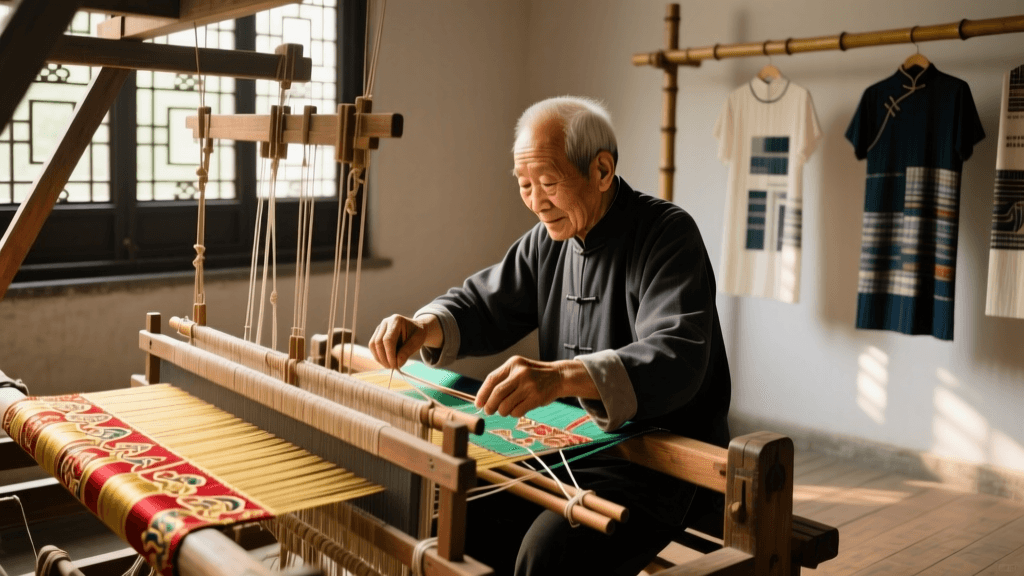
Unlike modern mechanized weaving, the creation of authentic Yunjin relies on a massive, ancient wooden drawloom and a complex oral and physical tradition passed down through generations. In 2026, as the demand for sustainable, slow-fashion heritage pieces reaches an all-time high, the meticulous art of Yunjin weaving stands as a testament to the enduring value of human craftsmanship in an increasingly automated world.
UNESCO Heritage and Historical Context
The cultural significance of this textile is globally recognized. The traditional weaving techniques of Nanjing Yunjin were inscribed on the UNESCO Representative List of the Intangible Cultural Heritage of Humanity. Originating over 1,600 years ago and reaching its zenith during the Ming and Qing dynasties, Yunjin was historically reserved exclusively for imperial garments, particularly the dragon robes of the emperor. The sheer complexity of the weave meant that it could not be replicated by early power looms, preserving its ancient methodology well into the 21st century.
According to The Metropolitan Museum of Art's Heilbrunn Timeline of Art History, Chinese silk weaving techniques, particularly brocades and damasks, were highly guarded secrets that drove the economic engines of the ancient Silk Road. Today, the preservation of these techniques is not just about maintaining a historical artifact; it is about keeping a living, breathing art form active in the modern design lexicon.
The Architecture of the Traditional Drawloom
To truly appreciate Yunjin, one must understand the formidable machinery used to create it. The traditional Yunjin drawloom is a colossal wooden structure, typically measuring 5.6 meters in length, 4 meters in height, and 1.4 meters in width. It is an engineering marvel of ancient China, comprising over 1,900 individual wooden parts. The loom is entirely assembled without the use of metal nails, relying instead on traditional mortise and tenon joinery.
Key Components of the Loom:
- The Warp Beam and Cloth Beam: These heavy wooden cylinders hold the tension of the silk warp threads, which can number in the tens of thousands.
- The Heddles and Quills: Used to separate the warp threads to allow the weft to pass through.
- The Pattern Tower (Hualou): The elevated section of the loom where the complex pattern harness is suspended. This is the 'brain' of the loom, where the intricate floral and dragon motifs are programmed using a system of knotted cords.
- The Shuttle and Bobbins: Unlike standard weaving which uses a single shuttle, Yunjin weaving utilizes dozens of small, specialized bobbins, each loaded with a different colored silk or metallic thread.
The Two-Weaver Symbiosis: A Choreographed Dance
One of the most defining characteristics of Yunjin weaving is that it cannot be operated by a single person. It requires a highly synchronized duo: the zhuaihua (pattern puller) and the zhiji (weaver).
The zhuaihua sits atop the 4-meter-high pattern tower. Their job is to pull the specific pattern cords in a precise sequence, lifting the exact warp threads required for the next row of the design. This requires immense physical strength and a flawless memory of the pattern's 'code.' Below, the zhiji sits at the front of the loom. They operate the treadles, throw the shuttles, and pack the weft threads tightly against the previous row using a heavy wooden reed. The two weavers communicate through a rhythmic chant or a series of taps, ensuring their movements are perfectly timed. In 2026, finding and training these synchronized pairs remains one of the greatest challenges for the Nanjing Yunjin Research Institute.
The 'Tong Jing Duan Wei' Technique Explained
The core technical marvel of Yunjin is the Tong Jing Duan Wei (通经断纬) technique, which translates to 'continuous warp, discontinuous weft.' In standard weaving, the weft thread runs continuously from one edge of the fabric to the other. In Yunjin, the weft threads are only woven into the specific areas of the warp where their color is needed for the pattern.
This means that if a design features a small red peony on a gold background, the red weft thread is only woven into the shape of the peony and then cut or turned back, rather than carrying across the entire width of the gold background. This technique allows for an unlimited color palette and incredibly detailed, painterly gradients within the fabric. It is essentially 'weaving with pixels,' where each small bobbin acts as a brushstroke. This method makes the fabric incredibly dense, heavy, and structurally sound, but it is also agonizingly slow. A master weaving team in 2026 can produce a maximum of 5 to 6 centimeters (about 2 inches) of authentic Yunjin fabric per day.
Luxurious Materials: Gold Leaf and Peacock Feathers
What elevates Yunjin above other global brocades, such as the French Jacquard or Italian Lampas, is its extravagant use of materials. Historically and in contemporary luxury commissions, Yunjin incorporates real gold and silver. Artisans use a specialized technique to hammer gold into microscopically thin leaf, which is then applied to paper, cut into hair-thin strips, and wrapped around a core silk thread. This creates a flexible, non-tarnishing gold thread that catches the light dynamically as the wearer moves.
Furthermore, premium 2026 Yunjin commissions often integrate peacock feather filaments. The iridescent 'eye' of the feather is carefully stripped and spun with silk, resulting in a shimmering, emerald-green thread that shifts color depending on the angle of light. These organic, precious materials are impossible to replicate authentically with modern synthetic metallic yarns.
2026 Market Analysis: Handwoven vs. Jacquard Adaptations
As the Xin Zhongshi movement matures in 2026, the market has bifurcated into two distinct categories: authentic handwoven heritage pieces and modern Jacquard-loom adaptations. Understanding the difference is crucial for collectors, designers, and consumers.
| Feature | Authentic Handwoven Yunjin (2026) | Modern Jacquard Adaptation (2026) |
|---|---|---|
| Production Time | 5-6 cm per day (approx. 2 inches) | 50+ meters per day |
| Price per Meter | ¥15,000 - ¥45,000+ ($2,100 - $6,300+ USD) | ¥800 - ¥3,000 ($110 - $420 USD) |
| Materials Used | Mulberry silk, real gold leaf, peacock feather | Silk blends, synthetic metallic Lurex, rayon |
| Weave Structure | True discontinuous weft (Tong Jing Duan Wei) | Continuous weft with floating warp patterns |
| Primary 2026 Use | Couture, museum archives, bridal, VIP gifting | Mass-market Xin Zhongshi apparel, accessories |
Sourcing and Authenticity in 2026
For designers and collectors looking to source authentic Yunjin in 2026, provenance is everything. True handwoven Yunjin is primarily produced under the strict supervision of the Nanjing Yunjin Research Institute and a handful of certified master artisan studios in Jiangsu province. When purchasing, buyers should look for the official geographical indication (GI) certification and the Intangible Cultural Heritage seal.
Beware of 'cloud brocade' marketed at suspiciously low prices or sold in large, continuous bolts. Because the traditional drawloom requires frequent stopping, tying, and shifting of the discontinuous wefts, authentic handwoven Yunjin is often sold in smaller, specific panel cuts rather than endless rolls. Furthermore, the back of an authentic Yunjin fabric will show the distinct, somewhat messy 'clippings' and tie-offs of the discontinuous weft threads, whereas a Jacquard imitation will have a clean, uniform reverse side with long 'floats' of unused thread.
Garment Care and Storage for Heritage Brocades
Owning a genuine Yunjin garment requires meticulous care, especially given the inclusion of organic materials like peacock feathers and delicate gold-wrapped threads. In 2026, conservation standards recommend the following storage protocols:
- Never Fold: Folding can cause the metallic threads to crack and the silk warp to break over time. Garments should be stored flat in acid-free archival tissue boxes or rolled around acid-free tubes.
- Climate Control: Maintain a stable environment with a relative humidity of 45-55% and a temperature around 18-20°C (64-68°F). Fluctuations in humidity can cause the silk to expand and contract, weakening the tension of the weave.
- Light Exposure: UV light is the enemy of natural dyes and silk proteins. Store garments in complete darkness and limit display lighting to low-lux, UV-filtered LED sources.
- Cleaning: Never dry clean or wash authentic Yunjin. The solvents used in dry cleaning can strip the natural sericin from the silk and dissolve the adhesives used in the gold-leaf threads. Surface dust should be gently removed using a soft, natural-hair brush or a low-suction conservation vacuum with a mesh screen.
The Future of the Loom
As we navigate through 2026, the survival of the Nanjing Yunjin drawloom is a beacon of hope for the preservation of global textile heritage. While the Xin Zhongshi movement has undoubtedly commercialized the aesthetic of Chinese brocade, it has also provided the vital economic influx needed to fund the grueling, decade-long apprenticeships required to train new drawloom weavers. By understanding the profound complexity of the 'continuous warp, discontinuous weft' technique and respecting the architectural majesty of the traditional loom, modern fashion enthusiasts can appreciate that true luxury is not just about the materials used, but the irreplaceable human time and ancient knowledge woven into every single millimeter of the cloth.