Nanjing Yunjin Brocade & Chinese Drawloom Weaving 2026
The Enduring Legacy of the Chinese Drawloom
When we trace the intricate pathways of the ancient Silk Road, the exchange of textiles often takes center stage. Yet, the true marvel of Asian textile history lies not just in the fabrics themselves, but in the ingenious machinery that created them. In 2026, the preservation and study of Chinese traditional looms, particularly the towering Hualou (drawloom), represent a fascinating intersection of ancient engineering and modern cultural heritage conservation. Unlike the simpler backstrap looms or standard pedal looms used for everyday garments, the drawloom was designed for one purpose: to weave the extraordinarily complex, multi-colored figured silks that adorned imperial courts and high-ranking officials.
According to the Metropolitan Museum of Art's Heilbrunn Timeline of Art History, the development of advanced silk weaving technologies in China fundamentally altered global trade and fashion. The drawloom, which reached its zenith during the Ming and Qing dynasties, operated on a binary logic that predated the European Jacquard loom by centuries. Today, as we navigate 2026, a dedicated cadre of master artisans, academic researchers, and digital archivists are working tirelessly to ensure that the mechanical heartbeat of the Hualou does not fade into silence.
Anatomy of the Hualou: Ancient Binary Engineering
To understand the genius of ancient Chinese weaving techniques, one must examine the physical structure of the Hualou. Standing over four meters long and nearly three meters high, this massive wooden apparatus requires a specialized architectural space to operate. The loom is traditionally constructed from durable, resilient timbers like elm and pine, joined without iron nails to allow the wood to flex and absorb the immense tension of the silk warps.
The Dual-Operator System
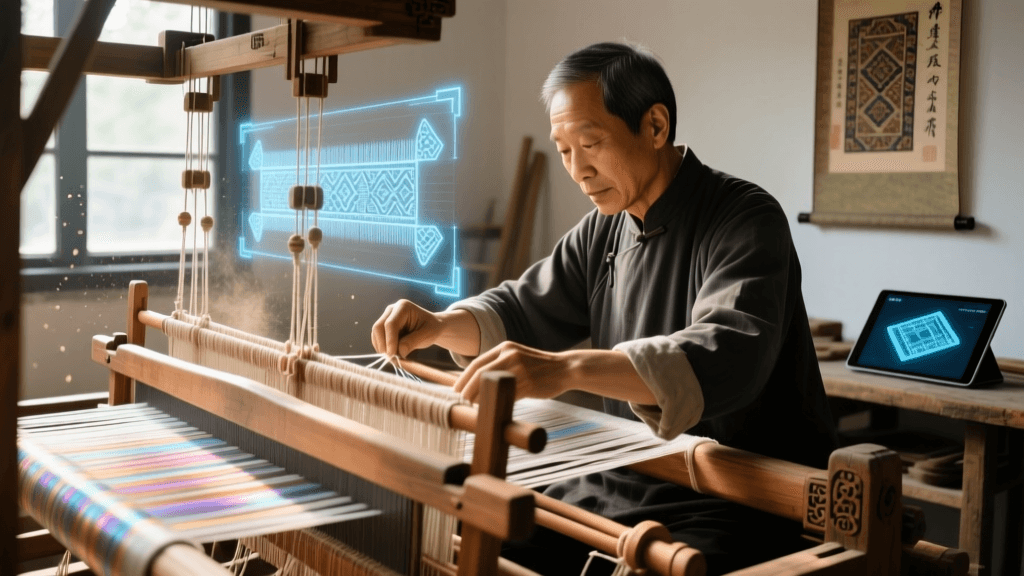
The most defining characteristic of the Chinese drawloom is its requirement for two operators working in perfect synchronicity. The primary weaver sits at the front of the loom, managing the shuttle, the reed, and the pedal mechanisms that control the ground weave. However, the complex figurative patterns are controlled from above. Sitting on a specialized platform atop the loom is the 'drawboy' (or in modern 2026 workshops, often a highly trained female 'drawgirl' or pattern master). This upper operator is responsible for pulling specific bundles of warp threads—known as the figure harness—according to a meticulously memorized or coded sequence.
This dual-operation allows for the separation of the ground weave structure from the elaborate surface patterning. The upper operator essentially acts as a human punch card, lifting only the precise warp threads needed for the shuttle to pass through and lay down a supplementary weft thread of gold, silver, or vibrantly dyed silk.
Nanjing Yunjin: The Pinnacle of Drawloom Artistry
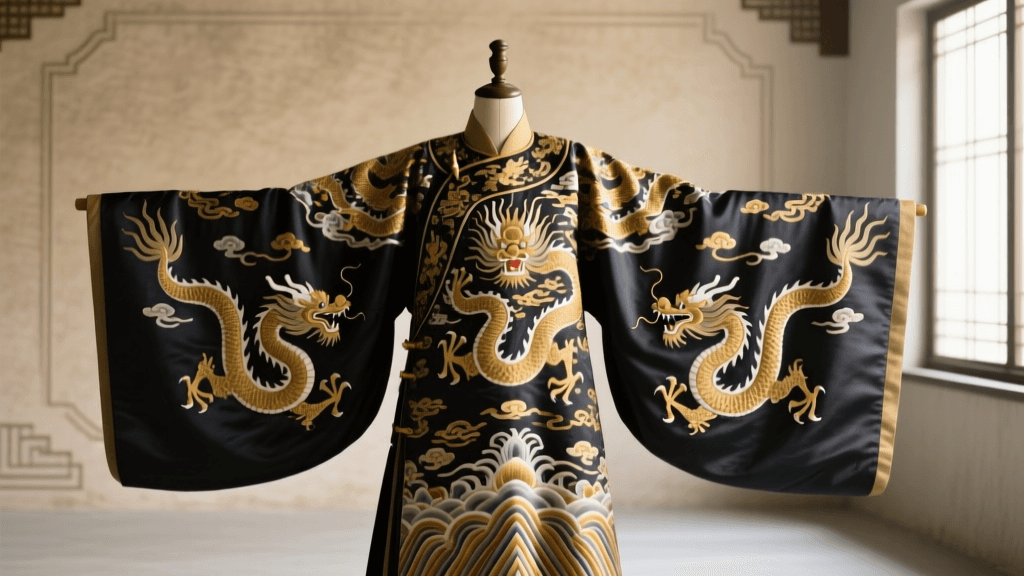
No discussion of the Chinese drawloom is complete without examining its most famous creation: Nanjing Yunjin, or 'Cloud Brocade.' Recognized by UNESCO as an Intangible Cultural Heritage of Humanity, Yunjin is celebrated for its lavish use of precious materials and its breathtaking visual depth. The name 'Cloud Brocade' derives from the fabric's rich, luminous patterns that are said to resemble the vibrant clouds of a sunset.
In 2026, authentic Yunjin remains one of the most labor-intensive textiles in the world. Master weavers utilize not just dyed silk, but also flattened threads of pure gold and silver leaf, and even iridescent yarns spun from peacock feathers. Because the supplementary wefts are inserted by hand using small, bobbin-like shuttles for each specific color block—a technique known as zhuanghua (swatching flowers)—the weaving process cannot be fully mechanized. A master weaving team operating a traditional Hualou can produce a mere five to six centimeters of genuine Yunjin brocade per day.
The 'Jie Ben' Coding System
Before a single thread is woven, the pattern must be translated into the loom's mechanical language. Ancient artisans developed a system called jie ben, a complex method of drafting and knotting the figure harness cords. In 2026, researchers at the Nanjing Brocade Research Institute have been utilizing AI-assisted optical scanning to digitize surviving jie ben knot-codes from the 18th century, translating physical cord arrangements into digital matrices. This allows modern weavers to recreate lost imperial patterns with mathematical precision, bridging the gap between ancient tactile memory and contemporary digital archiving.
Comparative Analysis: Traditional Looms vs. Modern Equivalents
To contextualize the mechanical achievement of the Hualou, it is helpful to compare it with other weaving structures utilized in Asian traditions and modern manufacturing. The table below outlines the operational differences as observed in contemporary 2026 textile studies.
| Loom Type | Primary Era of Prominence | Operator Requirement | Patterning Capability | Speed (Approx. Daily Output) | 2026 Preservation Status |
|---|---|---|---|---|---|
| Backstrap Loom | Neolithic - Present | 1 Weaver | Simple warp-faced geometries | 15 - 30 cm | Widely practiced in rural minority communities |
| Standard Pedal Loom | Han Dynasty - Present | 1 Weaver | Basic twills, tabby, small repeats | 1 - 3 meters | Common in artisan workshops and commercial silk mills |
| Hualou (Drawloom) | Song - Qing Dynasties | 2 Operators (Weaver + Drawer) | Unlimited scale, complex polychrome figures | 5 - 6 cm (Yunjin Brocade) | Highly protected; restricted to heritage institutes |
| Computerized Jacquard | 20th Century - 2026 | 1 Technician / Automated | Unlimited scale, photographic realism | 50 - 100 meters | Standard for commercial 'brocade-style' textiles |
2026 Preservation: Digital Twins and Ergonomic Innovations
As we move through 2026, the physical preservation of the Hualou faces significant challenges. The immense tension placed on the wooden frames causes micro-fractures over decades of use. Sourcing the specific aged timber required for authentic loom restoration has become increasingly difficult due to environmental protections and forestry regulations. In response, heritage institutions in Nanjing and Suzhou have begun employing 'Digital Twin' technology.
By utilizing LiDAR scanning and photogrammetry, conservationists have created millimeter-accurate 3D models of surviving Qing dynasty drawlooms. These digital twins allow structural engineers to simulate the tension loads of different silk warps, identifying stress points on the physical wooden looms before they fail. Furthermore, 3D-printed wooden composite joints are now being tested as replacement parts for non-critical structural elements, ensuring the antique looms can continue to operate without compromising their historical integrity.
Addressing Weaver Ergonomics
Historically, the physical toll on drawloom operators was immense. The weaver sits in a contorted posture, throwing the shuttle and beating the reed with repetitive force, while the drawer sits suspended in a poorly ventilated upper tier. In 2026, heritage workshops have introduced subtle, non-invasive ergonomic aids. Climate-controlled micro-environments are now installed around the looms to maintain the exact 65% humidity required to prevent silk threads from snapping, which simultaneously provides a comfortable temperature for the artisans. Custom-molded seating and specialized lumbar supports disguised as traditional wooden stools have been introduced to extend the careers of master weavers, whose tactile knowledge is irreplaceable.
Experiencing and Acquiring Drawloom Textiles in 2026
For textile enthusiasts, historians, and collectors visiting China in 2026, witnessing the Hualou in action is a profound experience. The Nanjing Brocade Research Institute remains the premier destination. Visitors can book guided workshops that not only demonstrate the weaving process but also allow guests to try their hand at the jie ben pattern-tying technique under the supervision of heritage masters.
A Buyer's Guide to Authentic Yunjin
The commercial market is flooded with machine-made Jacquard fabrics deceptively marketed as 'Yunjin brocade.' If you are looking to acquire an authentic, drawloom-woven piece in 2026, keep the following actionable advice in mind:
- Verify the Certification: Genuine Nanjing Yunjin comes with a serialized NFC-enabled certificate of authenticity issued by the Nanjing Municipal Bureau of Culture and Tourism. Scanning this chip with a smartphone will reveal the names of the two artisans who wove the piece, the loom number, and the exact completion date.
- Examine the Reverse Side: Machine-made jacquards often carry the supplementary weft threads loosely across the back of the fabric. Authentic hand-woven Yunjin utilizes a technique that tightly binds or cuts away the supplementary threads, resulting in a remarkably clean reverse side, which was historically necessary so the fabric could be reversible or lined without snagging.
- Understand the Pricing: Due to the extreme labor intensity and the rising cost of precious metals used in the threads, authentic drawloom-woven Yunjin is an investment-grade textile. In 2026, a standard 30cm by 30cm framed piece of genuine peacock-feather and gold-thread Yunjin typically starts at 15,000 RMB (approximately $2,100 USD), while full garment lengths can easily exceed 300,000 RMB.
- Check the Thread Count and Tension: Hand-woven drawloom textiles possess a slight, organic irregularity in the beat of the weft that machines cannot replicate. The tension should feel incredibly dense and heavy; genuine Yunjin has a stiff, almost metallic drape due to the high concentration of metallic and tightly spun silk threads.
Conclusion
The Chinese drawloom is far more than a relic of the past; it is a testament to the profound ingenuity of ancient Asian engineering. The Hualou represents a time when human memory, physical endurance, and mathematical precision converged to create objects of unparalleled beauty. As 2026 unfolds, the synthesis of ancient weaving techniques with cutting-edge digital preservation ensures that the rhythmic clack of the wooden shuttle and the intricate dance of the drawboy will continue to inspire generations of textile artists and historians worldwide. By supporting heritage institutions and understanding the true mechanics behind these masterpieces, we help keep the vibrant threads of the Silk Road unbroken.