Recreating Mythological Hanfu: A Guide to Deity and Spirit Attire
The Allure of Mythological Hanfu
The modern Hanfu movement has transcended historical reenactment, venturing into the realm of the divine and the supernatural. Recreating traditional clothing in Chinese mythology and legends allows enthusiasts to embody the ethereal beauty of lunar goddesses, the cunning elegance of fox spirits, and the imposing majesty of dragon deities. Unlike strictly historical garments, mythological Hanfu offers a canvas for creative interpretation, blending authentic textile traditions with fantastical elements derived from ancient folklore, classical literature like 'Journey to the West,' and traditional Chinese opera.
Understanding the roots of these legends is crucial for authentic styling. As noted in the comprehensive overviews of Chinese mythology, the divine hierarchy is deeply intertwined with natural elements, celestial bodies, and moral allegories. Translating these abstract concepts into wearable garments requires a deep understanding of fabric behavior, color symbolism, and traditional tailoring techniques. This guide provides actionable advice for sourcing, tailoring, and styling mythological Hanfu for conventions, cultural festivals, and editorial photography.
Archetypes of the Divine: Deities, Spirits, and Heroes
When designing or commissioning a mythological Hanfu set, it is essential to categorize your character into one of the primary archetypes. Each archetype dictates specific fabric weights, sleeve styles, and color palettes to accurately convey the character's supernatural nature.
| Mythological Archetype | Key Characteristics | Recommended Fabric | Sleeve Style & Measurement | Color Palette | Estimated Cost (USD) |
|---|---|---|---|---|---|
| Lunar Deity (e.g., Chang'e) | Ethereal, floating, celestial grace | Silk Organza, Chiffon (8-12mm) | Water Sleeves (Shui Xiu), 60-80cm extension | Icy blues, pearlescent whites, silver | $120 - $250 |
| Nature Spirit (e.g., Huli Jing) | Enchanting, layered, alluring | Gradient Silk, Faux Fur Trims | Pipa Sleeves, 40cm length with tight cuffs | Sunset oranges, deep crimsons, gold | $150 - $300 |
| Dragon / Martial Deity | Structured, imposing, powerful | Song Brocade, Heavy Jacquard (19mm+) | Standard Wide Sleeves, Cloud Shoulders (Yunjian) | Imperial yellow, emerald, azure | $250 - $500+ |
Chang’e and the Lunar Deities: Ethereal Elegance
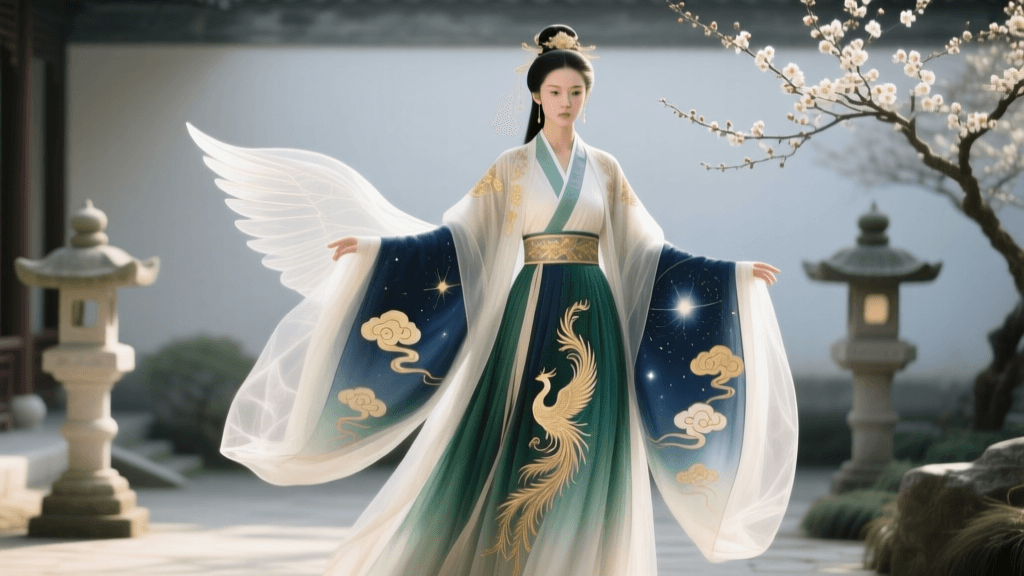
To capture the weightless beauty of Chang'e, the Moon Goddess, the focus must be on drape and translucency. Avoid heavy cottons or stiff linens. Instead, source 100% mulberry silk chiffon or silk organza with a weight of 8mm to 12mm (momme). The hallmark of lunar deity attire is the 'Shui Xiu' or water sleeve. For practical wear at conventions, ensure the water sleeve extension is between 60cm and 80cm beyond the wrist. Anything longer becomes a tripping hazard, while anything shorter loses the dramatic, weeping-willow effect required for celestial dances.
Layering is critical. A base layer of opaque silk satin (19mm) in pearl white should be paired with an outer 'Beizi' (long open-front jacket) made of translucent silver-embroidered organza. The contrast between the opaque base and the sheer overlay mimics the glow of moonlight through clouds.
The Nine-Tailed Fox and Nature Spirits: Enchanting Layers
Fox spirits (Huli jing) and flora-based deities require garments that suggest a connection to the earthly realm while hinting at hidden magic. The 'Mamianqun' (horse-face skirt) is ideal here, specifically those featuring gradient dyeing (jianbian) from deep crimson at the hem to pale gold at the waist. Look for skirts with intricate woven motifs of peonies, lotuses, or nine-tailed foxes hidden in the pleats.
To elevate the spirit aesthetic, incorporate detachable faux fur stoles or trim along the collar and cuffs of the 'Ru' (upper garment). Copper or brass jewelry with enamel floral motifs complements the warm, autumnal color palettes typical of nature spirits. When commissioning a custom Mamianqun, request a waistband width of 8cm to 10cm for better structural support, especially if the skirt is heavily embroidered and weighs over 1.5 kilograms.
The Dragon King and Martial Heroes: Structured Power
Martial deities and dragon lords require garments that project authority and invulnerability. The fabric of choice is Song brocade or heavy jacquard, boasting a weight of 19mm or higher. These textiles hold their shape, creating sharp, imposing silhouettes. The inclusion of a 'Yunjian' (cloud shoulder) is non-negotiable for high-ranking deities. A well-crafted Yunjian should feature four symmetrical panels resting on the shoulders, heavily embroidered with dragon scales, crashing waves, or auspicious clouds.
For the lower half, a structured Mamianqun with metallic thread weaving (zhi jin) provides a regal foundation. To simulate armor without the weight of metal, look for Hanfu sets that incorporate leather or stiffened fabric 'Huxin' (chest guards) and bracers adorned with dragon motifs.
Actionable Sourcing and Tailoring Guide
The foundation of any mythological garment is its textile. The production of these luxurious materials is a time-honored tradition, recognized globally for its cultural significance. In fact, the intricate processes behind these fabrics are preserved on UNESCO's Intangible Cultural Heritage list, highlighting the mastery of sericulture and silk weaving in China.
When sourcing fabrics for DIY sewing or commissioning a tailor, use the following specifications:
- Xiangyunsha (Gambiered Canton Gauze): Ideal for earth deities and ancient spirits. This fabric is dyed with薯莨 (shoulang) yam juice and coated with river mud, resulting in a dark, rustling textile that is water-resistant and uniquely textured. Expect to pay $40 to $80 per yard.
- Su Embroidery Panels: For nature spirits, source pre-embroidered Su silk panels for the front of a Ru jacket. Ensure the stitch density is high (at least 40 stitches per square centimeter) for a premium, three-dimensional effect.
- Measurements for Commissioning: Always provide your 'Jiankuan' (shoulder width), 'Xiongwei' (bust), 'Yaowei' (waist), and 'Shenyi' (garment length measured from the nape of the neck to the desired hemline). For floor-sweeping deity skirts, add 5cm to your floor measurement to account for the hem allowance and the drape over footwear.
Accessorizing the Myth: Hair, Jade, and Crowns
A mythological Hanfu set is incomplete without the appropriate headwear and accessories. Historical textile archives, such as those maintained by the Victoria and Albert Museum's Asian collections, demonstrate how heavily Chinese deities were adorned with jade, gold, and kingfisher feathers (diancui).
For modern recreations, ethical alternatives to diancui, such as dyed goose feather or enamel hairpins, are widely available and visually striking.
- Lunar Deities: Opt for a 'Dian' (crown) featuring crescent moons, jade rabbits, or lotus flowers. Use silver-toned metals and clear quartz or moonstone beads to catch the light. A single, long 'Buyao' (dangling hairpin) with pearl tassels adds movement.
- Fox Spirits: Asymmetrical hair styling works best. Use a cluster of small, floral 'Zanhua' (hairpins) on one side, paired with a golden comb (shubi) featuring fox or floral motifs. Incorporate red silk ribbons woven into the braids.
- Dragon Deities: A 'Guan' (topknot crown) made of dark wood or gold-toned metal is essential. Secure it with a single, thick jade hairpin. Add a 'Yapei' (jade pendant worn at the waist) featuring a dragon motif, suspended from a silk tassel to anchor the heavy brocade garments.
Styling and Makeup: Completing the Illusion
Mythological styling requires makeup that transcends everyday historical looks. For deities, incorporate 'Huadian' (forehead decorations). You can purchase pre-cut gold foil Huadian stickers or paint them using cosmetic-grade mica powder mixed with setting spray. Elongated, sweeping eyebrows (reminiscent of Tang dynasty styles) painted in a soft, faded gray or brown create an otherworldly, detached expression suitable for immortals.
For nature spirits, focus on the eyes and lips. Use warm, rusty orange and crimson eyeshadows blended outward toward the temples to mimic the cunning gaze of a fox. Apply a gradient lip tint, concentrating the deepest red in the center of the lips and fading outward, a technique known as 'bitten lips' that suggests a wild, untamed nature.
Care and Maintenance of Delicate Textiles
Mythological Hanfu often utilizes delicate silks, metallic threads, and intricate embroidery that require meticulous care. Never machine wash silk organza or brocade. Instead, hand wash using a pH-neutral silk detergent in cool water (below 30°C). Do not wring the fabric; gently press the water out and roll the garment in a clean, dry towel to absorb excess moisture. Hang to dry in a shaded, well-ventilated area, as direct sunlight will rapidly degrade silk proteins and fade gradient dyes. Store heavy brocade skirts flat or rolled to prevent permanent creasing in the pleats, ensuring your divine attire remains pristine for years of cultural celebrations and conventions.