Murasaki Shikibu's Legacy: Heian Layering in Modern Kimono Dressing
Murasaki Shikibu: The Architect of Japanese Aesthetics
When exploring the foundational pillars of traditional Japanese clothing, few historical figures cast as long a shadow as Murasaki Shikibu. Living during the Heian period (794–1185), this legendary novelist, poet, and lady-in-waiting at the Imperial Court is best known for authoring The Tale of Genji. However, beyond her literary genius, Murasaki was a meticulous observer and arbiter of Heian fashion. Her writings provide the most comprehensive historical record of the era's complex textile layering systems, seasonal color codes, and the profound emotional weight attached to silk garments.
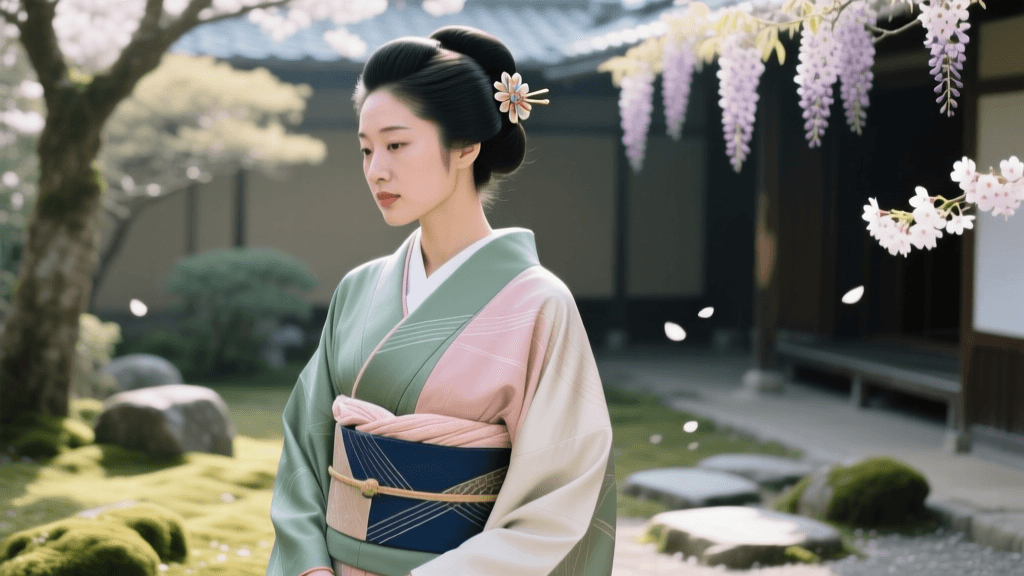
Today, the modern art of kitsuke (kimono dressing) still relies heavily on the aesthetic principles established by Murasaki and her contemporaries. While the heavy, restrictive robes of the Heian court have been replaced by the streamlined silhouettes of the Edo and modern periods, the legacy of Heian layering survives in the subtle, deliberate peek of layered collars, the seasonal alignment of silk linings, and the enduring philosophy of kasane no irome (layered color combinations).
The Anatomy of the Junihitoe: Twelve Layers of Silk
To understand Murasaki’s fashion legacy, one must first understand the Junihitoe, often translated as the 'twelve-layer robe.' Worn by high-ranking court ladies, this ensemble was less about practicality and more about displaying wealth, status, and an acute awareness of the seasons. According to the meticulous historical reconstructions preserved by the Kyoto Costume Museum, a full Junihitoe could weigh up to 20 kilograms (44 pounds) and required immense physical endurance to wear.
The layering system was highly structured, with each layer serving a specific visual and symbolic purpose:
- Kosode: The basic unlined silk undergarment, the direct ancestor of the modern kimono.
- Nagabakama: Long, flowing pleated trousers that extended well past the feet, creating a trailing silhouette.
- Hitoe: An unlined silk robe worn over the undergarments, usually in a deep, grounding color like crimson or dark green.
- Itsutsuginu: A set of five distinctly colored robes worn over the hitoe. The sleeves and hems were staggered by precise measurements (often just 2 to 3 centimeters apart) to create a gradient effect.
- Uchiginu: A stiffened, beaten-silk robe that provided structure and volume to the ensemble.
- Uwagi: The primary outer robe, featuring the most intricate weaving and dyeing techniques.
- Karaginu: A short, Chinese-style jacket with stiff, wing-like shoulders.
- Mo: An apron-like train worn at the back, often dyed with auspicious patterns and tied with elaborate cords.
The true artistry of the Junihitoe was not seen in a single, sweeping glance, but in the subtle revelations of color at the sleeves, the hem, and the neckline. This concept of hidden beauty—where the inner layers are just as important as the outer ones—remains a core tenet of modern kimono etiquette.
Kasane no Irome: The Heian Color Code
Murasaki Shikibu’s writings frequently reference the emotional impact of color combinations. The Heian court operated on a strict aesthetic code known as kasane no irome, which dictated specific color pairings for the outer robe and the inner lining based on the exact time of year, local flora, and even the wearer's mood. Wearing a winter color combination in early spring was considered a grave social faux pas.
Below is a data table illustrating classic Heian color combinations and how they translate to modern kimono styling:
| Season | Heian Name | Outer Layer Color | Inner Layer / Lining | Modern Kimono Application |
|---|---|---|---|---|
| Early Spring | Yanagi (Willow) | White or Pale Green | Deep Crimson | Use a crimson han-eri (collar) with a pale green spring komon kimono. |
| Mid-Spring | Sakura (Cherry Blossom) | Pale Pink | Deep Magenta or Red | Pink outer silk with a magenta date-eri peeking out at the neckline. |
| Summer | Fuji (Wisteria) | Pale Lavender | Dark Purple or Blue | Sheer ro or sha summer kimono with a deep purple lining or collar. |
| Autumn | Momiji (Maple) | Deep Crimson | Golden Yellow or Orange | Red autumn tsukesage with a yellow kasane-eri to mimic falling leaves. |
A crucial rule inherited from Murasaki's era is saki-dori (anticipation). In Heian times, and still in modern formal kitsuke, you must wear the colors of an upcoming season one to two weeks before the season actually begins. Wearing cherry blossom motifs or colors while the trees are in full bloom is considered late; the beauty lies in the anticipation of the season, not the literal reflection of it.
Modern Kitsuke: Translating Heian Layers to Today
While the Victoria and Albert Museum notes that the kimono evolved into a single-layered outer garment (the kosode) by the Edo period, the Heian obsession with layering was ingeniously preserved through the invention of the kasane-eri (layered collar) and date-eri (decorative under-collar). These accessories allow modern wearers to mimic the multi-layered neckline of the Junihitoe without the burden of 20 kilograms of silk.
Practical Guide: Sourcing and Styling Kasane-Eri
If you want to incorporate Murasaki’s layered aesthetic into your modern wardrobe, the kasane-eri is your most effective tool. This is a pre-sewn, double-layered collar that attaches to the nagajuban (under-kimono) to simulate two or three distinct silk robes peeking out at the neckline.
Measurements and Sizing:
- Standard Width: Most modern date-eri are 11 cm wide. When folded and worn, they show about 1.5 cm to 2 cm of color at the neckline.
- Heian-Style Width: For a more dramatic, historically inspired look, seek out wider kasane-eri measuring 14 cm to 16 cm. This allows for a broader band of contrasting color, closely mimicking the staggered sleeves of the itsutsuginu.
- Length: Standard length is 110 cm, which wraps securely around the back of the neck and ties at the front.
Costs and Materials:
- Synthetic/Washable (Polyester): $20 to $45. Ideal for beginners and summer wear, as they can be machine washed and resist sweat stains.
- Silk Blends / Crepe: $50 to $85. Offers a more authentic matte texture that grips the outer kimono collar better, preventing slipping.
- Pure Silk (Hand-Dyed): $100 to $250+. Reserved for formal events, weddings, and tea ceremonies. Often features subtle shibori (tie-dye) or gold foil accents.
Step-by-Step: Tying the Layered Collar
- Preparation: Lay your nagajuban flat. Align the center of the kasane-eri with the center back seam of the under-kimono's collar.
- Pinning: Use kimono clips (korin belt or collar clips) to secure the layered collar to the nagajuban collar, ensuring the inner color extends exactly 2 mm beyond the outer color.
- Tying: Wrap the collar around to the front. Cross the left side over the right (always left over right for the living). Tie securely with a date-jime (thin silk tie) just below the bustline.
- The V-Shape: When putting on the outer kimono, pull the back collar down to expose the nape of the neck (eri-nuki). The Heian aesthetic heavily emphasized the nape; aim for a fist-sized gap between the collar and your neck.
The Enduring Philosophy of Hidden Beauty
Murasaki Shikibu’s legacy in Japanese fashion is not merely about the garments themselves, but the philosophy they represent. The Heian court believed that true elegance was never loud or overt; it was found in the subtle rustle of silk, the fleeting glimpse of a crimson lining beneath a pale green sleeve, and the poetic alignment of one's attire with the turning of the earth.
Today, when a modern kimono wearer carefully selects a kasane-eri to hint at the coming autumn maples, or chooses a silk lining that contrasts beautifully with their outer robe, they are engaging in a silent, sartorial dialogue with Murasaki Shikibu. By understanding the historical mechanics of the Junihitoe and the poetic rules of kasane no irome, contemporary enthusiasts can elevate their kitsuke from simple garment-wearing to a living, breathing practice of traditional Japanese art.