Murasaki Shikibu and the Legacy of the Heian Junihitoe
The Literary Icon Who Dictated Court Fashion
When discussing historical fashion icons who fundamentally altered the trajectory of traditional Japanese clothing, few figures loom as large as Murasaki Shikibu (c. 973 – c. 1014 or 1025). Best known as the author of The Tale of Genji, widely considered the world's first novel, Murasaki was also a lady-in-waiting at the Imperial Court during the Heian period (794–1185). Through her meticulous literary descriptions and her own diary, The Diary of Lady Murasaki, she immortalized the aesthetic sensibilities of the era, effectively serving as the ultimate arbiter of Heian court fashion. Her writings provide the most authoritative primary sources on the jūnihitoe (twelve-layered robe) and the sophisticated color theories that governed aristocratic dress.
Murasaki's influence extended far beyond literature; she codified the visual language of the Japanese elite. In her era, a courtier's rank, taste, and emotional state were communicated not through spoken words, but through the subtle, layered hues of their silk garments peeking out from beneath sleeves and hems. Today, her legacy lives on in the foundational rules of kimono color coordination, seasonal awareness, and the enduring appreciation for the poetic subtleties of traditional Japanese textiles. As noted by the Victoria and Albert Museum's expert analysis of kimono history, the Heian period established the deep-rooted connection between Japanese garment construction, nature, and seasonal transitions that continues to dictate formal kimono etiquette today.
Deconstructing the Jūnihitoe: Anatomy of a Heian Masterpiece
The jūnihitoe (十二単), literally translating to 'twelve layers,' is the most complex, heavy, and expensive garment in the history of Japanese clothing. While the exact number of layers varied depending on the season, the wearer's rank, and the specific court occasion, the ensemble was a masterclass in structural engineering and textile artistry. The sheer weight of the garment—often ranging from 10 to 20 kilograms (22 to 44 lbs)—required immense physical endurance from the court ladies, forcing them into a slow, gliding gait that became synonymous with aristocratic grace.
According to Encyclopedia Britannica's comprehensive guide to the kimono, the evolution of the jūnihitoe stemmed from the earlier, simpler kosode and Chinese-influenced court robes, eventually morphing into a uniquely Japanese expression of layered opulence. The standard ensemble consisted of several distinct components:
- Kosode (小袖): The foundational small-sleeved undergarment, usually made of white or unbleached silk, worn directly against the skin.
- Nagabakama (長袴): Long, pleated trousers tied at the waist, often dyed in deep crimson or dark purple, extending well past the feet to create a sweeping train.
- Hitoe (単): An unlined inner robe, typically in dark red or crimson, serving as the base color that would influence the translucent layers above it.
- Uchigi (打衣): A series of layered robes (usually five, but sometimes more in winter). These were slightly smaller in successive sizes so that the collars and cuffs of each layer remained visible.
- Uwagi (表衣): The primary outer robe, featuring the most elaborate woven patterns and highest quality silk, showcasing the wearer's wealth and status.
- Karaginu (唐衣): A short, Chinese-style jacket with a stiff, brocade exterior, worn over the uwagi for the most formal court appearances.
- Mo (裳): A long, apron-like train tied at the waist and flowing down the back, often painted with metallic dyes or embroidered with auspicious motifs like cranes and pine trees.
Kasane no Irome: The Poetry of Color Layering
The true genius of Heian fashion, as chronicled by Murasaki Shikibu, was not merely in the volume of silk, but in the precise arrangement of colors. This practice is known as kasane no irome (襲の色目), or 'layered color combinations.' Courtiers were judged harshly on their ability to match the micro-seasons through their collar and cuff layering. A mismatched sleeve could lead to social ostracization and poetic mockery.
Murasaki frequently used these color combinations as metaphors in The Tale of Genji to describe the shifting moods of her characters and the passage of time. The aesthetic relied on the contrast between the inner layers and the outer layers, creating a composite color that mimicked natural phenomena. Below is a structured guide to historical kasane no irome combinations that remain highly influential in modern kimono styling:
| Season | Combination Name | Outer Layer (Uwagi) | Inner Layer (Hitoe/Kosode) | Visual Effect & Symbolism |
|---|---|---|---|---|
| Early Spring | Sakura (Cherry Blossom) | Pale Pink | Deep Crimson | Mimics light blossoms resting against dark, ancient branches. |
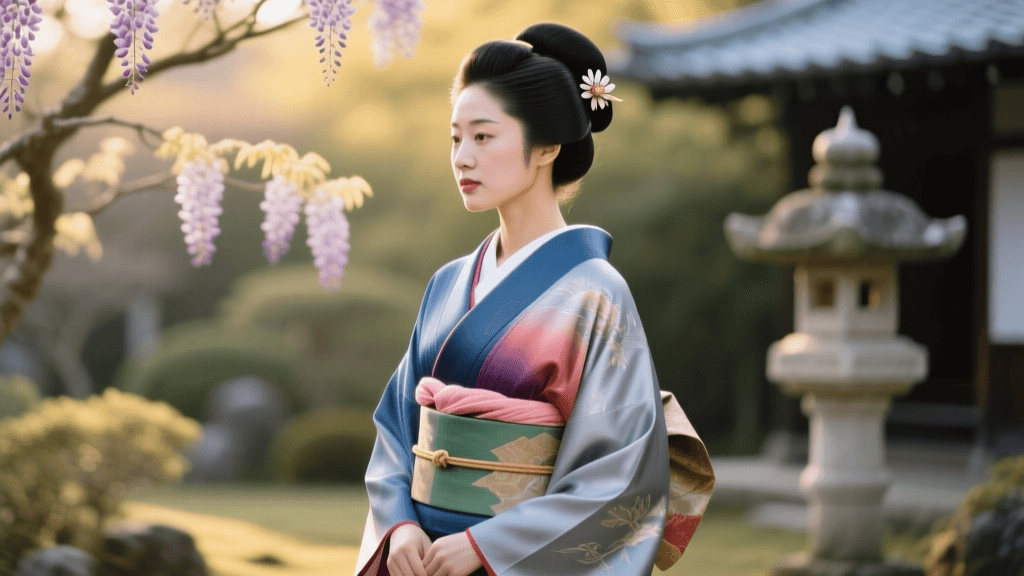
| Summer | Wisteria (Fuji) | Light Lavender | Deep Purple or Green | Evokes wisteria flowers hanging over dark pond waters or leaves. |
| Autumn | Maple (Momiji) | Bright Vermilion | Golden Yellow | Captures the fiery transition of autumn leaves catching the sunlight. |
| Winter | Plum Blossom (Ume) | White or Pale Blue | Deep Crimson | Represents early plum blossoms pushing through the lingering snow. |
Actionable Guide: Experiencing and Adapting Heian Fashion Today
While the 20-kilogram jūnihitoe is no longer worn in daily life, its aesthetic principles are highly actionable for modern kimono enthusiasts, collectors, and travelers looking to engage with traditional Japanese garments. Whether you are renting a historical garment in Kyoto or styling a modern kimono, Murasaki's legacy provides a strict, beautiful framework for your choices.
1. Renting and Photographing the Jūnihitoe in Kyoto
For those wishing to experience the physical weight and grandeur of the twelve-layered robe, several specialized studios in Kyoto offer jūnihitoe dressing and photography packages. Because the garment requires immense space and specialized knowledge to drape correctly, it is not available at standard tourist rental shops.
- Cost Expectations: A full jūnihitoe studio experience, including professional dressing, hair styling (often incorporating traditional suberakashi wigs), and a 30-minute photoshoot, typically ranges from ¥100,000 to ¥250,000 ($650 to $1,600 USD).
- Timing and Booking: You must book at least 2 to 3 months in advance. The dressing process alone takes 45 to 60 minutes. Studios are often located near the Kyoto Imperial Palace or Yasaka Shrine.
- Physical Preparation: Wear a low-cut, tight-fitting undershirt to the studio to prevent modern clothing lines from showing at the collar. Be prepared for restricted movement; the heavy mo (train) and stiff silks require you to move slowly and deliberately.
2. Modern Styling: Translating Kasane no Irome
You do not need a twelve-layered robe to practice Heian color theory. Modern kimono wearers utilize specific accessories to mimic the kasane no irome effect at the neckline and waist. The Victoria and Albert Museum's 'Kimono: Kyoto to Catwalk' exhibition highlighted how historical layering techniques seamlessly transitioned into the obi accessories of the Edo and Meiji periods.
- The Kasane-eri (Layered Collar): Instead of wearing multiple robes, modern wearers use a kasane-eri (重ね衿), a detachable double-layered collar that attaches to the under-kimono (nagajuban). Costing between ¥1,500 and ¥4,000, these collars allow you to pair a pale pink outer edge with a deep crimson inner edge, perfectly replicating the Heian 'Sakura' combination for early spring events.
- Obiage and Obijime Coordination: Apply the layering concept to your waist. The obiage (obi bustle scarf) and obijime (decorative cord) should contrast in a way that reflects a seasonal kasane. For an autumn 'Maple' aesthetic, use a golden yellow silk obiage peeking out from beneath a vermilion obijime. High-quality silk accessories from reputable Nishijin weavers will cost between ¥5,000 and ¥15,000 each.
3. Observing the Koromogae (Seasonal Wardrobe Transition)
Murasaki's era was obsessed with the exact timing of seasonal shifts. Today, this is institutionalized in the koromogae (衣替え), the traditional dates for changing one's wardrobe. To dress correctly according to Heian-derived etiquette:
- June 1st: Transition to natsumono (summer wear). Switch to unlined hitoe kimono, and by late June, move to breathable, sheer silk gauzes like ro and sha.
- October 1st: Transition back to awase (lined winter kimono). This is the time to introduce heavier silk crepes (chirimen) and begin utilizing the deeper, richer inner colors associated with autumn and winter kasane no irome.
Conclusion
Murasaki Shikibu did not merely write about the world; she curated its visual identity. The jūnihitoe and the intricate rules of kasane no irome represent a time when fashion was a high-stakes intellectual pursuit, deeply intertwined with poetry, nature, and social hierarchy. By understanding the anatomy of these historical layers and applying their color theories to modern kimono accessories, contemporary wearers do more than just put on traditional clothing—they participate in a millennium-old literary and aesthetic dialogue pioneered by Japan's most famous female author.