Mulberry vs Eri Peace Silk for Bespoke Cheongsams in 2026
The 2026 Cheongsam Renaissance: Tradition Meets Ethical Textiles
The cheongsam, or qipao, remains a cornerstone of East Asian sartorial elegance, continuously evolving to reflect contemporary values while honoring its rich heritage. As we navigate the fashion landscape of 2026, the conversation surrounding this iconic garment has shifted significantly toward sustainable and ethical textile choices. While traditional Mulberry silk has reigned supreme for decades, Eri silk—commonly known as peace silk or Ahimsa silk—has emerged as a formidable challenger in the bespoke tailoring market. For modern consumers and designers alike, understanding the nuanced differences between these two remarkable fibers is essential for creating a cheongsam that aligns with both aesthetic desires and ethical standards.
Choosing the right fabric dictates not only the drape and silhouette of the final garment but also its longevity, comfort, and environmental footprint. In this comprehensive guide, we will dissect the structural properties, tailoring requirements, and 2026 market costs of Mulberry versus Eri peace silk, empowering you to make an informed decision for your next bespoke commission.
Understanding Mulberry Silk: The Gold Standard of Qipao Tailoring
Mulberry silk is the most traditional and widely recognized silk used in high-end Asian garments. Produced by the Bombyx mori silkworm, which feeds exclusively on the leaves of the white mulberry tree, this fiber is celebrated for its uniform thickness, brilliant luster, and exceptionally smooth hand-feel. According to the Metropolitan Museum of Art's Heilbrunn Timeline of Art History, the domestication of the Bombyx mori moth and the subsequent refinement of sericulture in ancient China laid the groundwork for the luxurious textiles that would eventually define imperial and ceremonial wardrobes across Asia.
For a bespoke cheongsam in 2026, tailors typically recommend a heavy silk crepe or jacquard weighing between 19 and 22 momme (mm). The 22mm weight provides the necessary structural integrity to support the cheongsam’s signature high mandarin collar, intricate frog button closures (pankou), and body-skimming silhouette without clinging uncomfortably to the skin. The continuous filament nature of Mulberry silk allows it to take dyes vibrantly, making it the preferred choice for rich, jewel-toned qipaos featuring elaborate embroidery or woven brocade patterns.
Key Characteristics of Mulberry Silk
- Luster: High, reflective sheen that catches the light beautifully, ideal for evening and ceremonial wear.
- Drape: Fluid and heavy, allowing the fabric to cascade smoothly over the body’s natural curves.
- Texture: Exceptionally smooth and frictionless, reducing wear on the skin and providing a cooling sensation.
- Durability: High tensile strength, though the smooth surface can be prone to snagging if not handled with care during the sewing process.
Eri Peace Silk: The Sustainable Challenger
Eri silk, derived from the Samia ricini silkworm, represents a paradigm shift in ethical fashion. Unlike traditional sericulture, where the cocoon is boiled with the pupa inside to preserve the continuous silk filament, Eri silk is harvested only after the moth has naturally emerged from the cocoon. This Ahimsa (non-violent) process results in a spun silk rather than a reeled continuous filament. The Encyclopedia Britannica's comprehensive guide to sericulture notes that while wild and semi-domesticated silks like Eri have been used in South and Southeast Asia for centuries, their integration into high-end East Asian tailoring is a relatively modern, eco-conscious development.
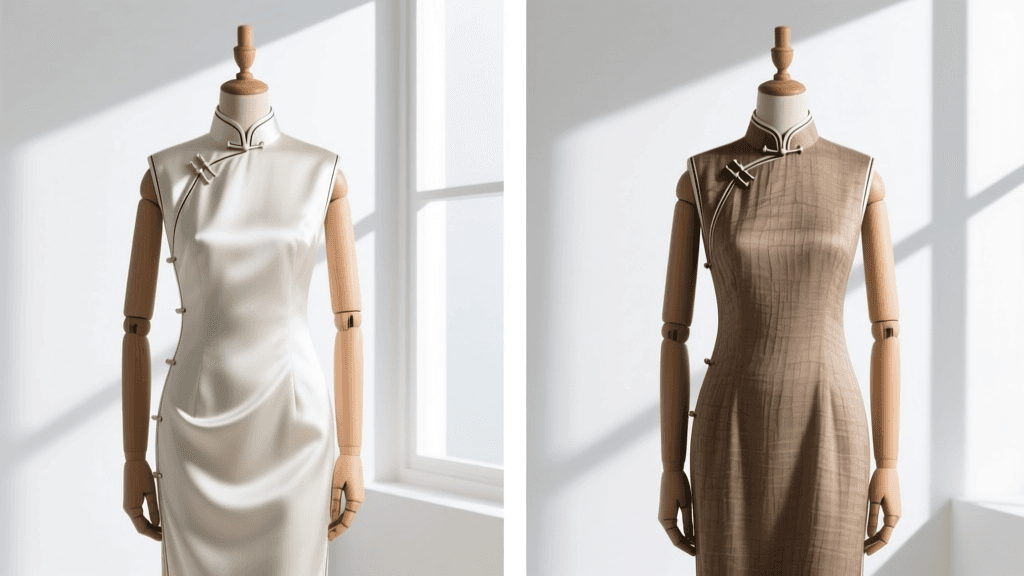
In 2026, Eri peace silk has been refined to meet the exacting standards of bespoke cheongsam tailoring. Because it is spun from shorter, broken fibers, Eri silk possesses a distinctly matte finish and a slightly nubby, textured hand-feel reminiscent of raw silk or fine cotton. It is highly breathable, thermoregulating, and remarkably durable. For clients seeking a daytime cheongsam, a professional office-appropriate qipao, or a garment that aligns with strict vegan and cruelty-free lifestyle principles, Eri silk is an unparalleled choice.
Key Characteristics of Eri Peace Silk
- Luster: Matte and subdued, offering an understated, organic elegance.
- Drape: Slightly stiffer and more structured than Mulberry silk, which can be advantageous for architectural collar designs.
- Texture: Soft but textured, with a gentle grip that prevents the garment from slipping.
- Ethics: 100% cruelty-free (Ahimsa), appealing to the growing demographic of eco-conscious consumers in 2026.
2026 Fabric Comparison Chart: Mulberry vs. Eri Silk
To help you visualize the practical differences between these two textiles, we have compiled a direct comparison based on current 2026 textile industry standards and bespoke tailoring metrics.
| Feature | Mulberry Silk (22mm) | Eri Peace Silk (Spun) |
|---|---|---|
| Fiber Type | Continuous filament (reeled) | Staple fiber (spun) |
| Visual Finish | High luster, glossy | Matte, organic texture |
| Drape & Structure | Fluid, heavy, body-skimming | Structured, holds shape well |
| Breathability | Moderate to High | Extremely High (thermoregulating) |
| 2026 Avg. Cost (per yard) | $95 - $145 USD | $65 - $105 USD |
| Ethical Profile | Traditional (pupa is boiled) | Ahimsa / Cruelty-Free |
| Best Occasion | Weddings, galas, evening wear | Daywear, office, eco-conscious events |
Practical Tailoring Guide: Needles, Thread, and Interfacing
Commissioning a bespoke cheongsam requires more than just selecting a beautiful fabric; it demands that your tailor utilizes the correct technical specifications to handle the unique properties of the chosen silk. In 2026, master tailors in hubs like Shanghai, Singapore, and Hong Kong adhere to strict technical protocols when working with these distinct fibers.
Needle and Thread Selection
For Mulberry silk, the continuous filament is highly susceptible to snagging and puckering. Tailors must use a brand-new Schmetz Microtex (sharp) needle, typically size 60/8 or 70/10. The thread should be 100% silk or a high-grade long-staple polyester (like Gutermann Mara 100) to ensure the seams have the same tensile strength and shrinkage rate as the fabric itself.
Conversely, Eri peace silk is more forgiving due to its spun nature but is slightly thicker at the yarn level. A standard sharp needle size 70/10 or 80/12 is appropriate. Because Eri silk has a matte, almost cotton-like quality, high-quality mercerized cotton thread or a cotton-wrapped polyester core thread is often preferred to maintain the fabric's organic aesthetic and prevent synthetic thread from cutting through the softer spun fibers over time.
Interfacing and Structure
The cheongsam’s iconic mandarin collar and side slits require careful stabilization. Modern 2026 tailoring eschews heavy, glue-based fusible interfacings, which can degrade and bubble over time, especially on natural fibers. Instead, for Mulberry silk, tailors use lightweight silk organza as a sew-in interfacing to maintain the fabric's fluid drape while providing necessary support at the collar and hem. For Eri silk, which naturally possesses more body, a lightweight horsehair canvas or a medium-weight linen interfacing is hand-basted into the collar and front placket to enhance its structured, architectural qualities without adding stiffness.
Cost Breakdown for a Bespoke 2026 Cheongsam
Understanding the financial investment required for a bespoke garment is crucial. Prices have adjusted in 2026 to reflect global supply chain shifts, the rising cost of ethical labor, and the premium placed on sustainable textiles. Below is an estimated cost breakdown for a custom-made, fully lined cheongsam commissioned from a reputable mid-tier to high-end bespoke tailor in 2026.
- Fabric (Mulberry Silk Jacquard, 3 yards): $285 - $435 USD
- Fabric (Eri Peace Silk, 3 yards): $195 - $315 USD
- Lining (Silk Habotai or Cupro Bemberg): $60 - $90 USD
- Bespoke Tailoring Labor (Pattern drafting, fitting, hand-finishing): $800 - $1,500 USD
- Custom Pankou (Frog Buttons) & Embroidery: $150 - $400+ USD
Total Estimated Investment: A Mulberry silk cheongsam will generally range from $1,295 to $2,425 USD, while an Eri peace silk alternative will range from $1,205 to $2,305 USD. While the fabric cost for Eri silk is lower, the labor and structural tailoring required to elevate the matte fabric into a formal garment often equalizes the final price.
Care and Maintenance for Longevity
The longevity of your cheongsam depends heavily on how you care for the specific silk variant. The Food and Agriculture Organization of the United Nations (FAO) highlights that natural silk fibers are highly sensitive to alkaline substances and prolonged UV exposure, necessitating specialized care routines.
Mulberry Silk Care: Due to its delicate continuous filaments and vibrant dyes, Mulberry silk cheongsams should be professionally dry-cleaned only. Water spotting is a significant risk, and aggressive washing can destroy the fabric's luster. Store the garment on a wide, padded hanger in a breathable cotton garment bag, away from direct sunlight to prevent the dyes from oxidizing and fading.
Eri Peace Silk Care: One of the greatest advantages of Eri silk is its resilience. Because it is a spun fiber with a matte finish, it does not water-spot easily and can often be gently hand-washed in cool water using a pH-neutral, enzyme-free detergent specifically formulated for delicates. Lay flat to dry and press with a steam iron on the 'silk' setting, using a press cloth to protect the textured surface. This ease of care makes Eri silk highly practical for frequent wear.
Final Verdict: Which Silk Should You Choose?
The decision between Mulberry and Eri peace silk ultimately hinges on the intended purpose of your cheongsam and your personal values. If you are commissioning a garment for a high-stakes evening event, a traditional wedding, or a formal gala where brilliant luster, fluid drape, and historical continuity are paramount, Mulberry silk remains the undisputed champion. Its ability to hold vibrant dyes and support heavy metallic embroidery is unmatched in 2026.
However, if you are seeking a versatile, daytime cheongsam that transitions seamlessly from the office to an evening dinner, or if your purchasing decisions are guided by a commitment to cruelty-free and sustainable fashion, Eri peace silk is a revelation. Its matte elegance, breathable comfort, and structural integrity offer a modern, ethical interpretation of a timeless classic. By understanding the unique properties of both fibers, you can collaborate with your tailor to create a bespoke cheongsam that is not only a masterpiece of construction but also a true reflection of your personal ethos.