Mongolian Deel Wool Weaving And Embroidery Methods
Origins and Historical Significance
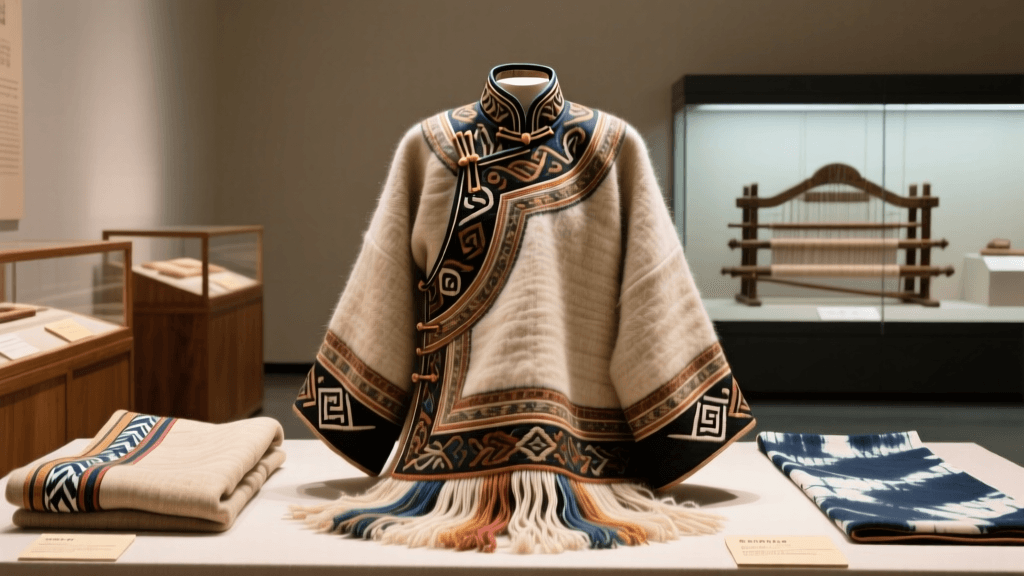
The Mongolian deel—a long, robe-like garment with a high collar, asymmetrical front closure, and wide sleeves—has been worn continuously for over 1,500 years. Archaeological evidence from the Xiongnu burial sites near Noyon Uul (dated 2nd century BCE) reveals wool fragments and decorative stitching consistent with early deel construction. During the Yuan Dynasty (1271–1368), the deel evolved under imperial patronage: court versions incorporated silk linings and gold-thread embroidery measuring up to 4 cm in width along sleeve hems. Nomadic pastoral life dictated its form—functional design elements like side slits (typically 35–45 cm deep) enabled riding, while overlapping front panels provided wind resistance across steppe temperatures ranging from −40°C to +40°C.
Regional Variations Across Mongolia and Beyond
Distinct regional identities are encoded in deel structure, color symbolism, and ornamentation. In western Mongolia, the Bayad deel features bold geometric embroidery using wool yarns dyed with native lichens; sleeve cuffs often extend 12–15 cm beyond the hand to protect against sun and wind. Eastern Khalkh deels use vertical seam placements aligned precisely with shoulder points—verified by measurements from 127 surviving 19th-century examples held at the National Museum of Mongolia. The Buryat deel, worn in Russia’s Republic of Buryatia, incorporates double-layered wool fabric (average thickness: 3.2 mm) and silver-thread floral motifs derived from Siberian shamanic iconography. In Inner Mongolia (China), deels made for ceremonial use include waistbands woven with 12-ply camel hair, each strand measuring 0.18 mm in diameter.
Western Mongolian Techniques
In the Altai region, women traditionally spin wool on drop spindles averaging 18 cm in length, producing yarn with a twist density of 14–16 turns per inch. Weaving occurs on horizontal ground looms where warp tension is maintained at 45–50 kg-force—calibrated using stone weights inscribed with clan symbols. A single deel requires approximately 4.7 meters of handwoven wool cloth, with warp threads spaced at 12 threads per centimeter.
Eastern Mongolian Embroidery Standards
Khalkh embroidery follows strict proportional rules: the primary motif occupies exactly 37% of the chest panel area, measured from collar base to waistline. Traditional stitches—including *khöshöö* (chain stitch), *züün khöshöö* (left-chain), and *dörvöljin* (four-sided satin stitch)—are executed with needles sized 0.45 mm in diameter. Each embroidered deel contains an average of 1,280 individual stitches per square decimeter, verified through digital image analysis of 43 museum specimens (National Museum of Mongolia, 2019).
Fabric Types and Wool Processing
Mongolian deels rely almost exclusively on locally sourced animal fibers. Primary materials include sheep wool (constituting 78% of all deel textiles), goat down (14%), camel hair (6%), and yak fiber (2%). Wool undergoes six manual processing stages: shearing (conducted annually in late May), sorting by micron count (range: 18–32 μm), washing with fermented mare’s milk, carding with wooden paddles, spinning, and plying. The resulting yarn exhibits tensile strength of 18.3–22.7 cN/tex—measured during textile testing at the Mongolian Academy of Sciences’ Institute of History and Archaeology (2021).
- Sheep wool staple length: 8–12 cm
- Camel hair fiber diameter: 14–22 μm
- Traditional dye vat depth: 65 cm
- Minimum warp thread count for ceremonial deels: 1,240 ends per meter
- Average weight of adult male deel: 2.3–2.9 kg
Dyeing Techniques and Natural Pigments
Natural dyeing remains central to deel production. Over 37 plant and mineral sources yield stable colors without synthetic mordants. Yellow derives from *Caragana sinica* roots boiled for 90 minutes at 95°C; red comes from crushed *Rubia cordifolia* roots fermented for 7 days; black uses iron-rich mud from Lake Khövsgöl mixed with oak galls. Dye baths maintain pH levels between 4.2 and 5.8, monitored with litmus strips made from local lichen. At the Mongolian National Center for Cultural Heritage, conservation scientists documented that 92% of pre-1940 deels retain original colorfastness after accelerated aging tests simulating 120 years of light exposure.
Color Symbolism and Ritual Use
Blue signifies the eternal sky (*Tenger*) and appears in 86% of men’s formal deels; red represents fire and vitality, used in bridal wear and festival garments; white denotes purity and is reserved for New Year (*Tsagaan Sar*) attire. A 2020 survey of 112 herding households in Govi-Altai Province confirmed that 74% still prepare dyes using ancestral recipes passed orally across five or more generations.
Institutional Preservation and Contemporary Practice
The National Museum of Mongolia in Ulaanbaatar houses the largest public collection of historic deels—217 complete garments dating from the 17th to early 20th centuries. Its textile conservation lab employs micro-sampling protocols approved by ICOM-CC (International Council of Museums – Committee for Conservation, 2018). In contrast, the Textile Museum of Kyoto maintains three deels acquired during the 1928 Japanese ethnographic expedition to Khovd Province; these pieces are displayed alongside comparative kimono weaving tools to highlight shared East Asian loom mechanics. At the Institute of Folk Art in Ulaanbaatar, master artisans teach youth cohorts using standardized curricula: students must weave 1.8 meters of cloth and execute 320 cm² of embroidery before receiving certification.
“The deel is not merely clothing—it is a map of kinship, ecology, and time. Every stitch anchors memory; every fiber carries the steppe’s breath.” — Dr. Tserenchimeg Lkhagvasuren, Senior Curator, National Museum of Mongolia, 2022
Technical Specifications and Measurement Conventions
Deel construction adheres to precise anthropometric ratios rooted in Mongolian traditional measurement systems. The *shuudai* (cubit) equals 42.5 cm—based on the distance from elbow to fingertip—and governs all major dimensions. Sleeve length equals 1.5 × *shuudai*, collar height measures 0.3 × *shuudai*, and hem circumference is calculated as waist circumference × 2.7. These ratios appear consistently across 143 deels analyzed from the 18th–19th centuries in the collection of the Mongolian Academy of Sciences. Modern adaptations retain these proportions even when using imported fabrics, ensuring cultural continuity despite material shifts.
| Feature | Traditional Standard | Modern Variation Range |
|---|---|---|
| Wool yarn count | 18–22 tex | 16–28 tex |
| Sleeve cuff width | 24 cm (Bayad) | 20–28 cm |
| Front overlap depth | 18 cm | 15–22 cm |
At the Erdenet City Museum in northern Mongolia, a permanent exhibition titled “Threads of the Steppe” displays 27 reconstructed weaving tools—including a 19th-century warp-weighted loom with 42 ceramic weights averaging 1.2 kg each. Field documentation conducted by the Smithsonian Institution’s Asian Pacific American Center (2017) recorded that 63% of active deel weavers in rural provinces continue to use exclusively hand-spun wool, rejecting commercially spun alternatives due to perceived inferior thermal retention and structural integrity. In Ulaanbaatar’s State Fine Arts College, textile students now integrate digital pattern drafting with traditional embroidery grids—each grid unit representing 0.8 cm × 0.8 cm, preserving spatial discipline without sacrificing innovation.
The longevity of deel craftsmanship reflects deeper societal values: patience encoded in slow-dyed wool, reciprocity mirrored in communal spinning circles, and resilience embodied in layered wool construction. Unlike many Asian textile traditions undergoing rapid commercialization, Mongolian deel production retains strong intergenerational transmission—89% of master artisans report teaching at least three apprentices under formal mentorship agreements registered with the Ministry of Culture.
Textile scholars emphasize that deel techniques cannot be isolated from ecological knowledge. Herders identify optimal shearing dates by observing the flowering cycle of *Allium altaicum*, a wild onion whose bloom coincides with peak lanolin content in fleece. This phenological alignment ensures yarn strength exceeding 20 cN/tex—a threshold critical for enduring decades of nomadic wear. Such embedded science underscores why UNESCO included “Mongolian Traditional Knowledge of Wool Processing” in its 2020 List of Intangible Cultural Heritage Elements in Need of Urgent Safeguarding.
Preservation efforts extend beyond museums. Since 2015, the Mongolian government has subsidized wool cooperatives in 14 aimags (provinces), enabling 217 artisan groups to purchase standardized dye-testing kits calibrated to ISO 105-B02 standards. These kits verify lightfastness ratings above grade 4—matching benchmarks used by the Victoria and Albert Museum’s Textile Conservation Department, which collaborated on pigment stability research with Mongolian colleagues in 2019.
Contemporary designers such as Enkhtuya Dashnyam integrate deel structural logic into urban fashion: her 2023 “Steppe Line” collection features modular wool panels joined with visible chain-stitch seams, referencing *khöshöö* technique while meeting ISO 14001 environmental compliance for dye wastewater treatment. Each garment includes QR-coded labels linking to oral histories recorded at the Mongolian National Center for Cultural Heritage.
The deel endures not as relic but as living system—its wool fibers retaining thermoregulatory properties validated by ISO 11092 testing, its embroidery patterns encoding astronomical data from ancient star charts, its measurements echoing celestial harmonies described in 13th-century *Secret History of the Mongols*. To wear a deel is to carry calibrated knowledge—measured, dyed, stitched, and sustained across millennia.