Ming Dynasty Court Attire: Decoding Rank Badges and Colors
Introduction to Ming Court Attire and Symbolism
The Ming Dynasty (1368–1644) represents a pinnacle of Chinese textile history, characterized by a rigid, highly codified sartorial system that communicated an individual's exact social and political standing. Following the expulsion of the Mongol-led Yuan Dynasty, the Ming emperors sought to restore traditional Han Chinese cultural norms, a movement vividly reflected in the Da Ming Huidian (Collected Statutes of the Great Ming). This comprehensive legal code dictated every aspect of court dress, from the cut of the collar to the specific flora and fauna embroidered on official robes. For modern Hanfu enthusiasts, historians, and textile collectors, understanding the symbolism, rank, and color codes of Ming court attire is essential for accurate appreciation, reenactment, and acquisition.
According to the Metropolitan Museum of Art's Heilbrunn Timeline of Art History, the Ming court utilized clothing as a primary instrument of statecraft. The visual hierarchy ensured that an official's rank was instantly recognizable across the vast imperial bureaucracy, maintaining order and reinforcing the Confucian social structure. This system relied heavily on two main pillars: strict color codes and the iconic buzi, or rank badges.
The Strict Hierarchy of Color Codes
Color in Ming Dynasty court attire was not merely an aesthetic choice; it was a legally enforced marker of cosmic and political authority. The emperor and his immediate family held the exclusive right to wear bright yellow, a color symbolizing the center of the universe and the earth element in Chinese cosmology. High-ranking officials and members of the imperial clan were permitted to wear various shades of red and crimson, while mid-to-lower-ranking officials were relegated to blue, green, and black.
Actionable Advice: Sourcing Authentic Dyes for Reenactment
For historical reenactors and bespoke tailors aiming for museum-quality accuracy, synthetic dyes must be avoided. Traditional Ming colors were derived from specific botanical and mineral sources:
- Imperial Yellow: Achieved using the buds of the pagoda tree (Styphnolobium japonicum) mixed with alum as a mordant. Modern bespoke dyers charge approximately $80 per yard for authentic pagoda-tree-dyed silk.
- Official Crimson: Extracted from safflower (Carthamus tinctorius). Because safflower yields a fugitive dye that fades in sunlight, authentic Ming reds required complex, multi-stage dyeing processes. Sourcing genuine safflower-dyed silk today costs upwards of $150 per meter.
- Bureaucratic Blue: Derived from indigo (Indigofera tinctoria). Indigo is highly colorfast and remains accessible, with artisanal vat-dyed silk costing around $60 to $90 per yard.
Decoding the Buzi (Rank Badges)
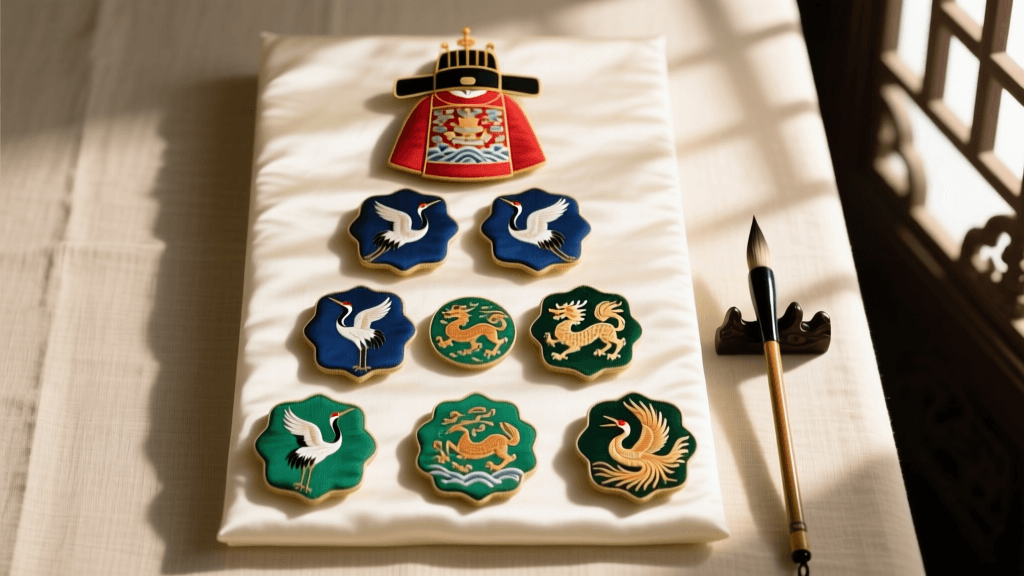
While the yuanlingpao (round-collar robe) provided the canvas, the buzi (rank badge) served as the definitive identifier of an official's specific grade. These intricately embroidered squares were affixed to the front and back of the outer surcoat (bufu). As documented in the Metropolitan Museum of Art's collection of Ming rank badges, civil officials were represented by birds, symbolizing literary elegance and scholarly virtue, while military officials were represented by beasts, denoting courage and martial prowess.
Below is a structured guide to the Ming rank badge system, essential for collectors identifying antique textiles or enthusiasts commissioning accurate replicas.
| Rank | Civil Official (Bird) | Military Official (Beast) |
|---|---|---|
| 1st (Highest) | Crane | Qilin (Mythical Unicorn) |
| 2nd | Golden Pheasant | Lion |
| 3rd | Peacock | Tiger |
| 4th | Wild Goose | Leopard |
| 5th | Silver Pheasant | Bear |
| 6th | Egret | Panther |
| 7th | Mandarin Duck | Rhinoceros |
| 8th | Quail | Rhinoceros |
| 9th (Lowest) | Paradise Flycatcher | Sea Horse (Mythical) |
Practical Guide for Hanfu Enthusiasts and Collectors
Whether you are a collector seeking authentic Ming-era fragments or a Hanfu practitioner commissioning a traditional bufu, understanding the practical dimensions, costs, and timelines of these garments is crucial. The China National Silk Museum emphasizes that the structural integrity and weaving techniques of Ming textiles require specialized knowledge to reproduce accurately.
Measurements and Proportions
Ming Dynasty robes were designed to obscure the natural human silhouette, favoring a flowing, imposing presence. When commissioning a replica yuanlingpao and bufu set, use the following baseline measurements (adjustable for the wearer's height):
- Robe Length (Back Neck to Hem): 135 cm to 145 cm. The hem should rest just above the ankles to reveal the underlying boots.
- Chest Circumference: 110 cm to 120 cm, allowing for deep, overlapping folds.
- Sleeve Span (Wing-to-Wing): 180 cm to 220 cm. Ming sleeves were exceptionally wide, often featuring curved underarms and tapered cuffs to hold ceremonial tablets.
- Buzi (Badge) Dimensions: Exactly 38 cm x 38 cm (approx. 15 inches square). Badges were split down the center front to accommodate the robe's opening.
Costs and Commissioning Timelines
The market for traditional Chinese garments varies wildly based on material authenticity and craftsmanship. Here is a realistic breakdown for sourcing or commissioning Ming-style court attire:
- Mass-Produced Polyester Replicas: Cost between $40 and $90. These are machine-printed and lack historical accuracy in drape and sheen. Delivery time is typically 1 to 2 weeks. Suitable only for casual cosplay or theatrical props.
- Machine-Woven Silk Brocade: Cost between $250 and $500 for a full robe. Utilizes modern jacquard looms to replicate Ming cloud-and-dragon patterns. Delivery time is 3 to 6 weeks. Ideal for serious Hanfu enthusiasts on a moderate budget.
- Bespoke Hand-Embroidered Su Xiu (Suzhou Embroidery): Commissioning a genuine silk robe with hand-embroidered rank badges using traditional split-stitch and gold couching techniques is a major investment. Expect to pay between $1,800 and $4,500. Because a single high-quality buzi requires 150 to 250 hours of meticulous handwork, the timeline for completion is typically 4 to 8 months.
Regional Variations in Weaving Techniques
When sourcing fabric for Ming attire, collectors should look for specific regional brocades. Shu brocade from Sichuan is known for its vibrant colors and sturdy, heavy drape, making it excellent for winter court coats. Conversely, Song brocade from Suzhou features a flatter, more refined weave with subtle geometric background patterns, historically preferred for high-ranking civil officials' spring and autumn garments. Authentic Zhuanghua (make-up flower) silk, a technique where discontinuous wefts are woven only where the pattern requires, can cost upwards of $300 per meter and is the gold standard for imperial reproductions.
"The clothing of officials must strictly correspond to their rank. To wear the colors or badges of a higher station is an act of usurpation, punishable by severe penal servitude and confiscation of property." — Adapted from the Da Ming Huidian (Collected Statutes of the Great Ming), regulating the Ministry of Rites.
Modern Revival and Reenactment Etiquette
As the global Hanfu movement continues to grow, the revival of Ming court attire has become a focal point for cultural preservation. However, enthusiasts must approach the wearing of rank badges with historical mindfulness. In a modern context, wearing a 1st-rank Qilin or Crane badge without an understanding of its historical weight can be seen as culturally incongruent. Many dedicated Hanfu societies recommend that modern practitioners wear unranked, auspicious motifs—such as clouds, plum blossoms, or generic cranes in flight—rather than strict buzi designs, unless participating in a specifically curated historical reenactment or theatrical performance.
Furthermore, when collecting antique Ming textiles, buyers must exercise extreme caution. The antique market is flooded with late-Qing dynasty badges falsely marketed as Ming artifacts. Ming badges typically feature a more open background with less dense embroidery than their Qing counterparts, and the animals or birds are often depicted in a more dynamic, less rigid posture. Consulting with certified textile appraisers or referencing museum databases is highly recommended before making significant financial investments.
Conclusion
The sartorial codes of the Ming Dynasty offer a fascinating window into the intersection of politics, art, and social hierarchy in traditional China. From the cosmic authority of imperial yellow to the meticulously embroidered silver pheasants of the civil bureaucracy, every thread served a purpose. For today's collectors, historians, and Hanfu practitioners, decoding these symbols is not just an academic exercise; it is a vital step in preserving and respectfully reviving the profound material culture of Asia's past. By adhering to accurate measurements, investing in traditional dyeing and weaving techniques, and respecting the historical context of the buzi, modern enthusiasts can ensure that the legacy of Ming court attire continues to be celebrated with the dignity it deserves.