Expert Guide to Authenticating Shibori, Yuzen, Kasuri
The Allure of Japanese Textile Arts
For collectors, historians, and enthusiasts of traditional Asian garments, few artifacts are as captivating as vintage Japanese textiles. The intricate dyeing and weaving techniques developed over centuries in Japan represent a pinnacle of artisanal craftsmanship. Among the most highly sought-after methods are Shibori, Yuzen, and Kasuri. Each technique requires years of apprenticeship to master, resulting in garments that are not merely clothing, but wearable canvases. According to the Victoria and Albert Museum's Asian Collections, these textiles offer profound insights into regional aesthetics, social status, and historical trade routes. However, as the market for vintage kimono and haori expands globally, distinguishing between authentic, hand-crafted pieces and mass-produced, modern imitations has become increasingly difficult. This guide provides actionable, technical advice for authenticating, sourcing, and preserving these magnificent textiles.
Shibori: The Sculptural Resist-Dyeing Art
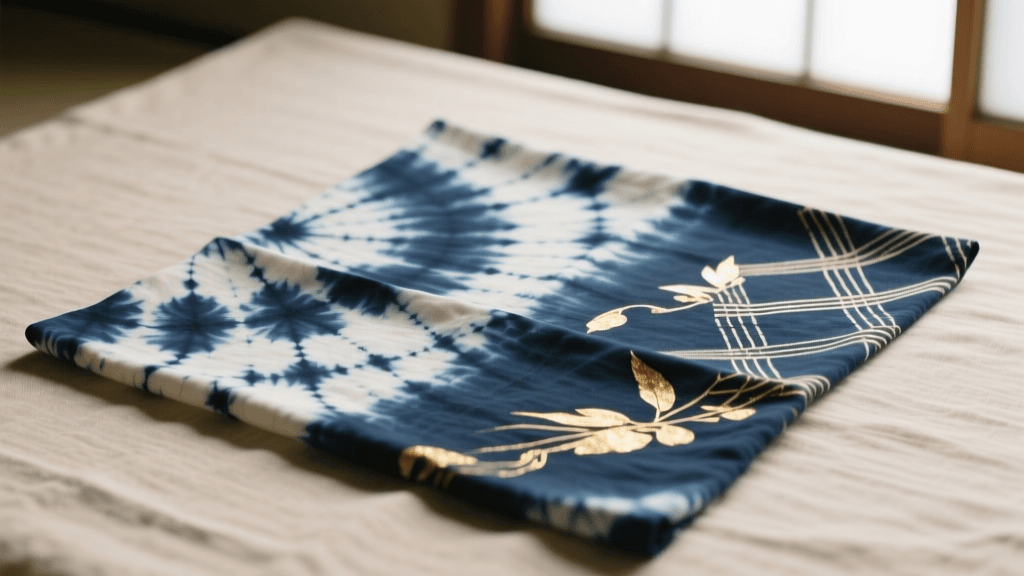
Shibori is a shaped-resist dyeing technique that involves folding, twisting, binding, or compressing fabric before submerging it in dye, traditionally natural indigo. Unlike flat surface designs, authentic Shibori possesses a distinct three-dimensional quality.
Authentication Markers
- Textural Memory: Genuine hand-tied Shibori (such as kanoko or fawn-spot tie-dye) retains a subtle, puckered texture. Run your fingers across the surface; you should feel the physical memory of the binding threads.
- Dye Penetration: Examine the reverse side of the fabric. Because the fabric is physically manipulated and submerged, the indigo dye penetrates deeply. The reverse side should show significant color saturation, mirroring the front, albeit with slightly softer contrast.
- Organic Bleed: Look closely at the edges of the resist patterns. Authentic Shibori features organic, slightly blurred edges where the dye naturally wicked into the bound fibers. Screen-printed imitations will have harsh, pixelated, or perfectly sharp boundaries.
Vintage Shibori garments, particularly those from the Arashi (pole-wrapping) and Itajime (shape-resist) traditions, are highly prized. A well-preserved, mid-20th-century indigo Shibori haori (jacket) typically ranges from $120 to $350, while full kimono can command $250 to $800 depending on the complexity of the tie-work.
Yuzen: The Painterly Paste-Resist Masterpiece
Originating in Kyoto during the Edo period, Yuzen is a paste-resist dyeing technique that allows for incredibly detailed, painterly designs. Artisans apply a rice-paste resist (using a cone similar to a piping bag) to outline designs, preventing dye from bleeding into adjacent areas. The Metropolitan Museum of Art's Asian Art Department frequently highlights Yuzen as a defining aesthetic of Japanese luxury formalwear.
Authentication Markers
- The Itome Line: The hallmark of authentic hand-painted Yuzen (tegata-yuzen) is the itome—a razor-thin, crisp white line that outlines the motifs. This is where the rice paste was applied. If the white lines are thick, uneven, or printed in grey ink, the piece is likely a modern stencil or digital reproduction.
- Reverse Side Saturation: Unlike Shibori, Yuzen is surface-dyed. The reverse side of an authentic Yuzen kimono will be predominantly white or the color of the base fabric, with only minimal dye bleed-through. If the reverse side is heavily saturated with the pattern's colors, it is not traditional Yuzen.
- Embellishments: High-end Yuzen often incorporates kimpaku (gold leaf), metallic thread embroidery, or hand-painted silver accents. Examine these under a loupe; real gold leaf will show micro-cracks and organic application edges, whereas foil stamping will appear uniform and plastic-like.
Authenticating Yuzen requires a keen eye for brushstrokes. Vintage homongi (visiting wear) featuring hand-painted Yuzen and gold leaf typically start at $300 and can easily exceed $1,500 for pieces by recognized masters or those bearing prestigious crests.
Kasuri: The Precision of Ikat Weaving
Kasuri is the Japanese iteration of Ikat, a weaving technique where the threads are resist-dyed before they are woven together. Recognized by the Japanese government as a vital cultural heritage, regional variations like Kurume, Bingo, and Iyo Kasuri are meticulously documented by The Traditional Craft Products (METI) organization.
Authentication Markers
- The Blurred Edge: The word 'Kasuri' literally translates to 'blurred.' Because pre-dyed threads are nearly impossible to align with mathematical perfection on the loom, authentic Kasuri features characteristic blurred, fuzzy edges along the geometric or pictorial motifs.
- Warp vs. Weft vs. Double: Identify the complexity. Tate-gasuri (warp ikat) has blurred vertical edges; yoko-gasuri (weft ikat) has blurred horizontal edges. Tateyoko-gasuri (double ikat) features blurred edges on all sides and is the most labor-intensive and valuable.
- Identical Reverse Side: Because the pattern is woven into the very structure of the fabric using pre-dyed threads, the reverse side of a Kasuri textile will look virtually identical to the front. This is the easiest way to distinguish woven Kasuri from printed faux-Kasuri.
Vintage Kasuri was often used for everyday workwear and informal kimono, making it more accessible. A vintage cotton Kasuri yukata or casual kimono generally costs between $80 and $250, while rare, indigo-dyed double-ikat Kurume Kasuri bolts can fetch upwards of $600.
Quick Reference: Shibori vs. Yuzen vs. Kasuri
| Technique | Primary Method | Visual Hallmark | Reverse Side | Avg. Vintage Price |
|---|---|---|---|---|
| Shibori | Shaped resist (tie/bind/fold) | 3D puckering, organic bleeds | Highly saturated with dye | $150 - $600 |
| Yuzen | Rice-paste resist & painting | Crisp white itome lines, painterly | Mostly white/base color | $300 - $1,500+ |
| Kasuri | Pre-dyed thread weaving (Ikat) | Fuzzy, blurred geometric edges | Identical to the front | $80 - $400 |
The Collector's Care and Storage Protocol
Proper preservation is critical. Vintage silk and cotton are highly susceptible to light damage, humidity fluctuations, and acidic degradation. Follow these precise, actionable guidelines to maintain your collection:
Washing and Spot Cleaning
Never machine wash or dry clean vintage Yuzen or Shibori, as the chemicals will strip natural dyes and dissolve metallic threads. For cotton Kasuri that requires washing, use Orvus WA Paste, a pH-neutral, archival-grade soap. Dissolve one teaspoon of Orvus in a basin of cold water (strictly 60°F / 15°C). Submerge the garment for exactly 3 minutes, gently agitate, and rinse with cool water. Roll the garment in a clean, white cotton towel to press out moisture—never wring or twist the fibers.
Folding and Archival Storage
Kimono must be folded using the traditional hon-datami method to prevent permanent crease lines along the motifs. The standard folded dimensions are approximately 33cm wide by 25cm high. Wrap each folded garment in a tatoushi—a specialized envelope made of unbuffered, acid-free archival tissue paper. Never use plastic bags, which trap moisture and cause mildew. Store the wrapped textiles flat in a cedar chest (tansu) or an archival corrugated cardboard box.
Environmental Controls
Maintain a stable environment with a relative humidity (RH) between 45% and 55% and a temperature around 65°F (18°C). Avoid traditional mothballs or camphor, which can chemically react with Yuzen dyes and gold leaf. Instead, use natural Aromatica cedar blocks or dried neem leaves placed in the corners of your storage chest, replacing them every six months.
Final Thoughts for the Aspiring Collector
Building a collection of Shibori, Yuzen, and Kasuri textiles is a deeply rewarding pursuit that connects you directly to the artisanal heritage of Japan. By understanding the structural differences between dye penetration, paste-resist, and pre-dyed weaving, you can confidently navigate estate sales, Japanese antique markets, and online auctions. Always prioritize condition and authentic structural markers over brand names, and remember that preserving these textiles is an act of cultural stewardship for future generations.