Ming Court Fashion: Evolution of Rank Badges and Robe Sourcing
The Renaissance of Han Sartorial Hierarchy
The Ming Dynasty (1368–1644) represents a profound renaissance of Han Chinese sartorial culture. Following the expulsion of the Mongol-led Yuan Dynasty, the Hongwu Emperor sought to restore traditional Han Chinese customs, particularly in court dress. This era birthed some of the most recognizable and highly codified garments in Asian history, including the iconic Buzi (rank badges) and the luxurious Mangpao (Python robes). For modern Hanfu enthusiasts, historical reenactors, and textile collectors, understanding the evolution of Ming court fashion is not just an academic exercise—it is the key to accurately sourcing, commissioning, and wearing these magnificent garments today.
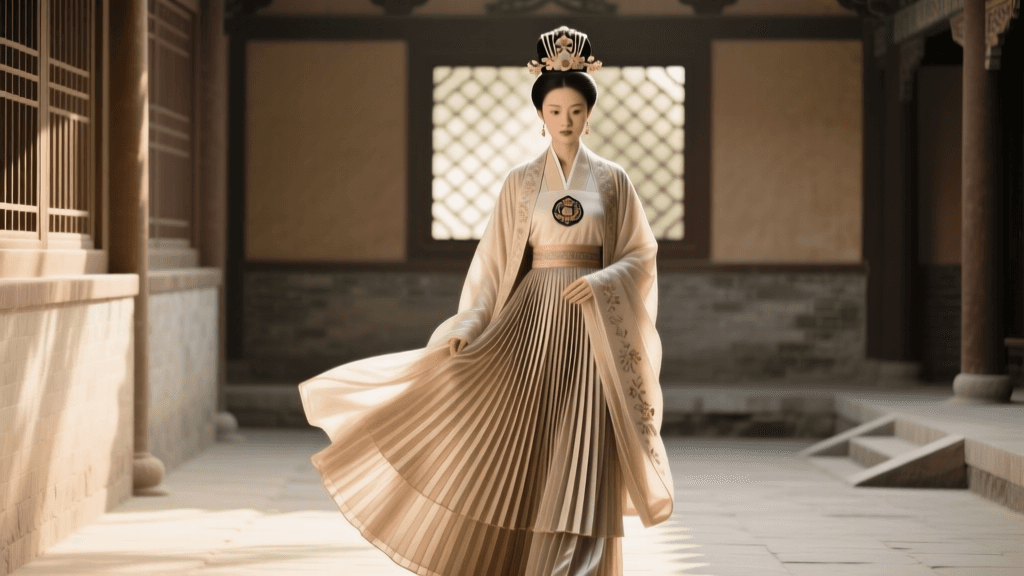
Unlike the Qing Dynasty that followed, which imposed Manchu sartorial laws like the qipao and changshan, Ming court fashion was characterized by flowing, voluminous silhouettes, intricate jacquard weaving, and a strict visual hierarchy that communicated a wearer's exact social and political standing from a distance.
The Evolution of Court Hierarchy: Tang to Ming
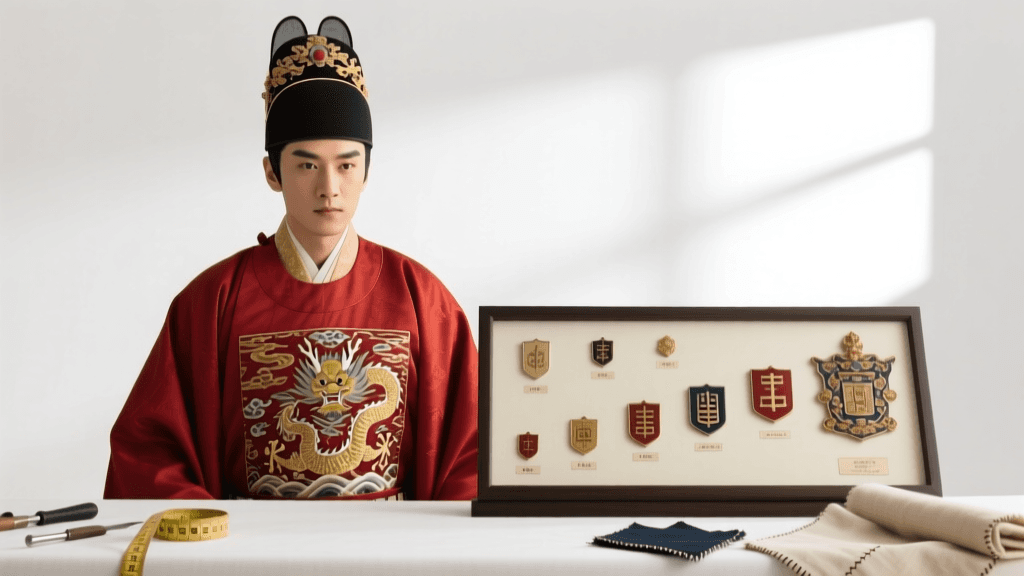
To understand Ming court dress, one must look at its predecessors. During the Tang Dynasty, court hierarchy was primarily denoted by the color of the official's robe—purple for high-ranking officials, red and green for mid-to-lower ranks. The Song Dynasty introduced more subtle variations, utilizing intricate woven patterns and specific headwear styles to denote rank. However, it was the Ming Dynasty that perfected and rigidly codified the visual language of court rank through the introduction of the Buzi, or Mandarin square, in 1391.
These embroidered badges were affixed to the front and back of the official's surcoat (bufu). According to the Metropolitan Museum of Art's Heilbrunn Timeline of Art History, the Ming system of using specific birds for civil officials and beasts for military officers became the definitive standard for Chinese court dress, heavily influencing the subsequent Qing Dynasty's sartorial codes.
Decoding the Ming Dynasty Buzi (Rank Badges)
The Buzi system was a masterclass in semiotics. Civil officials wore birds, symbolizing literary elegance and administrative grace, while military officials wore mythical or fierce beasts, representing martial prowess and courage. For modern collectors and tailors, recreating these badges requires strict adherence to historical species pairings.
| Rank | Civil Official (Bird) | Military Official (Beast) |
|---|---|---|
| 1st (Highest) | Crane (Xianhe) | Qilin (Mythical Chimera) |
| 2nd | Golden Pheasant (Jinji) | Lion (Shi) |
| 3rd | Peacock (Kongque) | Leopard (Bao) |
| 4th | Wild Goose (Yan) | Tiger (Hu) |
| 5th | Silver Pheasant (Baiyun) | Bear (Xiong) |
| 6th | Egret (Siyi) | Panther (Biao) |
| 7th | Mandarin Duck (Yuanwang) | Rhinoceros (Xi) |
| 8th | Oriole (Huangli) | Rhinoceros (Xi) |
| 9th (Lowest) | Quail (Anchun) | Sea Horse (Haima) |
Beyond the Badge: The Mangpao and Feiyufu
While the Buzi denoted everyday official rank, the highest honors in the Ming court were bestowed through the gifting of specialized robes: the Mangpao (Python Robe) and the Feiyufu (Flying Fish Robe). As detailed by Smithsonian Magazine, the distinction between a dragon and a python in Chinese imperial textiles was a matter of life, death, and treason. The Emperor alone wore the Longpao, featuring five-clawed dragons. The Mangpao featured four-clawed 'pythons' (mang), which were visually identical to dragons but legally distinct to protect the imperial monopoly on the five-claw motif.
The Feiyufu was similarly prestigious, featuring the 'Flying Fish'—a mythical creature with a dragon's head, fish-like wings, and a serpentine tail. These robes were not standard issue; they were imperial gifts awarded for exceptional military or civil service. Today, the Feiyufu is immensely popular among Hanfu enthusiasts, particularly within the traditional martial arts and Wuxia cosplay communities, due to its dynamic, aggressive aesthetic and dramatic silhouette.
Practical Guide: Sourcing and Commissioning Ming Court Garments
For those looking to acquire a historically accurate Ming-style court robe—whether for a formal wedding, a museum-quality collection, or high-end cultural events—navigating the modern market requires specific knowledge of traditional tailoring, fabric types, and commissioning timelines.
1. Fabric Selection and Costs
Authentic Ming court robes were woven on complex drawlooms, resulting in heavy, structured brocades. When sourcing fabric, avoid thin, shiny polyester satins, which drape too softly and lack the architectural stiffness required for Ming silhouettes.
- Zhuanghua Brocade (妆花): The pinnacle of Nanjing silk weaving. This technique involves weaving discontinuous wefts of gold thread and colored silk to create vibrant, raised patterns. Cost: $150 to $350 USD per meter. A full robe requires 4 to 5 meters, placing fabric costs between $600 and $1,750 USD.
- Song Brocade (宋锦): Slightly flatter and more matte than Zhuanghua, originating from Suzhou. Excellent for everyday formal wear and slightly more breathable. Cost: $80 to $150 USD per meter.
- Mass-Market Jacquard: Woven on modern power looms, often using a silk-rayon blend or high-grade polyester. Cost: $25 to $60 USD per meter. Suitable for stage performances or budget-friendly Hanfu entries.
2. Crucial Tailoring Measurements
Ming Dynasty garments were cut using a flat-pattern, cross-collared or round-collared system that relied heavily on the drape of the fabric rather than tailored darts. When providing measurements to a traditional tailor, use the following historical benchmarks:
- Tongxiu (Sleeve Span): The measurement from wrist to wrist with arms extended. For the dramatic, floor-sweeping sleeves characteristic of Ming court dress, the Tongxiu should be between 2.2 and 2.5 meters. Anything less will look like a modern theatrical costume rather than a historical garment.
- Yichang (Robe Length): Measured from the base of the neck (or shoulder seam) to the floor. Standard lengths are 135 cm to 145 cm. Always include a 10 cm inner hem allowance to weigh down the skirt and improve the drape.
- Liling (Standing Collar): For late Ming women's formal court wear (often paired with a Daopao or Yusan), the standing collar should be precisely 4 cm to 5 cm high, fastened with two gold or jade toggle buttons at the throat and base of the neck.
3. Timelines for Custom Commissioning
If you are commissioning a bespoke piece from artisans in Suzhou or Nanjing, patience is mandatory. According to textile archives at the Victoria and Albert Museum, traditional Chinese weaving and embroidery are deeply time-intensive crafts.
- Custom Loom Setup & Weaving: If you require a specific, non-stock Mang (python) pattern woven in Zhuanghua brocade, expect a 45 to 60-day lead time just for the textile production.
- Hand-Embroidered Buzi: A high-quality Mandarin square utilizing the traditional 'couching' technique (where gold threads are laid on the surface and stitched down with silk) takes a master embroiderer 3 to 4 weeks to complete. Cost: $250 to $600 USD per pair.
- Tailoring and Assembly: Once fabrics and badges arrive at the tailor, assembly takes 10 to 14 days.
Styling and Etiquette for Modern Formal Wear
Wearing a Ming court robe today requires attention to the complete ensemble. A Mangpao or Feiyufu is never worn in isolation. For men, the robe must be paired with a Wushamao (black gauze cap) for civil appearances, or a Jingzhongguan (pure loyalty crown) for military/martial artists. Footwear should consist of black leather or heavy silk court boots with white, thick soles (chaobei), which historically elevated the wearer and forced a slow, dignified gait.
For women recreating late Ming formal wear, the Diyi (pheasant robe) or a high-collared Daopao is typically paired with a Diji (a complex, winged gold and pearl headdress). Modern wearers should ensure that the inner layers (zhongyi) feature a crisp, white cross-collar that peeks out exactly 2 to 3 centimeters from the outer robe's neckline, providing a vital contrast that frames the face and highlights the outer brocade.
Conclusion
The court fashion of the Ming Dynasty is a testament to the sophistication of traditional Chinese textile engineering and social organization. By understanding the strict rules of the Buzi rank system, the legal distinctions of the four-clawed Mangpao, and the precise tailoring measurements required for an authentic drape, modern enthusiasts can move beyond superficial costuming. Whether you are investing in authentic Nanjing Zhuanghua brocade or carefully selecting a historically accurate embroidered badge, honoring the evolution of Ming court fashion ensures that these magnificent Asian traditions continue to be worn with dignity, accuracy, and profound cultural respect.