Ming Dynasty Court Fashion: Rank Badges and Mamian Qun
The Zenith of Hanfu: Ming Dynasty Sartorial Codes
The Ming Dynasty (1368–1644) represents a monumental era in the history of traditional Chinese clothing. Following the collapse of the Mongol-led Yuan Dynasty, the Hongwu Emperor Zhu Yuanzhang sought to restore Han Chinese cultural identity, instituting rigorous sumptuary laws and reviving ancient sartorial codes. This era birthed some of the most sophisticated textile techniques and iconic silhouettes in Asian fashion history. According to The Metropolitan Museum of Art, the Ming period was characterized by an unprecedented boom in silk production, state-sponsored weaving bureaus, and a highly codified system of court dress that communicated social hierarchy with absolute precision.
For modern enthusiasts of the Hanfu revival movement, the Ming Dynasty offers the most accessible and structurally influential designs. The garments from this era, particularly the outer jackets (ao) and the pleated horse-face skirts (mamian qun), form the bedrock of contemporary traditional Chinese street fashion. Understanding the historical evolution, precise measurements, and modern acquisition strategies for these garments is essential for anyone looking to authentically integrate Ming court fashion into a modern wardrobe.
Decoding the Buzi: Official Rank Badges of the Ming Court
At the heart of Ming court fashion was the buzi, or rank badge. Instituted in 1391, these intricately woven or embroidered squares were affixed to the front and back of an official's round-collared robe (yuanlingpao). The buzi served as an immediate visual indicator of the wearer's civil or military status, as well as their exact rank within the imperial bureaucracy. The craftsmanship required for these badges was extraordinary, often utilizing kesi (silk tapestry) or gold-wrapped thread embroidery, techniques highly prized by institutions like the China National Silk Museum.
Civil officials were represented by birds, symbolizing elegance and literary grace, while military officials were denoted by beasts, representing courage and martial prowess. The strict adherence to these motifs meant that a misplaced badge could be interpreted as treasonous usurpation of imperial favor.
Ming Dynasty Civil and Military Rank Badges
| Rank | Civil Official (Birds) | Military Official (Beasts) |
|---|---|---|
| 1st Rank | Crane (Xianhe) | Lion (Shi) |
| 2nd Rank | Golden Pheasant (Jinji) | Leopard (Bao) |
| 3rd Rank | Peacock (Kongque) | Tiger (Hu) |
| 4th Rank | Wild Goose (Yan) | Bear (Xiong) |
| 5th Rank | Silver Pheasant (Baihan) | Panther (Biao) |
| 6th Rank | Egret (Bailu) | Tiger Cat (Biao) |
| 7th Rank | Mandarin Duck (Xichi) | Rhinoceros (Xi) |
| 8th Rank | Quail (Anchun) | Rhinoceros (Xi) |
| 9th Rank | Paradise Flycatcher (Lianque) | Sea Horse (Haima) |
The Mamian Qun: From Palace Courtyards to Modern Streets
While court officials were bound by the rigid geometry of the buzi, the women of the Ming court and the broader Han populace popularized a garment that would transcend centuries: the mamian qun, or "horse-face skirt." Despite its equestrian-sounding English translation, the "horse-face" refers to the flat, unpleated panels at the front and back of the skirt, which resemble the architectural "horse-face" defensive towers on ancient Chinese city walls.
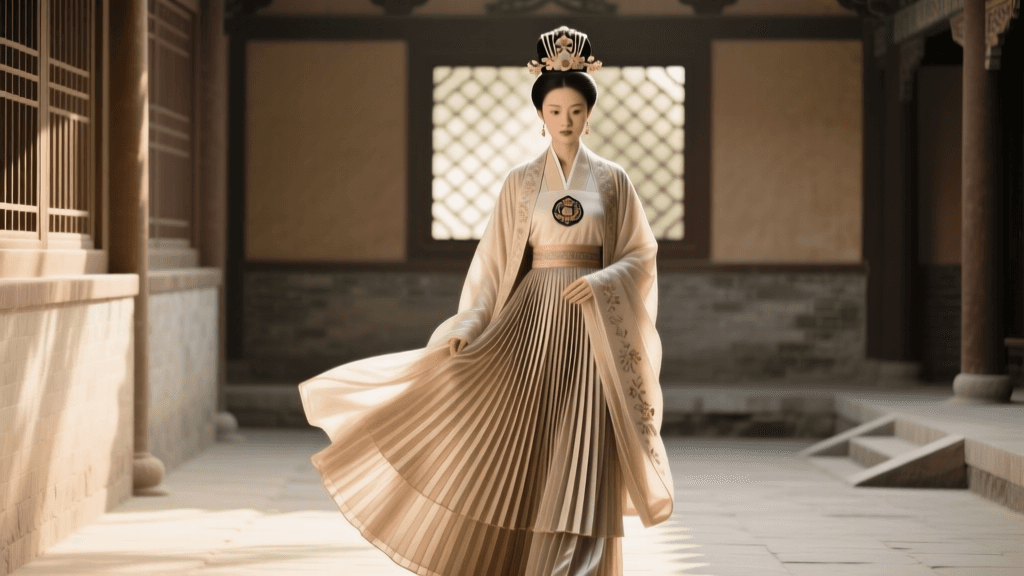
The mamian qun is a wrap-around skirt constructed from two overlapping pieces of fabric. It features flat front and back panels flanked by heavily pleated sides. This ingenious design allowed for modesty and structural integrity while providing the wearer with ample mobility—a necessity for both palace courtyards and the bustling streets of Ming-era Jiangnan. Recently, the skirt has experienced a massive global resurgence. As noted by BBC Culture, the mamian qun went viral on platforms like TikTok after high-fashion houses released designs bearing a striking resemblance to the traditional silhouette, prompting Gen-Z consumers to reclaim and popularize the authentic historical garment.
Anatomy and Measurements of the Traditional Mamian Qun
To appreciate the mamian qun, one must understand its mathematical precision. A traditional Ming-style skirt relies on specific proportions to ensure the pleats fall correctly and the flat panels do not gape open during movement.
- Waistband (Yaotou): Typically made of white or contrasting cotton/silk, measuring between 6 to 10 centimeters in width. It is designed to sit at the natural waist or slightly above.
- Flat Panels (Mamian): The unpleated front and back sections. For a standard modern waist (65-75 cm), the flat panel usually measures between 15 to 20 centimeters across.
- Pleats (Zhe): Ming Dynasty skirts favored deep, structured knife pleats or box pleats. A high-quality historical replica will feature between 4 to 8 pleats per side, with each pleat consuming 3 to 5 centimeters of fabric.
- Total Fabric Width: A single skirt can require anywhere from 4 to 6 meters of fabric to achieve the signature voluminous swing and ensure the overlapping layers provide complete opacity.
Practical Guide: Acquiring and Styling a Modern Mamian Qun
For those looking to add a Ming Dynasty mamian qun to their collection, navigating the modern Hanfu market requires an understanding of fabrics, sizing, and manufacturing timelines. The market is vast, ranging from mass-produced costume pieces to museum-grade artisanal reproductions.
Sizing and Measurements
Unlike Western wrap skirts, the mamian qun must be sized precisely to the wearer's natural waist to prevent the heavy pleats from dragging the skirt down.
- Waist Measurement: Measure the narrowest part of your torso. Add 2-3 centimeters to this number to account for the thickness of the skirt's overlapping layers and the clothing worn underneath.
- Length Calculation: The traditional Ming skirt grazes the top of the foot. To find your ideal length, measure from your natural waist to the floor, then subtract 3 to 5 centimeters depending on your preferred shoe height (e.g., traditional cloud shoes or modern heels).
- Skirt Swing: When purchasing, check the "hem circumference" (xia bai). A hem of 4.5 to 6 meters is ideal for a dramatic, historically accurate swirl. Anything under 3 meters will look stiff and restrict movement.
Costs, Fabrics, and Timing
The cost of a mamian qun varies wildly based on the weaving technique and material. Here is a breakdown of what to expect when shopping from specialized Hanfu vendors:
- Entry-Level ($30 - $60 USD): Usually made from polyester jacquard or lightweight chiffon. These are machine-washable and excellent for daily summer wear. Look for fabric weights around 120g/m².
- Mid-Tier ($80 - $150 USD): Features woven brocade, matte satin, or wool-blends for autumn and winter. These skirts often include intricate woven motifs like dragons, florals, or auspicious clouds directly into the fabric (a technique known as zhuanghua). Fabric weights range from 180g/m² to 250g/m².
- High-End / Artisanal ($300 - $1,000+ USD): Crafted from pure mulberry silk, utilizing traditional kesi (silk tapestry) or real gold-leaf thread weaving. These are investment pieces meant for formal ceremonies or collection.
Timing Your Purchase: Most authentic Hanfu brands operate on a "pre-sale" (Yu Shou) model to minimize textile waste. Major pre-sale windows align with traditional festivals like Hua Zhao Jie (Flower Festival in March) and the Qixi Festival (August), as well as global shopping events like Singles' Day (November 11). Expect a manufacturing wait time of 30 to 45 days before shipping.
Modern Styling and Conclusion
While the mamian qun was historically paired with a crossed-collar ao (jacket) or a round-collared robe, modern styling embraces versatility. The flat front panel of the skirt provides a perfect canvas for tucking in modern silk blouses, fitted turtlenecks, or tailored blazers. For a seamless blend of Ming court elegance and contemporary chic, pair a deep jewel-toned brocade skirt with a crisp, minimalist white button-down shirt and leather ankle boots.
The evolution of Ming Dynasty court fashion—from the strict, hierarchical buzi badges of imperial officials to the sweeping, mathematical grace of the mamian qun—showcases a civilization that viewed clothing as both an art form and a language. By understanding the historical context, precise measurements, and modern market dynamics, today's wearers do more than just put on a skirt; they participate in the living, breathing continuation of Asian sartorial heritage.